Smallpox Detritus
Historical document, translated for reference. It reflects medical knowledge of the 1920s–30s and is not medical advice.
Summary
This article from the 1928–1936 Soviet Great Medical Encyclopedia discusses smallpox detritus, a finely ground substance of calf and cow pustules mixed with glycerin used for vaccination. It details the history of its use, methods of preparation, animal selection, and safety standards.
Encyclopedia article (1928–1936)
SMALLPOX DETRITUS (from the Latin detritus — decay), a finely comminuted substance of calf and cow pox, mixed in a definite proportion with glycerin and containing the living vaccine virus. As a preparation for preventive vaccination, detritus is nowadays legalized in all civilized countries instead of the humanized vaccine previously used for this purpose (see Vaccination). The cases of transmission of syphilis and erysipelas observed during vaccination "from arm to arm," the difficulties associated with obtaining a humanized vaccine in the quantity required for mass vaccination, and finally the signs of degeneration of the old Jennerian vaccine with a partial loss of its immunizing properties prompted a return to the primary source of preventive cowpox and to the search for methods of artificial cultivation of the vaccine on animals. For the first time, the method of obtaining the vaccine "exclusively on animals" and the use of detritus were introduced into vaccination practice by Negri in Naples in 1848. Mature calf pustules were excised along with the base, spread with the wound surface down on the nail of the thumb or on a copper coin, their surface was scraped with a lancet, and the slurry thus obtained was used for vaccinations in children and passage calves. For lack of methods to prevent the putrefaction of excised pustules, vaccinations with scrapings taken from them were sometimes accompanied by serious complications, as a result of which they began to resort to vaccinations "directly from the calf" (de pis a bras). Despite these drawbacks, Negri's method quickly penetrated France (introduced by Lanoix in Paris in 1864) and Germany (introduced by Pissin in Berlin in 1866). In 1860, Andrew in Chicago discovered the property of glycerin to protect smallpox detritus from spoilage without weakening its specific action (confirmed by Reveil in France, Müller in Germany in 1866). Thanks to this discovery, the advantages of detritus (high take rate, stability, the possibility of obtaining it in any quantity) quickly gained universal recognition, and at present vaccination with humanized vaccine is prohibited in all civilized countries (in the RSFSR by order of the People's Commissariat of Health in 1919).--Over time, very valuable information on detritus from a clinical point of view has been obtained from the practice of routine vaccination. The application of experiment and bacteriological methods to the study of detritus proved to be equally fruitful. The data obtained in this regard leave no doubt as to the necessity of strictly methodical procedures in obtaining and processing detritus, possible only under the conditions of a corresponding laboratory environment (strict asepsis, bacteriological control, etc.). The procurement of detritus for mass vaccination is now carried out everywhere in special institutions specially adapted and equipped for this purpose (smallpox calf-stables and smallpox institutes). The requirements that a good and completely reliable detritus must satisfy are as follows: 1. High take rate (virulence): in the hands of an experienced vaccinator, detritus must give a full 100% take rate by the number of children and by the number of incisions. Without causing an excessively sharp local reaction, it must possess a high immunizing capacity and retain its take rate for a sufficiently long period - at least 3-6 months (under normal conditions of shipment and storage). 2. Absence of accidental microbes pathogenic to man (B. tetani, pyogenic cocci). The ideal state of detritus (complete sterility in the sense of the absence of any kind of accidental germs in it) is not always achievable, but the number of banal saprophytes in good detritus should not normally exceed a few hundred in 0.01 cm3.-In the matter of obtaining faultless detritus, the correct choice of animals for vaccination is of essential importance. Although the vaccine is successfully inoculated into many mammals, in practice almost exclusively cattle—cows, bulls, and calves—are suitable for the purpose of detritus procurement. Only in the absence or shortage of these animals (in the tropics) are buffaloes, pigs, and mouflons used. In Europe, only in Spain have rabbits been used very recently to obtain neurovaccine. Only completely healthy, well-fed animals, predominantly aged 1½-2 years, with clean, tender skin, are selected for vaccination. They are purchased only from areas completely free from cattle epizootics. Another preventive measure against the entry of pathogens of various zoonoses (foot-and-mouth disease, tuberculosis) into the detritus is careful observation of the animals before vaccination for at least 5-8 days. In areas with an epizootic spread of tuberculosis, the observed animals are subjected to a tuberculin test under appropriate conditions. Before vaccination, the animal is given a general bath. The generally accepted method of obtaining detritus is based on the fact that the epithelium of the outer integument in cows and calves is an excellent nutrient medium for the vaccine pathogen, in which it multiplies greatly under certain conditions. This process is most intense in the deep layers of the epithelium and is completely absent in the cornified layer. For the success of vaccination, therefore, a breach in the integrity of the skin is necessary, which is usually achieved by superficial non-bleeding incisions with some cutting instrument. The vaccination operation is performed as follows: the animal is firmly fixed on a special table, while the vaccination field (inguinal region, surface of the thighs, abdomen, and chest) becomes easily accessible to the operator (see separate table, Fig. 1-3). The area intended for vaccination is thoroughly shaved and prepared for the operation with the observance of all rules of modern surgery (washing with green soap, wiping with 70% alcohol, etc.). Vaccinations are usually done by making single incisions 5-6 cm long, placing them at a distance of 1-2 cm from each other, parallel or perpendicular to the white line. Sometimes the entire operation field is covered with a dense network of incisions using a special instrument with many blades. In the USSR, Dr. Umeno's toothed scarificator (Umeno, Tokyo) is very widespread, with the help of which 15 parallel incisions can be made simultaneously (see Fig. 1, Fig. 4). Chambon (Chambon) in France covers the animal's flanks up to the ridge, the outer surface of the thighs, part of the chest and abdomen with continuous incisions (see separate table, Fig. 2). Gamaleya in Leningrad, in addition to the indicated parts of the body, uses the neck, udder, perineum, and inner surface of the thighs for vaccination ("intensive method"). On the skin surface prepared in this way, stock seed material (or strain vaccine) is applied using a glass spatula. The success of vaccination largely depends on the quality of the latter. Not only specific virulence is important, but also the composition of the banal flora of the strain vaccine, since the types of bacteria contained in the strain vaccine (stock vaccine) are usually found in the substance of the pustules obtained from vaccination with it. The methodology aimed at obtaining highly virulent strain vaccines is usually based on two main observations. 1. It can be considered proven that every case of genuine cowpox, and consequently smallpox vaccine (detritus) of any origin, has its primary source in human natural smallpox. 2. The virulence of the vaccine is best preserved (or can even be enhanced in case of attenuation) by changing the medium on which the vaccine is usually cultivated (e.g., by vaccination from human to calf, from calf to rabbit, etc.). Correspondingly, two main methods of preparing the strain vaccine are generally accepted. 1. They turn to a very virulent primary source of the vaccine virus; liquid or solid components of pustules from people sick with natural smallpox are inoculated into animals, usually a calf or a rabbit. The material obtained, initially in the form of papules or nodules—variolo-vaccine (variolo-vaccina), after 2-3 passages through the animal organism acquires all the typical properties of the vaccine virus and serves as the strain lymph. 2. The vaccine at hand of one origin or another is passed from time to time through the organism of a rabbit (Lapina), since the enhancement of the virulent properties of the vaccine is most reliably achieved in this way (e.g., passages through the organism of a pig or guinea pig often give an uncertain result). The use of retrovaccine (human vaccine inoculated into a calf), which was widely practiced previously, is now abandoned on the same grounds as the use of humanized vaccine in vaccination practice (see above). Purification of the strain vaccine from unwanted representatives of the banal flora (hemolyzing coccal forms, etc.) is achieved by appropriate preservation of it in glycerin with the use, if necessary, of certain disinfectants (the best are eucupinotoxin and clove oil). - After vaccination, the animal remains on the table for 5-10 minutes, then is led to a stall. Special attention is required for the care of the vaccinated animal (frequent change of bedding, removal of manure, etc.). Twice a day (morning and evening), the animal's temperature is measured, which with the normal development of pustules should not exceed 41°.
After a two-day incubation, pocks develop, sequentially passing through the stages of a nodule and a multichambered vesicle. The contents of the pocks are most virulent 96-120 hours after vaccination and at the same time most abundant in Paschen vaccine bodies (Paschen; see Vaccine bodies). A calf's mature pock appears as a roll of a beautiful silvery-pink color with raised, even edges and a central depression. The width of the roll is about 6 mm, and the length corresponds to the extent of the incision. The pock very much resembles a coffee bean in appearance (see separate plate, Fig. 3). Harvesting of the pocks is done at the moment they reach their highest virulence—96-120 hours after vaccination. The degree of maturation of the pocks is judged by their appearance (size, color, shape of the edges, crust formation, etc.) and by the content of Paschen bodies in them (Morozov). Usually, harvesting is done 96 hours after vaccination and only in case of delayed maturation (which is sometimes observed in winter)—several hours later. Preparation of the animal for this operation and the harvesting of the pocks itself are performed with the observance of the usual rules of surgical asepsis and antisepsis. Linen, utensils, instruments, dressings, etc., necessary for the operation, are sterilized immediately before use. The animal is placed on a table, and the entire surface covered with pocks is thoroughly washed with warm water and green soap, abundantly irrigated with a sterile physiological solution, and dried with sterile towels. The entire operating field is covered at the edges with sheets (see separate plate, Fig. 4). Then all developed pocks are scraped down to the base using a sharp Volkmann spoon. The amount of scraping varies depending on the method of vaccination, the degree of maturity and lushness of the development of the pocks, the size of the operating field, etc. Usually, up to 0.7-1.0 of scraping is obtained per 1 kg of the live weight of the calf. The pock scraping collected in sterile dishes is weighed and poured over with a small amount of 80% glycerin (80 parts of glycerin and 20 parts of water). For the conservation of detritus, only the best grades of chemically pure glycerin of simple or (preferably) double distillation are suitable. In 80% glycerin, the ordinary flora of detritus is unable to multiply and quickly dies (with the exception of spore-bearing species), whereas the smallpox virus under certain conditions maintains its viability and virulent properties for a long time—the so-called «self-purification» of detritus occurs. Attempts to accelerate this process by adding various disinfectants to the detritus (eucupinotoxin, phenol, clove oil, rivanol, quinosol, etc.) were not successful, because all these substances are bactericidal to one degree or another in relation to the smallpox virus as well. Satisfactory results are given by keeping the freshly harvested detritus for several days at room temperature (20-22°). Placed after this in a room icebox for ordinary storage, the detritus becomes practically sterile within 2-3 weeks without a noticeable loss of virulent properties. Before final processing, the detritus is diluted with a 4-5-fold amount of 80% glycerin and thoroughly crushed using special mills of various designs (see Figure 2)—Chalybaeus, Paul (Chalybaeus, Paul), and others. Grinding in the Chalybaeus mill is performed by rotating the rod (a) in the sleeve (e). The rod has a screw thread—coarse at the top and almost micrometric at the bottom. The smallpox scraping is placed into the funnel (c) and, in a ground state, is pushed out from the lower end of the device. The entire apparatus is made of non-oxidizing metal (phosphor bronze). The finer the detritus is crushed, the more uniform the distribution of the vaccine virus in it, and the smaller the tendency to
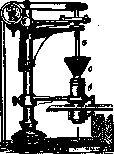
Figure of the Chalybaeus mill.
Chalybaeus
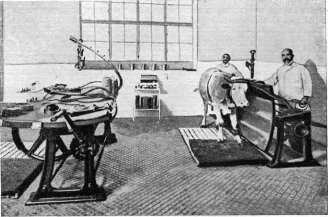
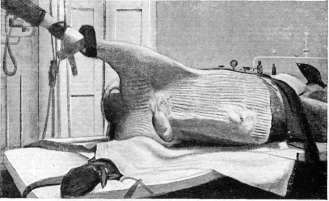
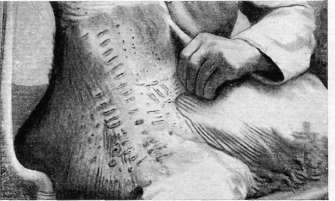
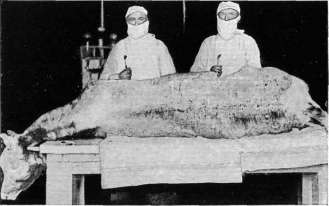
Figure 1. Room for vaccinating calves. (Vienna Smallpox Institute.) Figure 2. Calf vaccinated by the Chambon method (4th day after vaccination). Figure 3. Mature smallpox pustules of a calf, 130 hours after vaccination. (From Oroth.) Figure 4. Calf on the table before photographing pustules. (Smallpox Institute in Munich.) To the article Smallpox detritus. 7F9 separation into dense particles (sediment) and liquid glycerin—a phenomenon sometimes observed during prolonged storage of poorly ground detritus and which can be a cause of failures during vaccination. The ground scraping is filtered through 1-2 layers of gauze to remove hairs, coarse particles, tissue fragments, etc.--A well-prepared smallpox detritus is a thick, homogeneous, grayish-white or pinkish liquid with a faint animal odor (smell of raw leather). Before release into circulation, smallpox detritus is poured into various small receptacles, usually glass vials and capillaries. Filled capillaries are sealed at both ends, while vials (usually with a capacity of 0.1, 0.15, 0.25, and 0.40 cm3) are plugged with a cork stopper and sealed with mastic. One cm3 of smallpox detritus is usually sufficient to perform 100 vaccinations in children. Over time, the vaccinating power of smallpox detritus gradually drops under the influence of glycerin, high external temperature, and other causes (partly still insufficiently clarified). In addition, freshly prepared smallpox detritus always contains an admixture of extraneous germs, among which species sometimes occur that arouse suspicion in terms of pathogenicity for humans. Therefore, before and after release, smallpox detritus is subjected to repeated control for virulence and for the quality and quantity of the banal flora. At the present time, no less than 30 species of banal flora of smallpox detritus are known, including 1) Micrococcus up to 8 species; 2) Streptococcus 5 species; 3) pseudodiphtheria bacilli (cutaneous diphtheroids) - several species; 4) Bact. coli and paracoli, then various kinds of spore-bearing bacilli (hay bacillus), molds, sarcinae, yeasts, actinomycetes, and some others. Among them, as most suspicious regarding pathogenicity, hemolyzing species of Staph. aureus and Staph. albus deserve separate mention, followed by Bact. coli. On the contrary, Streptococcus (4-5 varieties), frequently encountered in smallpox detritus, is apparently completely non-pathogenic for humans and animals. The question of the presence in smallpox detritus of knowingly pathogenic bacteria (pathogen of foot-and-mouth disease, tetanus, tuberculosis) has almost no practical significance. According to the general opinion, B. tetani is encountered in smallpox detritus as a greatest rarity, while the tuberculosis pathogen has never been found in smallpox detritus. Recently, interest in this issue has significantly intensified in connection with universally frequent complaints of excessively strong reactions after smallpox vaccinations and with the increase in cases of vaccine encephalitis (see). However, contrary to the old opinion of Landmann (1896), the majority of researchers deny the etiological role of the banal flora in the occurrence of excessively sharp local phenomena after vaccination and entirely explain these anomalies by the action of the smallpox virus itself, since similar local phenomena are observed after vaccination with sterile smallpox detritus. On the other hand, there are indications that when pure cultures of micrococci and streptococci isolated from smallpox detritus are vaccinated onto human skin scarifications, the reaction is absent or observed only in the weakest degree (Dreyer, Meder). Thus, the main task of bacteriological control is the examination of smallpox detritus for the presence of pathogenic and suspicious germs. If control establishes the complete death of such germs under the influence of glycerin, the smallpox detritus is recognized as fit for use, even if some amount of saprophytes still survives in it. Control is conducted according to the general rules of bacteriology. Usually, all vaccinated animals are slaughtered immediately after the removal of smallpox detritus, their internal organs are subjected to careful inspection and (if necessary) bacteriological and microscopic examination. Control of smallpox detritus for virulence is usually carried out by vaccination of small rodents: on the cornea of a guinea pig - according to Gins, on the skin surface of a rabbit - according to Calmette-Guerin, or intradermally - according to Groth. Smallpox detritus is considered still suitable for vaccination, 1) if in a dilution of 1:1,000 it causes specific keratitis on the scarified cornea of a guinea pig (Gins), 2) if in the same dilution, injected into the skin of a rabbit, it causes the formation of a specific inflammatory focus after 3-4 days (Groth). Smallpox detritus produced by smallpox institutes usually possesses a higher (reserve) virulence (e.g., giving a positive reaction on the cornea of a guinea pig or rabbit even in a dilution of 1:100,000 and even 1:200,000). Undesirable phenomena in the vaccinated, sometimes observed with the use of such highly virulent smallpox detritus, have recently prompted the raising of the question of a standard for the upper limit of virulence of smallpox detritus. This question has not yet received a satisfactory resolution. Two circumstances somewhat undermine the significance of the experimental method: 1) sharp individual fluctuations are observed in the susceptibility of animals to the vaccine, 2) the result of the experiment often only approximately coincides with the result of vaccination in humans. Therefore, when a completely accurate check of virulence is required, one cannot dispense with vaccination in humans. It is undertaken only after bacteriological examination has established the absence of human-pathogenic germs in the smallpox detritus. The results are most apparent in primary-vaccinated individuals. The Chambon method is usually applied. On one arm of the child, the tested smallpox detritus is vaccinated, and simultaneously on the other arm, vaccination is performed with a knowingly virulent vaccine. After three days, the development of pustules on one and the other arm is compared. The tested smallpox detritus is recognized as flawless if the pustules caused by it do not differ from standard ones in appearance and course: they are continuous, with even edges, and occupy the entire length of the incision. In the Chambon method, therefore, only the character of the pustule is evaluated, while the properties of the areolae are not taken into account, and this is a significant drawback of the method. Thus, the oldest method—evaluation of smallpox detritus by the results of its mass application in primarily vaccinated children—remains the most reliable. The percentage of successfully vaccinated children, the percentage of developed pustules to the total number of incisions are determined, and the course, appearance, width of the pustules, size of redness, and infiltrate are taken into account. Naturally, impeccable vaccination technique is necessary. There are indications of the possibility of determining virulence by counting Paschen bodies in smears from the tested smallpox detritus (Morozov, Paschen). However, according to observations by Kii, the activity of smallpox detritus depends not only on the number, but also (and furthermore to a greater extent) on the pathogenic power of the specific germs contained in it; therefore, the virulence of smallpox detritus should be determined by the product of the amount of virus and a certain coefficient characterizing the strength of its pathogenic properties. Dry smallpox detritus. The preparation and transportation of smallpox detritus are associated with special difficulties in hot climate conditions. Special methodological techniques are required to maintain the stability and virulence of passage vaccine, while the best series of smallpox detritus sometimes rapidly weaken and lose vaccinating power under the influence of high ambient temperature. However, even in temperate climate conditions, the need for smallpox detritus preparations that are particularly resistant to unfavorable thermal influences is very great (in our country in the south and southeast outposts). Dry smallpox detritus best satisfies this need. It was already known to old vaccinators that the most reliable method of preserving humanized vaccine is drying it on glass plates, ivory sticks, etc. At present, in the preparation of dry smallpox detritus, one most often resorts to drying the raw scraping of pustules in a vacuum desiccator over calcium chloride at room temperature. The dry mass obtained after 24-36 hours is thoroughly ground in a mortar or in a special mill and sifted through a fine mesh. The grayish-white fine powder obtained in this way is enclosed in amounts of 0.025-0.05 in small glass tubes, the air is pumped out from them, and they are sealed. Before use, the thin end of the tube is broken off, the powder is poured into a small dish (e.g., a staining salt cellar, watch glass, etc.), and a 12-fold amount of 80% sterile glycerin is added to it (after drying, the raw scraping loses about 3/4 of its original weight). The powder is thoroughly mixed with glycerin, and the mixture is used for vaccinations like ordinary glycerinated smallpox detritus (it must be used on the day of preparation, as it rapidly loses vaccinating power). Data on the use of dry smallpox detritus are contradictory, but in general speak in its favor. In laboratory experiments, dry smallpox detritus withstands thermostat temperatures from 35 to 92 days (Carini, Tomarkin, and Serebrennikova). In vaccination practice, dry smallpox detritus has been tested in many countries of the hot belt with generally good results even under the most unfavorable conditions. Recently, Otten has prepared dry detritus that withstands a temperature of 41° for 60 days. According to Otten, a necessary condition for thermal stability is the continuous stay of dry smallpox detritus in vacuo.
The slightest crack in the tube containing dry detritus leads to rapid deterioration of the preparation. The questions of the banal flora and the methodology of obtaining dry detritus in a state of practical sterility are insufficiently developed. The indication by some authors that drying, heat, and time contribute to the self-purification of dry detritus requires a significant correction: the process of self-purification of dry detritus under the influence of the aforementioned factors occurs very slowly and always goes hand in hand with the loss of virulent properties by the detritus. It is therefore necessary that for the preparation of dry detritus only those series of raw scrapings are chosen in which preliminary control has proven the absence of microorganisms suspicious in terms of pathogenicity (hemolyzing cocci, etc.). Dispatch and storage of detritus. As indicated above, over time, under the action of glycerin, detritus gradually weakens and finally completely loses its ability to vaccinate. Deterioration occurs the faster, the higher the ambient temperature. Thus, at the temperature of a room icebox or a good cellar, detritus is preserved without significant weakening for 3–6 months; it tolerates room temperature already significantly worse, and at the temperature of the human body (37°) it becomes unfit for smallpox vaccination within just 3–4 days. In smallpox institutes, detritus is usually stored in room iceboxes at a temperature of about 2–5°. Under the same temperature conditions, detritus should be kept as much as possible during transport and storage on site. When shipping over long distances, it is useful to pack detritus in wooden boxes lined on the inside with a thick layer of some thermal insulator (cork, cotton wool, wool, etc.). At vaccination stations, medical districts, etc., stocks of detritus should be stored in an icebox or, in the absence of one, in a good cool cellar.
Related articles
Mentioned in
Cite this page
“Smallpox Detritus.” Soviet Medical Encyclopedia. English translation of Bolshaya Meditsinskaya Entsiklopediya, 1st ed. (Moscow, 1928–1936), ed. N. A. Semashko. https://sovietmedicalencyclopedia.pages.dev/article/smallpox-detritus/