Mineralogy
Historical document, translated for reference. It reflects medical knowledge of the 1920s–30s and is not medical advice.
Summary
Mineralogy is the science of minerals, studying their chemical composition, physical properties, formation conditions, and transformations in nature. The article discusses the historical development of mineralogy, its relationship with chemistry and geology, and the practical applications of minerals in medicine and industry.
Encyclopedia article (1928–1936)
MINERALOGY (from Latin minera - a piece of ore, a rock specimen, and Greek logos - doctrine, word), the science of minerals, of their chemical composition, physical properties, conditions of formation in nature, and changes and transformations in connection with changes in these conditions. Minerals are natural substances that are solid, liquid, and gaseous. Their composition is expressed by a chemical formula. In terms of physical structure, they often represent crystalline substances and sometimes occur in the form of crystals. The geometric and physical properties of such substances are studied by crystallography (the science of crystals), crystal optics, and other branches of physics. Minerals have value as useful minerals. From them are smelted millions of tons of different metals. The basic chemical industry obtains from minerals tens of millions of tons of salts and other chemical products. Minerals are used in medicine in rare cases directly (for example, minerals from the salt group), but mainly as products of their processing. Such minerals include the following. Native sulfur; sulfur flowers, obtained by sublimation of native sulfur; it has application in veterinary medicine. Native bismuth and bismuth glance serve as the basis for obtaining bismuth preparations, especially white bismuth, a widely used medicinal agent. Realgar and auripigment (arsenic sulfides) are the raw material for arsenic preparations. Cinnabar (mercury sulfide) is a source of mercury compounds. Potassium permanganate is obtained from pyrolusite (manganese oxide). White magnesia and other magnesium salts are obtained from the mineral magnesite or from brine of salt lakes, lagoons, where magnesium is in the form of magnesium chloride and is easily extracted. Borax and boric acid are obtained from natural compounds of similar composition found in lakes associated with volcanic activity. Glauber's salt is found in large quantities in lakes and marine lagoons. In addition, it is necessary to mention the soft mineral talc, the powder of which is known in medicine under the name talcum powder. Radioactive preparations are obtained in the USSR from the mineral tyuyamunite, found in Turkestan and representing a urano-vanadate. Known deposits in Czechoslovakia are deposits of uranium pitchblende, which is mainly uranium oxide. Relatively few minerals are used directly in the form as they are mined from the earth--corundum, diamond, asbestos, mica, graphite, etc. The greater part of minerals undergo fundamental processing before finding application in science or technology. The practical significance of M. lies in the fact that, by studying the properties of minerals, it leads to the discovery of new useful minerals and to the best use of already known ones. By studying the conditions of formation of minerals in nature, M. helps to discover new deposits of useful minerals and to clarify their industrial significance. For a long time, M. was a descriptive science. Its purpose was to describe the external form and properties, chemical composition1 and place of occurrence of minerals. The successes of geology in the 18th century and chemistry in the early 19th century were reflected in M.; a view of it as the chemistry of the earth's crust (Berzelius) appeared; more attention began to be paid to the conditions of formation of minerals in nature (Werner), as well as their joint occurrence, paragenesis (Breithaupt, Krostedt), but this trend did not receive further development and stagnated for several decades. In the first half of the 19th century, M. is characterized mainly by two directions - crystallographic and chemical-analytical. Thanks to the discovery by Abbe Haüy of the geometric law of crystallography (the law of parameters), an exceptional interest in questions of formal crystallography appeared in M. Minerals began to be subjected to careful measurement to establish crystallographic forms. The successes of analytical chemistry caused a similarly formal interest in the chemical composition of minerals on the part of prominent chemists. M. entered a new era in the second half of the 19th century. The development of mining (especially in America) and the increased interest in it were the reasons for the tendency evident in M. to transfer questions of mineralogical research into the setting of field observations. Modern M. has retained interest in individual minerals and continues their comprehensive study, but in addition it studies the very processes of their formation. Minerals are now understood as products of natural reactions. M. seeks to predict the appearance of minerals from consideration of a given set of phenomena and, conversely, from observation of minerals in nature to establish the process itself. Paragenesis, age relationships between minerals, changes in their composition depending on the form of their occurrence in nature, the nature of destruction of minerals, etc., have again received special significance. Not being satisfied with questions of the origin of minerals, M. deepens its tasks in the direction of geochemistry, i.e., it studies the laws of distribution of chemical elements in the earth's crust, the reasons for the joint occurrence of elements and their groupings, their dispersion and concentration. In Russia, the tasks of M. were widely understood as early as by M. V. Lomonosov. In the middle of the 19th century, the crystallographic direction that dominated M. was represented by Koksharov, and questions of mineral analysis were resolved by the leading analysts Hermann, Gadolin, and others. M. with a modern understanding of its tasks was born in Russia at Moscow University in the 90s. Its founder should be considered V. I. Vernadsky, who created here a major school of mineralogists of a geochemical direction. In the works of V. I. Vernadsky himself, a special place is occupied by the role of biochemical processes in the surface zone of the earth's crust. An outstanding representative of this trend was Ya. V. Samoylov, who established the concept of biolith, by which he meant any mineral connected in its origin with the life activity of organisms. In recent years of intensive work of an exploratory and survey nature, a noticeable increase in interest in M. in the USSR is observed, especially in the part of questions of the genesis of useful minerals and geochemistry. The study of questions of the genesis of minerals has been mainly promoted by N. M. Fedorovsky. A representative of the geochemical direction is A. E. Fersman. In its content, M. is divided into 2 parts - genetic and descriptive M. In a brief review, the data of genetic M. are presented in the following form. Phenomena of mineral formation are studied within the surface zone of the earth's crust to a depth of 16 km. The studied area includes the lower layers of the atmosphere (their power is not included in the given figure). Petrographic composition of the lithosphere: igneous rocks 95%, slates 4%, sandstones 0.75% and limestones 0.25%. The total chemical composition of the entire earth's crust to the indicated depth, counting also the atmosphere, is as follows (in %): O Si, Al, Fe, Mg 49.20, 25.67, 7.50, 4.71, 1.93 Ca, Na, K, H, Ti, C, P, Cl, Others 3.39, 2.63, 2.40, 0.87, 0.58, 0.08, 0.19, 0.74. In the attached schematic section, various thermodynamic zones of the earth's crust are presented (Figure 1). I. Surface zone of weathering. Characterized by low pressure and temperature. Chemical reactions proceed with the participation of aqueous solutions, O, CO2 and the life activity of organisms. -II. Zone of deep weathering. Somewhat elevated temperature and pressure. Reactions proceed in aqueous solutions with the main participation of carbonic acid. -III. Zone of cementation. Even higher pressure and temperature. The precipitation of minerals predominates over dissolution. -III. Zone of diagenesis represents special conditions under which a solid sedimentary rock is formed from clastic material under a layer of sea water. -IV. Zone of crystalline schists. Characterized by high pressure and temperature, absence of free O and water. Silica displaces carbonic acid from its compounds under the conditions of this zone. Minerals are created by the recrystallization of other minerals unstable in this zone. -V. Zone of magma. An area of molten substance at high pressure and temperature, of complex silicate composition. Formation of igneous rocks. -V. Zone of formation of minerals in rock cracks due to substances released during the solidification of magma. Pegmatite veins of special genesis and mineralogical composition. Ore veins. -V. Formation of contact zones. Interaction of magma with foreign rocks. The study of the question of the distribution of chemical elements in the earth's crust leads to the conclusion that the deepest parts of the magma are rich in iron, chromium, and magnesium, corresponding to the main igneous rocks. The edge portions of the magma, on the contrary, are rich in silica and alkalis and poor in iron, magnesium, and partly calcium. The corresponding rocks are acidic, of the granite type. Figure 2 gives an idea of the zonal distribution of chemical elements in a vertical section in connection with intrusions, intrusions of granite.
The chemical element symbols on the diagram indicate the presence at a given point of conditions favorable for the formation of corresponding minerals. Thus, magmatic minerals are distinguished—containing Zr, Ta, Nb, etc.; contact minerals—containing Fe, Cu, Ti; vein minerals of deep horizons—containing Sn, W, Mo; of medium horizons—Cu, Pb, Zn; and of upper horizons—containing Sb, As, Hg. All minerals in general are stable under the conditions of their formation, with changes in which they undergo transformation, decomposition, alteration. Cyclic processes are of great importance in mineralogy, when minerals after a series of changes can regenerate from the products of their own destruction. Descriptive mineralogy considers minerals in the order of some classification. The greatest recognition is enjoyed by the chemical classification of the American mineralogist Dana. In it, minerals are distributed according to chemical composition into the following groups: native elements, sulfides, halides (compounds of metals with Cl, Br, F), oxides, carbonates (salts of carbonic acid), silicates, phosphates, sulfates and some others. In the genetic classification, minerals are combined into groups according to the similarity of conditions of genesis; such are for example the minerals obtained during the drying up of marine basins—rock salt, gypsum, potassium salts, etc. Another example can be the group of bioliths—phosphorite, bog iron ore (vital activity of Lepitothrix ochracea), saltpeter (in some cases), pyrite (in some cases), coral calcite (CaCO3) and etc. In descriptive mineralogy, the physical and chemical properties of minerals are studied. Some of these properties are of great interest and are the reason for the practical use of minerals (hardness of diamond and corundum, graphite, mica, etc.). In addition, it notes the conditions of genesis, associated minerals, decomposition products, deposits, practical application of minerals, etc. The total number of minerals is about 1,000, and counting varieties—about 3,000. About 50 new minerals (with varieties) are discovered each year. Along with extremely common minerals, for example quartz (about 12% of the weight of the lithosphere) and feldspars (about 57%), there are also very rare ones, known only in a few specimens. Also from a practical point of view, besides minerals of great importance, there are minerals that have not yet found application. In its research, mineralogy uses field observations and data and the methods of sciences: geology, physics, chemistry in the broad sense of this word—analytical, physical, colloidal and even biochemistry. Crystallography in modern mineralogy has an auxiliary significance. In essence, crystallography, now understood as the physics of solids, has passed to physics. In the setting of new, purely physicochemical questions that separated crystallography from mineralogy, two major Russian scientists played a role—E. S. Fedorov and G. V. Wulff. Great importance was acquired by the optical method of studying minerals in thin sections under a microscope in polarized light, discovered in the middle of the 19th century when studying rocks and the recently developed method of studying in reflected light when investigating ores. Methods of mechanical and thermal analysis are widely used. The former consist in the separation of minerals by means of heavy liquids, decantation, magnetic separation, flotation, etc., the latter—in observing and studying the changes occurring in the mineral when heated to high temperatures. For this, self-recording instruments are used, which make it possible to record the course of changes in the form of a continuous curve. Questions and methods of artificial reproduction of minerals in the laboratory for clarification of natural conditions of genesis are acquiring ever greater importance. For the same purpose, the conditions of equilibrium of various artificial physicochemical systems are studied. The data of observations are here also usually presented in the form of diagrams and curves. The teaching of mineralogy in former times was organized at universities and higher mining institutions where there were departments of mineralogy and mineralogical institutes. With the reform of higher education, the teaching of mineralogy has been concentrated in higher mining institutions and technical schools. The teaching method is active. For students, field and industrial practice in mining enterprises and geological exploration parties is mandatory. The corresponding educational and scientific institutions in the USSR are built on the principle of combines. According to such a plan, for example, the Geological Exploration Combine of the Main Geological Administration of the Supreme Economic Council was built. It absorbed the mineralogical institutes and departments of mineralogy of the former Moscow University and the Moscow Mining Academy. The GRC includes workers' faculty, geological exploration technical school, geological exploration institute and scientific research institute. In addition, there are mineralogical institutes at production and industrial enterprises (associations). Their task consists in scientific assistance to enterprises. The work in research institutes is organized on the principle of a complex method in order to, as a result of comprehensive study of minerals, indicate the best ways of their use, and in the part of questions of genesis to obtain data for the most rational organization of exploration and exploitation work. The largest research institutes of mineralogy are the Institute of Applied Mineralogy and the State Institute of Non-Ferrous Metals in Moscow. At the Academy of Sciences in Moscow there is the Institute of Genesis of Minerals and Rocks, and at it a synthetic laboratory for experiments on the artificial production of minerals. Scientific mineralogical questions are widely posed and deeply worked out at the Mineralogical Museum of the Academy of Sciences. In the USSR there exists a scientific mineralogical society, founded in 1830, having its own organ (Proceedings of the Russian Mineralogical Society, M., since 1870).
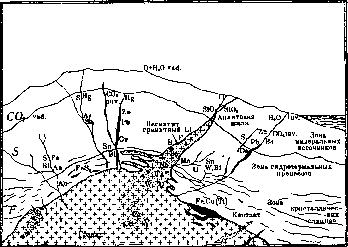
Figure 2. Ideal section through the earth's crust in the area of granitic magmas and associated geochemical processes.
Institute of Non-Ferrous Metals in Moscow. At the Academy of Sciences in Moscow there is the Institute of Genesis of Minerals and Rocks, and at it a synthetic laboratory for experiments on the artificial production of minerals. Scientific mineralogical questions are widely posed and deeply worked out at the Mineralogical Museum of the Academy of Sciences. In the USSR there exists a scientific mineralogical society, founded in 1830, having its own organ (Proceedings of the Russian Mineralogical Society, M., since 1870).
^=Г^ ^i.jlcXJc co'г,№:* L 46^5600 Na60Cas„ The International Society of Medical Hydrology has a special commission for standardizing descriptions of mineral waters. It has developed a standard similar to the Russian one, differing mainly in that the milligram, not the gram, is taken as the unit. The nomenclature and classification of mineral waters, according to the resolution of the IV Hydrological Conference, must be based on the names of ions, not salts; as a rule, only ions present in quantities of not less than 25 valpercent are included in the name. Therapeutically active elements and gases are included in the name and in the Kurlov formula at concentrations not below: Fe"-10 mg., Al'-5 mg, J'-10 mg, Br'-25 mg, HAs04" and HPO4"-1 mg, H2S free-10 mg, CO2 free.-750 mg.-Sources with t° above 35° are called hot; at 20°-35° they are called warm. Thus, names are composed of the names of therapeutically active substances (in order of decreasing concentration in grams), anions (in order of decreasing valpercent values) and cations (in order of decreasing valpercent values). The temperature t° is placed at the end of the name if it deserves it. On the basis of this nomenclature, Prof. V. A. Aleksandrov in 'Fundamentals of Balneology' has developed the latest classification of mineral waters, which has the advantage of unambiguity over all previous ones: each class has certain numerical limits, and no water can fall into two classes at once. As an example, the analysis of the water from the Batalinsky source is given. In old classifications, often still used now, there are many ambiguities; to facilitate the use of old literary data, a summary of the main names along with their corresponding ions is provided: iron sources, ferruginous contain Fe**, steel-Fe", lime-Ca", earthy, earthy-Ca", Mg", Fe", alkaline earth-2 meanings: 1) Ca", Mg", 2) Ca", Mg", K', Na*; alkaline-2 meanings: 1) Na*, K*, 2) waters of alkaline reaction; glauber's-Na2SO4; bitter, sulfate, sulfuric-SO/'; gypsum-CaSO4; saline, muriatic, brine-Cl; gas-usually CO2, rarely H2S, CH4, N2; sulfide, sulfuric, sulfur, hydrogen sulfide, containing H2S or HS' or both together [it is more correct to call waters with SO3" sulfurous, with free (colloidal) sulfur-sulfur waters, with free H2S-hydrogen sulfide]; carbonic-CO2, HCO3', CO3" (correct only CO2); carbonate-CO3"HCO3'(correct only CO3"); bicarbonate, hydrocarbonate-HCO3'; arsenic, arsenic-As. (Overview of old classifications - see Balneology.) - The International Commission for Standardizing Descriptions of Mineral Waters proposed in 1930 a very simple classification-by one predominant or active ingredient, e.g. chloride, iron, etc. This classification has not yet become widespread. The radioactivity of mineral waters is usually measured in units of Mache (ME); it ranges from fractions of ME to thousands; it depends 1) on the gas content - radon emanation (Em); such radioactivity disappears quickly, since the half-life of Em is 3.85 days; or 2) on the salt content of radium itself or other radioactive metals with a long half-life (radium-1760 years); such radioactivity can also increase to certain limits, as the activity of decay products is added to it. - Cryoscopic and ebullioscopic studies (decrease in freezing point and increase in boiling point) of mineral waters determine the total concentration of all substances dissolved in the mineral water, and therefore its osmotic properties, or 'tonicity'. The International Commission for Standardizing Descriptions of Mineral Waters proposed to call 'hypotonic' waters whose osmotic pressure is less than that of a solution containing 9 g NaCl in 1 l, or 303 millimoles of all ions and molecules; 'isotonic' and 'hypertonic' are waters with osmotic pressure equal to or respectively greater than that of this solution. Changes in the composition of mineral water may depend on changes in the source regime or (more often) on changes in conditions when the water comes to the surface. In the first case, changes most often depend on the inflow of fresh water to the main mineral stream; for vadose and mixed sources, fluctuations in composition occur, for example, with seasonal fluctuations in precipitation; such changes are always accompanied by changes in flow rate and usually temperature. Therefore, the source's feeding area must be protected from the possibility of pollution and from violations of the normal water regime, which is the task of sanitary protection of mineral waters (see). M. i.-When mineral water comes to the surface, its conditions of existence change radically; this is always accompanied by some change in composition; often these changes are so great that after a short time they completely devalue the mineral water. When the temperature of the water changes, the solubility conditions change, and substances that were in a saturated solution can be released. Thus, thermal sources upon cooling often deposit siliceous sediments; cold sources saturated with gas, when heated, release it in the form of bubbles. A decrease in pressure also causes the release of gases saturating the water in bubbles. However, gas loss occurs not only by bubbles, but also by the invisible diffusion of gas from water into air. The loss of CO2 is especially important, because due to this the reaction of the water changes (increase in pH), which is the transition of bicarbonates to carbonates and the precipitation of CaCO3, MgCO3, Fe(OH)3. They form deposits at the source exit, called travertines. With a decrease in the concentration of carbonic acid (corresponding to an increase in pH), the conditions of sulfide-carbonate equilibrium change, and part of the free H2S passes into a 'bound' state - into HS'.-At the same time, the process of saturation of mineral water with atmospheric gases occurs; oxygen is especially important here, as it determines a number of oxidation processes that radically change the composition of mineral water. Ferrous compounds oxidize into ferric compounds, which are more prone to hydrolysis and therefore usually precipitate; the same applies to manganese. Free hydrogen sulfide oxidizes depending on conditions to sulfur or to sulfuric acid. Sulfides (S") and hydrosulfides (HS') upon oxidation give hyposulfite (S3O3").H sulfate (SO/')- At the same time, sulfite (SO3") appears as an intermediate product in the solution. Microorganisms play a large role in all these processes; their organic substance is often the binding material for sediments S, Fe(OH)3 and others,-thus gelatinous masses 'muff', 'barezina' and other sediments are obtained; these accumulations cause clogging of the pipes through which mineral water is supplied to baths or drinking pavilions (see). For balneotechnics, the physical properties of mineral water are especially important. Temperature is measured in degrees Celsius. The true thermal conductivity of water (K) is very small, but in practice the transfer of heat from the bath to the patient's body and back occurs very quickly due to convective currents, thanks to which the layer of water adjacent to the body constantly changes; heat transfer is especially accelerated in so-called flow baths (Strombader), in Charcot showers, etc. The heat capacity (C) ranges from 1 (pure water) to 0.75 (strong brines), i.e. brines give off or take away less heat from the body than waters with low mineralization at the same temperature. The specific gravity (d) of mineral waters is usually close to 1; it increases with the amount of dissolved salts and in brines reaches 1.3; the specific gravity determines the pressure of the water on the patient's body immersed to a certain depth. Electrical conductivity Г -1 is measured in reciprocal ohms per 1 cm3; it is important for galvanomineral baths; it depends on the composition of salts and their degree of dissociation.
The materials used for the capture of mineral waters and for conducting water to the place of use are acted upon by the water and themselves influence its composition. Cement and concrete are corroded by carbonic water and enrich it with calcium; sulfate waters cause the destruction of concrete due to volume changes during the formation of complex compounds in the concrete. Iron pipes are subject to the action of carbonic, hydrogen sulfide, and brine waters; sulfide waters act particularly strongly on all materials (except wood and glass) at their point of contact with air; the sulfuric acid formed here corrodes everything in a very short time; therefore, sulfide waters must be conducted completely hermetically, ensuring constant filling of the entire cross-section of the pipe with water. The possibility of significant changes in the composition of mineral water both underground and on the surface necessitates constant control of the composition through brief analyses. Usually, the daily determination of 1-2 ingredients is quite sufficient, e.g. for saline waters-chlorine; for hydrogen sulfide waters-H2S, alkalinity (pH); for carbonic waters-free CO2 and pH, etc. In control, exclusively volumetric or colorimetric methods are used as requiring a minimum of time. Small changes in the composition of water can be easily detected by changes in its electrical conductivity. There are self-recording instruments that register fluctuations in the electrical conductivity of water. The timing and principles of observation of mineral waters and their chemical control were established in 1925 by the Main Resort Administration. Fluctuations in the flow rate or temperature of the source always indicate some change in composition. Heating and cooling of mineral water should be done, if possible, avoiding contact with air. The best system is closed coils cooled externally by water; for heating, the most rational method is the use of detachable coils immersed in the bath and heated internally by steam. It is necessary to avoid overheating the water to prevent loss of gases. When heating or storing water in tanks, wooden covers floating on the water surface are of great service, as they minimize the surface of contact with air. The basic technical conditions for bottling mineral waters are sterility and absence of aeration. When storing and transporting mineral waters, bottles should be kept in a horizontal position so that the cork is always moistened with water; otherwise, the cork dries out, the tightness of the seal is lost, and with the escape of gases, the composition of the water changes. A low temperature is an essential condition for the stability of composition; therefore, mineral waters are usually stored in cellars and icehouses, transported in isothermal cars. Saturation of mineral water with CO2 significantly increases not only its taste qualities but also the stability of the composition of mineral water in the bottle; nevertheless, the therapeutic properties of bottled water are not identical to the properties of water at the sources. Artificial mineral waters are usually prepared from chemically pure salts according to the analysis of natural water; complete identity of composition and properties of artificial and natural water can be achieved only with great difficulty; special difficulties are presented by the exact imitation of the composition of dissolved gases and the properties of colloids. Of artificial mineral waters, only saline baths, baths with sea salt, and carbonic baths have become widespread. Artificial hydrogen sulfide baths are beginning to come into use. The therapeutic application of mineral waters-see Balneotherapy. Sanitary protection zones of mineral waters-see Mountain-sanitary protection.
Related articles
Mentioned in
Cite this page
“Mineralogy.” Soviet Medical Encyclopedia. English translation of Bolshaya Meditsinskaya Entsiklopediya, 1st ed. (Moscow, 1928–1936), ed. N. A. Semashko. https://sovietmedicalencyclopedia.pages.dev/article/mineralogy/