Myoclonus
Historical document, translated for reference. It reflects medical knowledge of the 1920s–30s and is not medical advice.
Summary
Myoclonus is a distinct symptom characterized by brief, lightning-like muscle jerks that do not cause significant limb movement. It can occur in various neurological conditions, including myoclonus epilepsy, which is a hereditary disease with progressive dementia and extrapyramidal rigidity.
Encyclopedia article (1928–1936)
Myoclonus (from Greek mys-muscle and klonos-convulsion) as a particular symptom is distinguished from other hyperkineses (see) by the following signs: an unceasing series of individual brief, lightning-like, clonic jerks of a muscle or its part, and as a result of these contractions there is no significant displacement of the corresponding segment of the limb in space. The convulsions most often spread to the muscles of the limbs and trunk, but they are not localized and reappear now in one, now in other muscle groups; the contractions of different muscle groups are not synchronous; the convulsions are observed both at rest and during movements, but disappear during sleep; the strength, trophism, and excitability of the muscles affected by convulsions do not suffer; reflexes are preserved. There are every grounds to consider "myoclonic convulsion" as being caused by an anatomical disease of the extrapyramidal motor apparatus. It has not yet been possible to carry out a more detailed localization with full certainty. In individual cases, symptomatic M. was observed with foci in the striatum, but even more data makes one think of predominant damage to the nuclei dentati cerebelli. And in myoclonus-epilepsy, predominant damage to the nucleus dentati is also found, but other parts of the brain are also affected, such as the pallidum, nucleus ruber, thalamus, substantia nigra (Westphal and others). This symptom can be observed in many focal diseases of the brain, but in addition it is characteristic of a certain disease or, better to say, a group of similar disease forms, which are united under the same general name M. (syn. polymyoclonia). The nosological division within this large group has not yet been completed. However, some types have already been quite clearly distinguished at the present time. Here myoclonus refers primarily to myoclonus-epilepsy, described by Unverricht and especially thoroughly studied by Lundborg. Myoclonus-epilepsy (myoclonia Unverricht, dementia myoclonica Lundborg) - a hereditary disease characterized by early onset, progressive course, combination of myoclonic syndrome with epileptic seizures, progressive dementia and initial extrapyramidal rigidity. The nosological independence of this form was at first disputed by many authors (Mobius, Schultze and others), who considered it simply as a combination of genuine epilepsy and Huntington's chorea. However, further patho-anatomical and genealogical studies definitely forced one to consider myoclonus-epilepsy as a separate form. The genetics of this form were very thoroughly studied by Lundborg, and it turned out that family transmission definitely obeys the laws of autosomal-recessive inheritance (see figure):
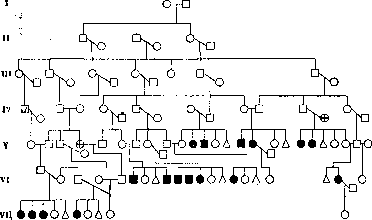
Family with myoclonic epilepsy (+ the same woman)
healthy children are born from healthy parents, often related to each other by blood kinship, and the ratio of the total number of sick siblings to healthy ones quite accurately reproduces the ratio of 1:3. In individual family fragments, there can of course be significant deviations from this ratio. Thus, in Unverricht's first observation, on the basis of which he was the first to describe this disease in detail, out of 8 surviving children, 5 were sick. Naturally, sporadic cases also often occur. In those rare cases when sufferers from myoclonus-epilepsy marry, they have healthy offspring. Sometimes in families with myoclonus-epilepsy, individual cases of pure epilepsy, not complicated by myoclonic jerks, have also been observed. Here, the possibility of an accidental admixture of hereditary factors of ordinary, genuine epilepsy, which is very common in the population (Lundborg), cannot be ruled out. On the other hand, pure M. without convulsive seizures has never yet been proven in patients coming from families with myoclonus-epilepsy. Interesting is the frequency of cases of 'trembling paralysis' among relatives of patients suffering from myoclonus-epilepsy, established by Lundborg. Most likely (Davidenkov, Kehrer), this is not a true trembling paralysis, but a phenotypic modification of myoclonus-epilepsy, which itself is characterized by akinetic components. In those individual families (Weiss) where M. was traced through several generations as a dominant trait, it turned out clinically that it was not about typical myoclonus-epilepsy, but about some other form (m. perhaps an atypical manifestation of Huntington's chorea). Myoclonus-epilepsy apparently occurs more frequently in northern Europe. The first observations were made by Unverricht in Dert, and the most detailed family studies were made by Lundborg in Sweden. Many cases and varieties have also been described by Russian authors. Patho-anatomically in myoclonus-epilepsy, peculiar intracellular amyloid-like inclusions were found (Lafora, Westphal and others) in almost all ganglion cells of the brain, but especially in large numbers in the cells of the striato-thalamo-rubro-cerebellar system. The assumption about the role of the parathyroid glands in the pathogenesis of myoclonus-epilepsy has not been confirmed. The development and symptomatology of the disease in familial cases are usually stereotypical. Epileptic seizures, most often nocturnal, appear at about 10 years of age and characterize the first phase of the disease. After that, gradually, usually after several years, myoclonic jerks begin to develop. As a rule, they are not accompanied by a locomotor effect, are not regular, not rhythmic, and disappear during sleep. In only a few cases has the development of myoclonia been observed before the appearance of epileptic seizures (Filimonov, Crouzon). Patients often note significant fluctuations in the intensity of hyperkinesis ('good' and 'bad' days). Mental excitement, as well as various sensory stimuli, usually intensify myoclonia (psychoclonic and sensoclonic reactions of Lundborg). Gradually, dementia progresses. Sometimes catatonic-like symptoms are observed. In later periods of the disease, general extrapyramidal rigidity gradually begins to develop. In the final periods, a significant decline in general nutrition is not uncommon. Epileptic seizures gradually disappear as the disease progresses. The disease is characterized by a slowly progressive course. The disease is not amenable to treatment. The property of chloral hydrate to temporarily reduce the intensity of myoclonic jerks has more than once led myoclonics to severe phenomena of chronic chloral poisoning. According to many authors, luminal has a good effect. Prevention of suffering is only possible through medical-eugenic measures: healthy members of the affected family should be provided with proper marital advice; as with all recessive forms, consanguineous marriages are particularly dangerous here. Diagnosis of familial cases is not difficult, but in sporadic cases, one usually has to face significant diagnostic difficulties. It should be borne in mind that in genuine epilepsy, individual myoclonic jerks in one or another muscle group are often observed, often preceding an epileptic seizure. However, unlike myoclonus-epilepsy, the myoclonic syndrome is expressed much weaker here. Kozhevnikov's epilepsy (see) is characterized by the development of a convulsive seizure according to the Jacksonian, and not the genuine type. In diagnosing myoclonic convulsions, it is always important to keep in mind tics (see) and so-called convulsive tic disease (maladie des tics convulsifs), as well as hysteria. It is important to remember that myoclonic jerks, unlike hysterical ones, involve muscle groups or parts of muscles that do not allow isolated voluntary contraction. In sporadic cases, it is especially difficult to diagnose myoclonias as independent diseases from symptomatic myoclonic convulsions. Thus, often the syndrome of fibrillar jerks preceding the appearance of poliomyelitic muscular atrophy or amyotrophic lateral sclerosis can be developed so strongly that it becomes extremely similar to the myoclonic syndrome. Myoclonic jerks have also been observed in chronic lead poisoning. Differential diagnosis of M. from so-called electric chorea is no longer necessary, since under this name, among other cases, cases of true myoclonus-epilepsy were probably described earlier. Besides this main form, a number of atypical M. have been described, but most of these observations were made on relatively small family fragments, especially compared to such a complete family examination as the well-known observation of Lundborg, which covered more than 2,000 people. Therefore, it is not always possible to say with full certainty whether we are dealing with variations of myoclonus-epilepsy or with special hereditary factors. However, the stereotypical repetition of an atypical clinical picture in individual members of the family makes one rather inclined to favor the assumption of special hereditary predispositions here. Thus, in a few observations (Belynovsky, Kryshova, Tkachev), a pure familial M. without epileptic seizures was noted (also recessive), thus reproducing in a purer form the original description of Friedreich, who in 1881, under the name 'paramyoclonus multiplex', 'paramyoclonus fibrillaris', presented the first description of the features of M. based on a sporadic case, thus isolating this convulsion from the chaos of various hyperkineses. Similarly, without epileptic seizures and also with recessive inheritance, M. proceeded in combination with schizophrenia in the family described by Krabbe (K. Krabbe). A completely independent and also recessive form under the name 'nystagmus-myoclonia' was described by Lenoble and Aubineau in Brittany; the clinical picture was here more complex, and to the symptoms of M. were added nystagmus, anisocoria, hyperreflexia and intellectual disorders. Dzerzhinsky and Kozhevnikov under the name 'myoclonia familialis nocturno-atactica' described a disease transmitted in the family through 2 generations, in which myoclonic convulsions were observed mainly during sleep, and in addition, mild atactic phenomena in the lower extremities were observed. In one (recessive) family described by Davidenkov, myoclonic jerks in two brothers were accompanied by a marked locomotor effect, in another family (also recessive) the phenomena of M. in a brother and sister were combined with a dystonic syndrome and were characterized by deep remissions. It is very likely that in all these observations we are dealing with peculiar and non-identical hereditary factors. It is of course much more difficult to evaluate the significance of sporadic cases or those family observations where only the proband was examined. Such observations include the case of Filimonov (myoclonic epilepsy with unusually voluminous and synchronous convulsions) and many others.
S. Davidenkov.
Related articles
Mentioned in
Cite this page
“Myoclonus.” Soviet Medical Encyclopedia. English translation of Bolshaya Meditsinskaya Entsiklopediya, 1st ed. (Moscow, 1928–1936), ed. N. A. Semashko. https://sovietmedicalencyclopedia.pages.dev/article/myoclonus/