Kozhevnikov's Epilepsy
Historical document, translated for reference. It reflects medical knowledge of the 1920s–30s and is not medical advice.
Summary
This article from the 1928–1936 Soviet medical encyclopedia describes Kozhevnikov's epilepsy, a specific form of cortical epilepsy characterized by continuous clonic seizures and Jacksonian-type attacks. It details the clinical features, historical context, and ongoing debates regarding its pathogenesis and localization.
Encyclopedia article (1928–1936)
KOZHEVNIKOV'S EPILEPSY (epilepsia partialis continua, constant partial epilepsy, polyclonia epileptoides continua, clinical form of Kozhevnikov).- In 1894, Kozhevnikov described "a special form of cortical epilepsy." Four observations were described, presenting a uniform picture of the disease: the patients suffered from occasional epileptic attacks, between which they had constant clonic convulsions; from these constant convulsions, Jacksonian-type attacks or general attacks developed. Consequently, K. e. represents a special form of epilepsy, in which, in the intervals between attacks, the patient has phenomena of constant hyperkinesis of a chronic character, closely connected with the attacks, since the latter develop from them.- Kozhevnikov was convinced that the symptom complex he described depends on damage to the cerebral cortex in the motor zone or near it, although in none of his cases was there an autopsy. Therefore, Kozhevnikov proposed for the described form the name "epilepsia corticalis, sive partialis continua." N. F. Filatov proposed the name of K. e., which has been retained and acquired citizenship in foreign literature. Descriptions of K. e. observations belong to Russian authors in the overwhelming majority of cases. The picture of constant hyperkinesis in K. e. has peculiar features distinguishing it from other forms similar to it by the presence of attacks and by constant motor disorders in the inter-attack time. These features are reduced to the following: clonic character of constant contractions, their beginning in some definite territory of muscles and gradual spread to neighboring territories of the same side; constant participation in the hyperkinesis of the same muscles or muscle groups, until new muscles are captured by twitching; tendency of synergistic muscles (flexors, extensors) to be involved in constant twitching. In general, for constant hyperkinesis in K. e., conservatism and very gradual evolution of the picture of constant muscle twitching observed at the moment are characteristic, stereotypy or tic-like nature of the latter. If constant twitching tends to vary both in their strength and rhythm, and in their localization in different muscles and even muscle bundles, if they appear on one side as well as on the other, if they develop and distribute without special order and are generally characterized by their disorderliness in everything,- then in such cases one must assume that we are dealing with some other form of constant hyperkinesis in epilepsy, related to Kozhevnikov's, such as: myoclonus-epilepsia Unverricht, choreic epilepsy Bekhterev, prolonged cortical convulsions in progressive paralysis Muratov, paramyoclonus and epilepsy, etc., or else a completely different disease, such as hysteria, athetosis, etc. Since general attacks in K. epilepsy have only an epileptiform character, since the very form of epilepsia partialis continua does not always testify to the presence of epilepsy as such in the patient, since finally the picture of constant clonic twitching is in turn diverse,- it was proposed (Khoroshko) a new term "polyclonia epileptoides continua" for a group of similar symptom complexes consisting of phenomena of constant clonic hyperkinesis and the presence of internally linked epileptoid attacks. Tendency to frequent variation, scattering and disorderliness of constant twitching are not typical for Kozhevnikov's epilepsy, the absence of clonic character in phenomena of constant hyperkinesis and consequently the presence of tonic or athetoid element in muscle contractions is a fact excluding the clinical form of Kozhevnikov. The pathogenesis of K. e. does not appear to be finally elucidated. Kozhevnikov and the overwhelming majority of authors who have written about this form hold the view that epilepsia partialis continua is a cortical syndrome as a result of some damage to the motor zone of the cerebral cortex. This view was opposed in 1906 by a new doctrine on the subcortical origin of the symptom complex of the clinical form of Kozhevnikov (Khoroshko). It is necessary to note retrospectively that the development of the question of subcortical pathogenesis of the syndrome epilepsia partialis continua raised the question in Russian literature in general about the role of subcortical mechanisms in the development of phenomena of constant hyperkinesis long (more than 10 years) before the manifestation of increased and even sharpened interest in the pathology and clinic of subcortical formations in Western European neurology. Patho-anatomical research in K. epilepsy is still very scanty. Microscopic examination of pieces of cerebral cortex removed during operative intervention in cases of K. e., performed in a few cases, also proved unable to resolve the question. Alfeevsky, Krumholz, Omorokov presented anatomical data in favor of cortical localization of the symptom complex epilepsia partialis continua, Khoroshko published an observation with damage to the lentiform nucleus. In most cases, the patho-anatomical picture of changes is interpreted by authors as parenchymatous encephalitis, if there are no changes of a special character (such as syphilis, progressive paralysis, cysticercosis, etc.).- The results of surgical intervention in K. e. are also controversial. There is a whole series of observations where after excision from the cerebral cortex, as it seemed, certain of its areas or their alcoholization, constant convulsions ceased only temporarily, to then reappear after some time. Thus, neither operative intervention nor anatomical examination have so far given decisive data for a final judgment on the pathogenesis in K. e. Apparently one must think that the pathogenesis of the symptom complex epilepsia partialis continua can be heterogeneous: in some cases it depends on diseases of the motor zone of the cerebral cortex, in others-on damage to subcortical formations. For a living judgment on the pathogenesis, the presence of other symptoms in the given syndrome is of great importance. First in place stands here the presence or absence of disorders of deep sensitivity, so-called muscular sense (astereognosis). In those cases where deep sensitivity is disturbed, there are simultaneously symptoms of damage to the motor zone of the cerebral cortex, in particular the posterior central gyrus. Where deep sensitivity is normal, it is permissible to search for and find subcortical localization.- In cases where anatomical damage to the motor zone of the cerebral cortex was proved, clinically there were signs of disease of the pyramidal tract (Babinski reflex). Meanwhile, usually in K. e., pathognomonic symptoms of pyramidal disease are not noted, and the syndrome itself must be referred to extrapyramidal symptom complexes, which is why there is interest in the question of its subcortical localization. Of course, if there are data in the clinical picture testifying to damage to the pyramidal tract, then the question of the presence of cerebral cortex damage is decided positively. In the syndrome of prolonged cortical convulsions of Muratov, usually deep sensitivity disorders ("muscular sense") and signs of damage to pyramidal tracts (pathological reflexes) are also observed. Based on our schematic representations, it must be considered that the presence in constant hyperkinesis of disorders of astereognostic character and deep sensitivity speaks for damage to the posterior central gyrus, and the absence of these disorders in the case of cortical localization of the process speaks for damage to the anterior central gyrus.- As for subcortical localization, in Khoroshko's observations the discussion concerned damage to the lentiform nucleus, quadrigeminal plate area, thalamus as places of hypothetical topographic diagnosis of the symptom complex of K. e. In two cases it was possible to establish the transition of the process from the subcortical area to the anterior horns of the spinal cord.- Thus, at present the question of the pathogenesis of K. e. does not appear to be finally resolved; in different cases, in accordance with clinical individual features, one can speak of different localization of the pathological process. The clinical significance of the symptom complex of K. e. appears to be much more definite and better outlined than the understanding of its pathogenesis.
t^^a
Figure 1. The patient holds the affected hand with the healthy hand, in which there are constant twitchings.
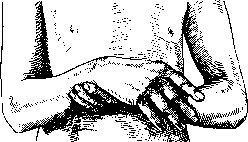
K. e.-clinic, symptom complex or syndrome, which may be observed in various diseases: encephalitis, syphilis, traumatic damage, tumors, progressive paralysis, cysticercosis. However, in most cases K. e. occurs as a symptom of subacute or chronic encephalitis. In some cases the disease begins with a seizure, in others with phenomena of constant hyperkinesis. The first seizure occurs sometimes shortly after the first appearance of convulsions or, for example, after 3 weeks, but sometimes only after several years. The same must be said regarding the appearance of constant hyperkinesis following seizures. The frequency of seizures varies greatly: in some cases daily and even several times, in other cases once a year and less often. Seizures are often not entirely typical for an epileptic seizure (partial loss of consciousness, underdevelopment of the seizure, etc.). Phenomena of constant hyperkinesis appear most often on the right side and in the hand (Figure 1), but are also observed in the leg, face, tongue, palate, pharynx, larynx, etc. Constant hyperkinesis is sometimes observed on both sides of the body. In the hand three types of constant twitching are observed: flexor (most often) (Figure 2), extensor (Figure 3), mixed (Figure 4 and 5). The strength of muscular contractions varies greatly; patients have 'light' and 'heavy' days. Various psychological moments intensify the phenomena of constant hyperkinesis. In sleep, twitching is absent in some patients, while in others it does not cease. Before a seizure, there is usually an intensification of constant muscular contractions, after a seizure, a weakening of them. Often after a seizure, twitching appears in muscles not previously affected by the last seizure. Minor named the constant twitching in K. e. 'aura continua', emphasizing thereby the internal connection between seizures and hyperkinesis. There is a series of transitional cases from K. e. to other border forms and combinations: tic+epilepsia, chorea+epilepsia, or epilepsia choreica, paramyoclonus+epilepsia, myoclonia+epilepsia, tremor+epilepsia, athetosis+epilepsia, etc. In addition, in the differential-diagnostic respect one should bear in mind the possibility of development of a similar symptom complex in hysteria, multiple sclerosis. It is especially necessary to note that in K. e. there is an internal connection between seizures and constant hyperkinesis, while there are frequent cases when we have only an external combination of epilepsy with some phenomena of hyperkinesis.
Figure 3. 'Finger' position. Figure 3. Extensor type of constant hyperkinesis of the hand. (Figure 3).
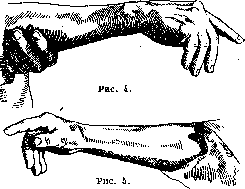
Figure 4 and 5. Mixed type of constant hyperkinesis of the hand.
Kozhevnikov's epilepsy stands apart from the observations of Omorokov, made in Siberia. The author is inclined to consider that among the Siberian, especially the peasant population of forested areas, K. e. occurs very frequently. He believes that in most cases this is an infectious disease of the encephalitis type with sharply expressed parenchymatous changes on the part of nerve cells and interstitial substance. The author describes in the nerve cells of the cerebral cortex peculiar inclusions, which he considers as a product of the tissue reaction to an unknown pathogen, analogous to Negri bodies in rabies. Omorokov counts 42 cases of K. e. described in the literature, while through his clinic in Tomsk passed 52 cases over 8 years. It is well known that in Siberia various diseases with phenomena of convulsive twitching are very widespread. On the other hand, it is necessary to remember that in combination with epileptic seizures the most diverse manifestations of constant hyperkinesis can occur. The course of the symptom complex of K. e. is usually chronic. The disease is extremely stubborn and resists various measures, if it is not possible to successfully conduct therapy eliminating its cause. Bromides, luminal are of little effect, especially regarding constant hyperkinesis. In recent times some improvement of the disease phenomena could be noted after the application of oxygen therapy and roentgen therapy to the subcortical nodes. Surgical intervention on the cerebral cortex and its membranes, as has been said, is far from always accompanied by a lasting success and does not always pass without recurrence; sometimes the operation leads, due to the formation of new scars, to a certain deterioration in the patient's condition. However, a number of authors describe good results of surgical intervention. A milder intervention than the removal of pieces of cerebral cortex with suspected areas of brain substance of the motor zone is the introduction of alcohol into the brain substance proposed by Razumovsky. For those who share the views on the subcortical pathogenesis of Kozhevnikov's epilepsy, the alcoholization of peripheral nerve trunks with the aim of stopping the conduction of irritating impulses to their constant contraction is more acceptable. Alcoholization peripherally practically gives certain results. Where the question of reflex pathogenesis of the disorder arises, interventions for cutting off irritating reflex influences from the periphery are indicated.
Related articles
Mentioned in
Cite this page
“Kozhevnikov's Epilepsy.” Soviet Medical Encyclopedia. English translation of Bolshaya Meditsinskaya Entsiklopediya, 1st ed. (Moscow, 1928–1936), ed. N. A. Semashko. https://sovietmedicalencyclopedia.pages.dev/article/kozhevnikovs-epilepsy/