Gaze Paralysis and Spasm
Historical document, translated for reference. It reflects medical knowledge of the 1920s–30s and is not medical advice.
Summary
This article from the 1928–1936 Soviet Great Medical Encyclopedia defines gaze paralysis as the inability to move both eyeballs simultaneously in a specific direction. It discusses the anatomical substrates of this condition, including the role of supranuclear pathways and the Dejerine scheme, and describes gaze spasms, particularly in the context of epilepsy and post-encephalitic states.
Encyclopedia article (1928–1936)
GAZE PARALYSIS, SPASM. Gaze paralysis is expressed by the impossibility of the simultaneous movement of both eyeballs in one direction or another: to the right or left, upward or downward. Opinions differ regarding the anatomical substrate of this symptom. Previously, the center for eye movement in one direction or another was sought in the nucleus of the abducens nerve on the same side. At the present time, it is believed that this always involves a lesion of the supranuclear pathways. The most detailed of the schemes is the Dejerine scheme. According to it, gaze paralysis may depend, firstly, on an interruption of the central corticonuclear tract, which connects the cortical center with the oculomotor nuclei; secondly, gaze paralysis may be caused by damage to the fibers that connect Deiters' nucleus with the oculomotor nuclei and which pass within the fasciculus longitudinalis posterior. And, thirdly, gaze paralysis may depend on a lesion of the internuclear fibers, i.e., the fibers connecting the nucleus of the VI pair with the nucleus of the III pair and also passing in the fasciculus longitudinalis posterior. Depending on the localization of the lesion, gaze paralysis may be ipsilateral to the hemiplegia or contralateral. With foci in the anterior part of the tegmentum pontis, the patient cannot turn their gaze toward the side of the hemiplegia (upper Foville's syndrome). With foci in the posterior part of the tegmentum, the patient cannot move their eyes toward the side of the healthy limbs (lower Foville's syndrome). Vertical gaze paralysis, i.e., the inability to turn the eyeballs upward or downward (the so-called Parinaud's syndrome), is observed rarely and is characteristic of lesions in the region of the midbrain.
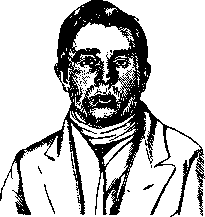
FIG. 1.
Gaze spasm, the so-called conjugate deviation of the eyes (deviation conjuguee des yeux), is observed, mainly, in epilepsy, especially in Jacksonian epilepsy, as well as in large, fresh hemorrhages in the cerebral hemispheres, and indicates irritation
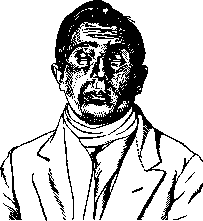
Fig. 2.
of the cortical center for eye abduction, which is localized in the posterior section of the second frontal gyrus. In such cases, the eyeballs deviate toward the side of the limbs seized by the spasm. In recent years, gaze spasm has been encountered very frequently in residual states following epidemic encephalitis. From time to time, the eyeballs are forcibly abducted upward and can be brought out of this position only with difficulty and only for a short time (see figure 2; in fig. 1 is the normal state). At the same time, the head is usually also abducted upward. In rarer cases, abduction of the eyes and head to one side or the other is observed. The general condition of patients during such seizures usually does not undergo significant changes.
Related articles
Cite this page
“Gaze Paralysis and Spasm.” Soviet Medical Encyclopedia. English translation of Bolshaya Meditsinskaya Entsiklopediya, 1st ed. (Moscow, 1928–1936), ed. N. A. Semashko. https://sovietmedicalencyclopedia.pages.dev/article/gaze-paralysis-and-spasm/