Deiters' Nucleus
Historical document, translated for reference. It reflects medical knowledge of the 1920s–30s and is not medical advice.
Summary
Deiters' nucleus is a component of the vestibular system located in the medulla oblongata and pons. It plays a critical role in maintaining equilibrium by connecting with the cerebellum, oculomotor nerves, and spinal cord.
Encyclopedia article (1928–1936)
DEITERS' NUCLEUS (Deiters), belongs to the VIII pair of cranial nerves, their vestibular part; it lies in the upper sections
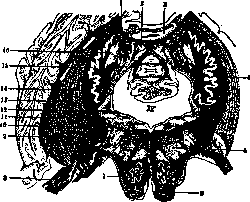
Section of the medulla oblongata in its upper sections: 1-nucleus globosus; 2-nucleus fastigii; 3-cortex of the vermis; 4-brachium conjunctivum; 5-substantia reticularis; 6-pyramidal tract; 7-olive of the medulla oblongata; 8-nervus acusticus; 9-nucl. et radix n. trigemini; 10-nucleus Deitersi; 11-Bechterew's nucleus; 12-fibr. vestibulo-cerebellares; 13-brachium pontis; 14-corpus restiforme; 15-nucl. dentatus; 16-nucl. emboliformis. (After Villiger.)
of the medulla oblongata (see figure) and in the lower sections of the pons Varolii along the floor of the IV ventricle, in the angle formed by the descending root of the n. trigeminus and the corpus restiforme, and it enters into the composition of the inner part of the pedunculi cerebelli ad medullam oblongatam (corpus juxtarestiforme), the outer part of which is formed by the corpus restiforme; downwards, Deiters' nucleus continues into the gray matter—nucleus descendens. Deiters' nucleus is formed by very large cells, between which a large number of fibers are visible, belonging to bundles beginning or ending here and known under the general name of Deiters' tract. In Deiters' nucleus terminate: 1) a part of the fibers of the rami vestibularis n. acustici (although some authors deny this); 2) fibers from the nucleus fastigii of the cerebellum and the cortex of the vermis; to these latter structures, Deiters' nucleus sends fibers. Deiters' nucleus sends fibers into the fasciculus longitudinalis posterior, through which it connects with the nuclei of the oculomotor nerves of the opposite and its own side. Some authors assume that the fibers from Deiters' nucleus entering the fasciculus longitudinalis inferior are few in number and belong exclusively to its descending fibers going to the spinal cord. Besides that, the Loewenthal tract or fasciculus vestibulo-spinalis originates from Deiters' nucleus, heading to the spinal cord and terminating in the cells of the anterior horns of its own side. The connection of Deiters' nucleus with the cerebellum and with the vestibular system indicates its function—together with them, it takes part in maintaining equilibrium. - Disease of Deiters' nucleus causes a series of symptoms, distinguished under the name of Deiters' nucleus syndrome (Bonnier). This syndrome is characterized by a disturbance of equilibrium, dizziness, nystagmus, nausea, and disorder of the oculomotor apparatus (see also Bulbar paralysis). Recently, a hypothesis has been put forward (Ken Kure) that the higher sympathetic center of muscle tone is located in the cerebellum; fibers from this center go through Deiters' nucleus to the spinal cord (it is possible that the center itself extends into Deiters' nucleus), as a result of which disease of the latter, by destroying the fibers (and perhaps the center itself), leads to muscular dystrophies. This opinion is not yet shared by everyone.
Related articles
Mentioned in
Cite this page
“Deiters' Nucleus.” Soviet Medical Encyclopedia. English translation of Bolshaya Meditsinskaya Entsiklopediya, 1st ed. (Moscow, 1928–1936), ed. N. A. Semashko. https://sovietmedicalencyclopedia.pages.dev/article/deiters-nucleus/