Progressive Paralysis
Historical document, translated for reference. It reflects medical knowledge of the 1920s–30s and is not medical advice.
Summary
Progressive paralysis is a psychiatric disease characterized by the somatic and psychological disintegration of personality due to an inflammatory-degenerative process in the nervous system caused by the syphilitic spirochete. The article discusses its epidemiology, etiology, pathogenesis, and historical patterns of incidence across different populations.
Encyclopedia article (1928–1936)
PROGRESSIVE PARALYSIS (paralysis progressiva alienorum, dementia paralytica), a psychiatric disease, first described in detail by Bayle in 1822, and characterized by somatic and psychological disintegration of personality due to a special inflammatory-degenerative process in the nervous system, caused by the syphilitic spirochete. P.P. is a very widespread disease, although in recent years some decrease in its incidence has been noted, especially in the USSR. In the pre-war period, progressive paralytics on average constituted 14% of men and 5% of women out of the total number of patients in Russian psychiatric institutions (Zhdanov, Ignat'ev); in 1922 there were 11.9% of men and 5.5% of women; in 1928-7.28% of men and 4.5% of women (Prozorov). Mortality from P.P. in psychiatric hospitals in the pre-war period reached 40% of total mortality, at present 25%. Etiology and pathogenesis. Already at the end of the 19th century, the syphilitic origin of P.P. was considered proven by the majority of authors, but at the same time the prevailing opinion was that P.P. is a metasyphilitic disease, rather a consequence of syphilis than true syphilis. The discovery of spirochetes in the brain of paralytics by Noguchi established that this disease is a true syphilitic process of the nervous system, only somewhat modified compared to its other forms. There is even reason to believe that only P.P. can be considered true syphilis of nervous tissue (primarily affected ectoderm), whereas other forms of cerebral syphilis primarily affect only the mesoderm (membranes, vessels). In connection with this, specific serological reactions (Wassermann reaction and others) are more definite and constant in P.P. than in other forms of syphilitic psychoses. The belonging of P.P. to syphilitic diseases does not exclude the isolation of this disease. The duration of the incubation period, features of psychiatric symptoms and serological reactions, the malignancy of the disease course not amenable to ordinary anti-luetic treatment, patho-anatomical features—all these data to the present day substantiate the concept of P.P. as a special nosological unit. The dependence of P.P. on spirochete infection does not exhaust the question of the etiology of this disease, since only some syphilitics (3-4%) subsequently develop paralysis and therefore one has to take into account the presence of additional, not yet fully clarified factors contributing to the disease. These factors can be sought in individual predisposition, in the influence of additional exogenous factors, and in the peculiarities of the spirochete itself. Individual predisposition is expressed in the weakened ability of the organism to fight the spirochete (weak production of antibodies, insufficiency of the hemato-encephalic barrier). The influence of such external weakening factors as trauma, alcoholism, etc., probably has no greater significance in the pathogenesis of P.P. compared to other psychoses. As for the special properties of spirochetes, there is a hypothesis that some of their species (strains) cause predominantly skin changes, others—lesions of the nervous system (dermatotropic and neurotropic syphilis). Confirmation of this hypothesis can be considered: 1) the weakness of skin syphilitic reactions in the anamnesis of most paralytics; however, it is possible that such weakness of reaction is explained not only by the peculiarities of the spirochete (weakness of irritations coming from it), but also by the insufficient ability of the organism to produce antibodies; 2) cases when several people infected from the same source develop P.P.; 3) relatively frequent cases of marital P.P. According to the data of Junius and Arndt, out of 1,000 cases of P.P. there are 38 conjugal ones. In addition, it has been experimentally proven that there is a difference in virulence of different strains of spirochetes, and what is especially important, a certain neurotropism of paralytic spirochetes (Plaut, Mulzer): infection of rabbits with paralytic spirochetes gives more pronounced changes in the nervous system compared to infection with ordinary syphilis. However, it has not been proven whether the neurotropism of the paralytic spirochete is its constant property or acquired during its stay in the body of a P.P. patient. Furthermore, some significance in the pathogenesis of P.P. is attached to the preceding energetic treatment of syphilis. Some authors believe that treatment, by weakening the body's ability to produce antibodies, contributes to the subsequent development of P.P. Indirect confirmation of this opinion is the rarity of P.P. among some so-called 'primitive' peoples, who are precisely deprived of the possibility of rational treatment of syphilis, as well as the circumstance that the introduction of salvarsan into the practice of treating syphilis apparently led to a shortening of the incubation period of P.P. However, statistical data (Nonne and others) show the fallacy of such a hypothesis about the influence of syphilis treatment on the incidence of P.P.; on the contrary, these data prove that paralytics are still more often those who were not treated or poorly treated syphilitics. Great importance for the study of the pathogenesis of P.P. is given to data on the prevalence of this disease. P.P. is more often observed in the urban population than in the rural population, more often in men than in women. This circumstance can only be partially explained by the greater prevalence of syphilis in cities and among men. Syphilis in women occurs only 20% less frequently than in men, and the incidence of paralysis is 2-3 times lower. However, this difference in incidence between urban and rural populations, men and women—1—in recent times has somewhat smoothed out. In any case, apparently additional harmful factors related to social conditions of urban life and acting differently on men and women play a role here. It has long been noted that P.P. is relatively little spread among peoples who have remained to some extent outside bourgeois culture and who predominantly live in a hot climate. Numerous studies of recent times have shown that this circumstance by no means can be explained simply by the insufficiency of statistics in the mentioned countries. At the same time, it has been proven that the incidence of paralysis does not stand in direct dependence on the prevalence of syphilis. For example, in Abyssinia and among American Indians, despite the huge number of syphilitics, there are almost no cases of P.P. The assumption has been expressed that the lower frequency of P.P. in a hot climate may depend on the prevalence of malaria (now used for the treatment of P.P.) and other infections there, as well as on profuse sweating, which has long been attributed importance in the treatment of syphilis. However, all these explanations, if they have any significance, are only partial: Europeans in a hot climate often suffer from P.P. The above seems to indicate some significance of nationality and culture in the pathogenesis of P.P.; some clarification of this question is possible only when considering the historical development of this disease, as well as of syphilis itself, in different countries. At the appearance of syphilis in Europe, skin and bone lesions predominated, the disease sometimes proceeded very acutely, with violent phenomena, often ending in death. The same was observed among non-European peoples at the beginning of the spread of syphilis among them. Only later did the forms of manifestation of syphilis change up to the appearance of P.P. Remarkably, even in Europe, P.P. began to spread only at the end of the 18th century. The study of old case histories in the archives of Western European hospitals shows that until the time mentioned, P.P. really did not exist. Then the number of paralytics in all European countries began to rapidly increase among the urban population, and later among the rural population until the end of the 19th century, and from the beginning of the 20th century the curve of diseases began to fall, so that undoubtedly the culminating point in the development of P.P. among European peoples has already been passed. In Southeast Europe (Bosnia, Serbia, etc.), in Central Asia, among the Negroes of North America, etc., the curve of P.P. diseases began to rise only recently, while among some other peoples, as already mentioned, P.P. is still encountered very rarely, and its further development can be expected, and perhaps among individual peoples the wave of P.P. diseases has already ended (it is possible that this concerns American Indians, among whom syphilis was spread earlier than among Europeans). One can assume that the differences in the spread of P.P. among different peoples depend, at least in part, on the degree and duration of syphilization of the population in the past, and syphilis apparently changes depending on the changing ability of the human organism to produce antibodies; in other words, the struggle of the human organism with the spirochete over a number of generations goes through various stages and ultimately leads to new forms of manifestation of syphilis. Moreover, P.P. itself gradually changes, which has been noted over the last decades (still independent of malaria treatment, which in turn sharply influenced the course of P.P.): some forms of P.P. have become less frequent.
(expansive), more often others (especially demented and depressive).-From the above, the enormous complexity and insufficient clarity of the problem of the pathogenesis of P. p. is evident. It is obvious, however, that the resolution of the question lies in the study of the properties of the spirochete and the defensive reactions of the human organism, which change under the influence of various conditions. Pathological anatomy. Changes in the brain in P. p. are usually noticeable even macroscopically. The following are noted: clouding and thickening of the soft meninges, its adhesion to the brain substance, atrophy of the cortex (especially frontal)-widening of the grooves, thinning of the gyri, expansion of the cerebral ventricles, increase in the amount of cerebrospinal fluid in the meninges and ventricles, granularity on the floor of the IV ventricle, sclerosis of cerebral vessels. Focal lesions (in the form of softening, hemorrhages) are almost never present. In cases of death from stroke, there is marked hyperemia of the brain, pinpoint hemorrhages, sometimes phenomena of the so-called brain swelling.-The weight of the brain in paralytics is 100-150 z below average. Of the changes in other organs, atheromatosis of the aorta (even in relatively young subjects) is the most characteristic and constant.--HistopathologyP. p. is one of the most developed chapters in the anatomy of psychoses. The paralytic process is characterized by lesions of ectodermal and mesodermal tissues. In the mesoderm, an inflammatory process is observed, expressed in the infiltration of the soft meninges and vessels, as well as in the proliferation of the latter. Infiltration of vessels, especially small ones, is extremely characteristic and particularly important for the anatomical diagnosis. The composition of the infiltrate is predominantly plasma cells with an admixture of lymphocytes and fat cells, as well as reticular cells containing hemosiderin. Further, proliferation of vessels and proliferation of their adventitial and endothelial elements are observed. Regressive changes in the vascular walls are also common. Around medium and large vessels, as well as in the soft meninges, there is an accumulation of decay products. In severe cases, miliary encephalitic and necrotic foci are observed.-The degenerative process in the ectoderm manifests as sclerotic atrophy of nerve elements, their severe Nisslian changes, as well as lipoid degeneration. Ultimately, some nerve cells are completely destroyed, and a gradual emptying of the cortex occurs. Nerve fibers are also affected, partly due to degeneration caused by cell death, but mainly due to the direct process in the fibers themselves. The neuroglia is also strongly changed, with progressive changes predominating over regressive ones; in the superficial layers of the cortex, proliferation of glial fibers predominates, in the deep layers-plasma glia. Rod-shaped cells, originating from pathologically altered microglia (it was previously believed that these cells originate from the adventitia of vessels and therefore belong to the mesoderm), are very characteristic of P. p. In cases of death of paralytics from stroke, proliferation of the so-called ameboid cells (also of glial origin) is observed, which proliferate vigorously mainly in the deep layers of the cortex. Ameboid glia quickly degenerates and disappears within a few days if the patient recovers from stroke. All the described changes in vessels, nerve, and glial cells lead to changes in the architectonics of the cortex, which is one of the most characteristic signs of P. paralysis [see separate table (art. 223-224), fig. 1-7]. Although the paralytic process spreads diffusely in the brain, there is a certain unevenness in the lesion of individual parts and significant individual fluctuations in this regard. Most often, lesions are observed in the cortex, mainly in the frontal lobe, then in the Ammon's horn, in the striatum; the visual thalamus, pallidum, subthalamic region, and cerebellum are less affected. Changes in the spinal cord are quite common. Individual forms of P. p. differ from each other both in terms of the predominant localization of changes (lesion of the temporal lobes in the paranoid-hallucinatory form, striatum in the catatonic form, occipital lobes in Lissauer's paralysis, spinal cord in taboparalysis), and especially in terms of the intensity of the process: in the epileptic and galloping forms, especially marked inflammatory changes are observed, sometimes small inflammatory foci and even miliary gummas; in slowly progressing forms, especially in stationary paralysis, very weak vascular infiltration and preservation of the architectonics of the cortex are observed.-Spirochetes in the brain of paralytics are found in very different quantities in different cases. They are most often found in the areas and layers of the cortex where the greatest anatomical changes are also detected. The dependence of miliary necrosis on spirochetosis is especially clear. In the so-called epileptic paralysis and in general in cases of death after stroke, spirochetes are found in enormous quantities. If the patient survives after stroke, most of the parasites die, partly probably as a result of the activity of the mentioned ameboid cells, whose vigorous proliferation can be considered as a reaction of the brain to the proliferation of spirochetes. In sluggishly progressing forms, the number of parasites is small, and they can be found only with difficulty. However, the relationships between the proliferation of spirochetes, the histopathological picture, and the clinical phenomena are far from clear. Spirochetes are located mainly around vessels and nerve cells and especially at the border between white and gray matter. In P. p., treated with malaria, if the patient dies during an exacerbation of the process, inflammatory phenomena are observed in an especially intense form, lymphocytic infiltration predominates over plasma cell infiltration, plasma cells are observed to exit from the vessel walls into the ectoderm (which almost never happens in ordinary P. p.), and miliary gummas may sometimes appear. These features of P. p., treated with malaria, can be considered as a certain shift towards brain syphilis. It is remarkable that under the influence of malaria treatment, gummas can also sometimes form in bones, etc. In cases of death (from accidental illness) of malaria-treated patients-in a state of good remission-a picture is observed that resembles, in its weakness, the changes of stationary paralysis; one can note in addition the presence of more or less significant emptying in the cortex (evidently at the site of former lesions). In new illnesses after remissions, there is often an atypical predominant localization (in the temporal lobe, in the striatum), which corresponds to a shift in the clinical picture.-Histopathological examination of P. p. is usually performed by staining according to Nissl. For rapid anatomical diagnosis, the Spatz method is applicable, which detects the iron-containing pigment, very characteristic of progressive paralysis. The symptomatology of P. p. is determined by the progressive phenomena of degradation from the psychic and somatic sides.-Mental symptoms are usually considered according to the stages of the illness, distinguishing the initial, or prodromal, stage, the stage of full development, and paralytic marasmus (the final stage). The first stage usually lasts for several months, its onset is imperceptible and often cannot be precisely determined. There are reasons to believe that paralytic changes in the nervous system are prepared and ripen long before the appearance of clinical symptoms; cases have been described where in apparently healthy people who died from accidental causes, unmistakable changes characteristic of P. p. were found in the brain. Obviously, the compensatory forces of the organism can fight the advancing disease up to a certain point. The first clinical manifestations usually express themselves in the form of so-called neurasthenic symptoms: the patient becomes irritable, distracted, his work capacity decreases, inability to correct his mistakes is observed, there is a decrease in interests, tactlessness in dealing with others, weakness of will (lability of affects), fluctuations in mood (towards hypomania or depression). Often there is an increase in primitive drives (gluttony, crude sexuality). All these changes in the patient's personality are initially assessed by others as simple nervousness due to overwork, etc. The patient continues to work, but gradually loses his leading role (if he had one), makes gross mistakes, confuses affairs, commits absurd acts (purchase of unnecessary things, senseless theft, absurd squandering, etc.). The illness becomes obvious, the patient has to leave work, and his absurd behavior leads to the necessity of placing him in a hospital. This measure is sometimes accelerated by the appearance of severe excitement or stroke, which in some cases may even be the first manifestation of the illness, as if its acute onset. In the first stage, the patient is still physically strong, neurological symptoms are not yet sharp and isolated, but serological reactions are usually already present. In the second stage, the axial symptom of P. p.-dementia-comes to the fore: memory and reasoning disorders are observed, weakness of judgment, a sharp decrease in criticism and especially self-criticism. In this period, the illness manifests itself in different forms depending on the presence of various additional symptoms. In the expansive form (the so-called
(the 'classical' form, as it was considered the most typical for this disease)—in the foreground is manic excitement with a grandiose delusion of absurdly magnificent character (the patient considers himself a billionaire, ruler of the world, the greatest singer, he has thousands of palaces, airplanes, he is building a bridge across the ocean, etc.). In the depressive form, a depressed mood and absurd hypochondriacal ideas predominate (the patient has no internal organs, he is dead and decomposing, etc.). In the agitated form, there is marked motor excitement with confusion. This form sometimes takes on a particularly rapid malignant course (the so-called galloping paralysis). The malignant course is also characteristic of the so-called convulsive paralysis with frequent strokes and epileptiform seizures. In addition, a circular form with alternating excitement and depression, catatonic and paranoid-hallucinatory forms with the predominance of corresponding symptoms have been described (generally in P. p. hallucinations are relatively rare). The most common form of P. p. is the so-called demented form with a relatively slow course; it is characterized by progressive dementia without other bright symptoms and in the presence of a cheerful (euphoric) mood. All these forms, despite some differences not only in the external picture but also in the course, are still not sharply isolated, can replace one another, and most importantly, all of them are clearly expressed only in the second period of the disease, whereas in paralytic dementia the differences between them are smoothed out. The diversity of external manifestations in P. p. depends on a number of factors: the prepsychotic peculiarities
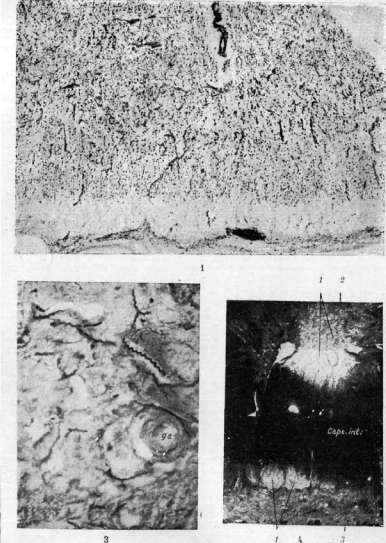
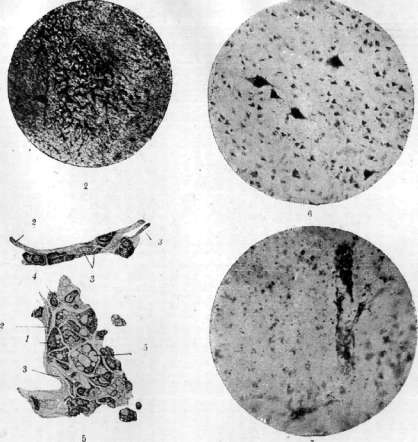
Fig. 1. Cortex of the large brain in progressive paralysis; infiltration of the membrane of the vessels, proliferation of the latter; disruption of the intracortical architectonics of the cortex (according to Nissl). Figure 2. A healing focus in progressive paralysis after malaria treatment. Figure 3. Presence of spirochetes and gumma in the central nervous system in progressive paralysis (according to Nissl). Fig. 4. Foci (1) with myelin disintegration in progressive paralysis; 2-putamen; 3-nucleus caudatus (according to Jakob). Fig. 5. Infiltrations around vessels in progressive paralysis: 1-plasma cells; 2-endothelial cells; 3-adventitial cells; 4-mast cell; a-degeneration of a plasma cell with vacuoles (according to Pfeiffer). Figure 6. Chronic changes in nerve cells in progressive paralysis. Fig. 7. Infiltrations of vessels of the cortex of the large brain by plasma cells in progressive paralysis. The clinical picture of progressive paralysis is extremely varied. The onset of the disease is often insidious, sometimes with vague prodromal phenomena: general malaise, headaches, dizziness, irritability, sleep disturbances, sometimes hypochondriacal ideas. The first signs of mental disorder are often vague: a change in the character of the b-ny, a decrease in his working capacity, a change in his interests, sometimes a certain euphoria, self-conceit, or, conversely, a decrease in self-esteem. The further development of the disease depends on the individual characteristics of the personality, on the peculiarities of the localization of the process, on the resistance of the organism, on the strength and toxicity of the infection, as well as on external factors (social position, profession). In the second stage, the physical strength of the b-ny begins to fall, neurological symptoms and especially changes in the motor sphere are already sharply expressed. In the last stage—the marantic-psychotic and somatic degradation reaches extreme degrees. Deep dementia, complete helplessness is observed; the b-ny is extremely weak, bedridden, unkempt. Exhaustion, trophic disorders depend on the lesion of the vegetative centers, which leads to the death of the b-ny, which is sometimes accelerated by a stroke or by a random somatic disease. Neurological and somatic symptoms. Motor changes are discovered relatively early due to the lesion of cortical and subcortical centers. Inaccuracy in the execution of motor acts is discovered, coordination is disturbed, especially of fine movements, trembling appears in the hands, lips, tongue; handwriting is disturbed: it becomes uneven, unsteady, with omissions of letters and syllables. Changes in handwriting depend not only on purely motor disorders, but also on the lesion of active psych. functions (attention); in the last stage the b-ny of course cannot write at all. Very characteristic for P. p. is the disorder of speech, which first appears in the pronunciation of difficult words—stumbling on syllables, omissions of syllables, general indistinctness and unclearness. The voice loses its timbre and distinctiveness due to fibrillary twitchings in the muscles of the larynx. In the last stage the patient utters only inarticulate sounds. Aphasia, paraphasia, observed after strokes, are not persistent. Also transient are hemiplegias. In general, gross focal symptoms are as a rule not characteristic of P. p., for it a general weakening of the entire motor apparatus is more characteristic. Paralysis of cranial nerves are common for P. p.: unequal innervation of the face, ptosis, deviation of the tongue to the side when protruded, mask-like face. Tendon reflexes (patellar, Achilles tendon, etc.) are usually sharply increased, sometimes decreased or absent, often unequal. Increase of reflexes depends on cortical changes or on the lesion of the lateral columns of the spinal cord; at this time clonus of the feet is often observed. Absence of reflexes depends on the lesion of the posterior columns of the spinal cord. Path. pyramid symptoms (Babinski and others) are usually absent, but are often observed temporarily after strokes. In the marantic period contractures of the extremities are sharply expressed. The symptom of Romberg is very often observed. Early, constant and very important signs are pupil disorders: inequality of pupils, their irregular shape, sluggishness or absence of reaction to light with preservation of reaction to accommodation (Argyll-Robertson symptom), as well as decrease of reactions to sensory and psych. irritations. Further disorders of sphincters are very common in P. p. (especially in the last stage): incontinence or retention of urine, and then of feces. Vasomotor and trophic disorders are especially expressed in the state of marasmus: fragility of bones, atrophy of muscles, tendency to bedsores, cyanosis and edema of the extremities (without protein in the urine), ot hematoma (hematoma of the auricles with their subsequent wrinkling and disfigurement, caused by trauma—even slight). All these phenomena are connected with the lesion of vegetative centers, with disturbance of nutrition and metabolism. Incidentally in paralytics sharp fluctuations of body weight are observed: usually obesity at the end of the 2nd period (when b-ny are calm, demented, sluggish, do nothing) and sharp emaciation in the marantic stage, despite often good appetite. In paralytics the nitrogen equilibrium is disturbed, protein metabolism is disordered, the ability for protein synthesis is decreased.--Great diagnostic significance have serological reactions in P. p.: positive RW in the blood and cerebrospinal fluid, reaction of Nonne-Appelt in the fluid, characteristic curve in the reaction of Lange, lymphocytosis in the fluid, etc. Course. The incubation period of P. p. lasts from 2 to 40 years, but most often the disease begins 8-15 years after infection with syphilis. Correspondingly to this the main mass of diseases refers to the age of 30-45 years, but diseases are also quite frequent in old age. Children (congenital syphilitics) get sick at the age of 10-15 years; consequently P. p. on the basis of congenital syphilis has approximately the same incubation period. The duration of P. p. is 2-4 years, with a difference in the duration of individual forms (agitated, convulsive forms proceed faster, expansive, circular and dementive forms proceed slower). Strokes, which accelerate the outcome, and remissions, which prolong the course of the disease, are of great importance. Natural remissions occur in 10-15% of all cases (more often in circular and expansive forms) and last for several months, rarely 2-3 years. With modern treatment remissions have become much more frequent (up to 60%) and longer (they last for years), consequently of course the duration of P. p. has also increased.--The prognosis is very unfavorable, but this assessment is considerably mitigated thanks to the application of modern methods of treatment. Atypical forms of P. p.: 1) stationary paralysis with very slow course (up to 15-20 years and more), when b-ny usually die from some accidental disease. In general this is a very rare form, but nowadays such course is taken for cases with favorable result of treatment by malaria or relapsing fever. 2) Paralysis of Lissauer differs by the presence of focal symptoms of deficit, not characteristic of ordinary P. p., which depends on the peculiarities of localization (mostly in the occipital lobes). The course is slow; at the end of the disease the process generalizes and gives the usual for P. p. final stage. 3) Taboparalysis is characterized besides the ordinary paralytic symptoms by the presence of tabetic disorders, which is connected with the corresponding lesion of the spinal cord. Usually these tabetic symptoms precede the development of psych. disorder by several years, mainly connected with the lesion of the cortex of the large brain. The course of taboparalysis is relatively slow. 4) Juvenile paralysis develops on the basis of congenital syphilis in children, often already imperfect from birth, but sometimes also in children who developed correctly before the disease. It is equally often observed in boys and girls. The dementive form predominates; sometimes focal symptoms are observed, often complete immobility of the pupils (and not only to light) is noted. Characteristic is the arrest of growth in children who got P. p. Endocrine disorders (eunuchoidism, obesity) are often observed. Differential diagnosis of P. p. has special significance in the initial stage. Recognition from neurasthenia is made on the basis of beginning neurological symptoms, degradation of psyche and serological reactions. Hypomanic and depressive syndromes at the beginning of P. p. differ from analogous phenomena in manic-depressive psychosis by the presence of a special euphoria, spinelessness, absurd behavior and neurological and serological data. Recognition from other organic diseases (arteriosclerosis, alcoholic pseudoparalysis, tumors of the brain, etc.) is made on the basis of careful comparison of psychopathological, neurological and serological data, keeping in mind that to arteriosclerosis focal deficits, lacunar changes of psyche are characteristic, to tumors—presence of choked disk and other phenomena connected with increase of intracranial pressure, etc. The greatest difficulties are presented by the delimitation of P. p. from syphilis of the brain in view of the commonness of many neuropsychic and serological manifestations. However to syphilis of the brain focal symptoms are more characteristic, dementia has a lacunar character, changes of speech are less characteristic, hallucinations are more frequent, the course is not so malignant and the process often yields to antisyphilitic treatment. RW in the cerebrospinal fluid in syphilis of the brain is usually positive only with large doses of it (0.4-0.8 g), in P. p.—even with small ones (0.2); also the curves of Lange's reaction differ.
Differentiating P. p. from so-called tabetic psychoses presents approximately the same difficulties (in the latter, hallucinatory-paranoid syndromes are more common, there are no paralytic speech disorders, serological reactions are not so constant, and the course is not so malignant). Special difficulties for diagnosis (in the absence of anamnesis) may be presented by cases of P. p. in a state of prolonged remission after malaria treatment, when there is a generally more or less significant decrease in mental activity with weakly expressed neurological symptoms. Usually, however, pupillary changes and serological reactions remain persistent signs even in such cases. Prevention of P. p. comes down to broad socio-hygienic measures in the decisive fight against syphilitic infection. Energetic and systematic treatment of syphilitics to some extent is a preventive measure in relation to P. p. Wagner-Jauregg believes that every syphilitic after 3-5 years from infection should examine his liquor, and if the result is positive, he should be treated with malaria. In his opinion, this will reduce the number of P. p. to a minimum. Treatment of P. p. until recently was considered completely hopeless. Anti-syphilitic agents give no results. Some success in 'the sense of achieving remissions' is obtained by using agents that increase temperature and cause leukocytosis of the blood (treatment with sodium nucleinate, tuberculin, injections of milk, etc.). A sharp turn in the treatment of P. p. was achieved by the use of malaria (Wagner-Jauregg, 1917). This infection apparently activates the body's protective forces to fight the spirochete. Malaria (usually malaria tertiana) is transmitted directly from a malaria patient: 2-4 cm3 of blood is taken and injected subcutaneously into the paralytic. After an incubation period (10-15 days), the paralytic contracts malaria. 8-10 attacks are sufficient, after which malaria is suppressed with quinine, and then salvarsan treatment is carried out. At present, when malaria treatment has been administered to many thousands of paralytics in all countries, we can confidently say that in this method we have a very effective means. A large number of paralytics can be considered practically cured and continue to work for many years. Comparing numerous statistical data, the results of malaria treatment can be schematically presented as follows: about 15-20% give good long-term remission with return to previous professional activity, about 30% give remission with a defect allowing the patient to return to a family environment but with loss of working capacity; in 10-15% the paralytic dies during the malarial disease or soon after it due to exacerbation of the paralytic process. In the remaining cases, treatment has no definite effect on the course of the disease. Often after remission the process resumes, in such cases renewed malaria treatment is indicated. The maximum duration and stability of remissions cannot yet be established, as this therapy has been used too recently. Cases with 7-10 year remissions have already been described. Wagner considers a remission stable if it lasts two years, after which one can hope for the stability of improvement, considering the patient practically cured. Improvement during remission is first of all reflected in the general physical condition: the patient becomes stronger, more vigorous, fresher, his motor abilities improve. At approximately the same time, mental improvement begins: delusions disappear, behavior normalizes, the patient becomes calmer, more reasonable, memory improves. Finally, what is especially remarkable, the patient ceases to be feeble-minded; this circumstance refutes the usualf concept of feeble-mindedness as something persistent, irreversible. Speech and handwriting also improve. Only pupillary symptoms and serological reactions in most cases remain persistent for a long time, and only in exceptionally favorable cases do these changes disappear. The earlier treatment is started, the more one can count on success, therefore early recognition of P. p. is especially important. However, even in far-advanced cases, good results are often obtained. Besides malaria, since 1919 (Plaut, Sterner), African relapsing fever (Spirochaeta Duttoni) has also been used successfully in the treatment of P. p. A few drops of blood from the heart of mice infected with recrudescence are mixed with several cm3 of physiological solution and 0.5-1.0 cm3 of the mixture is injected subcutaneously into the paralytic. After 5-7 days an attack of recrudescence occurs (1-2 days); attacks are repeated after several days, gradually weakening, and stop by themselves; usually there are 3-10. The results of treatment are approximately the same as after malaria, but recrudescence seems to be better tolerated even by very weak patients with poor heart and kidneys (which to some extent is a contraindication for malaria treatment). In our USSR, treatment of P. p. with European relapsing fever (Obermeier's spirochete) has also been successfully carried out by transmission from patients (Krasnushkin) or by inoculation of Obermeier's spirochete cultures (Yudin). Besides specific therapy for P. p., of course, symptomatic treatment methods must also be used: baths and bed rest during excitement, work regimen for strong patients, care during paralytic dementia. Placement of paralytics in hospitals is almost an inevitable measure at the height of the disease due to the incorrect behavior of patients, attacks of excitement, possible strokes, etc. The treatment with malaria or recrudescence must be carried out in institutional settings. From a forensic-medical point of view, it should be borne in mind that paralytics may commit offenses, especially in the initial stage of the disease (theft, embezzlement, sexual crimes, especially against minors, etc., are not uncommon). Usually in such cases the pathological condition of the accused is established during the preliminary investigation, which leads to the termination of the case; more rarely, an expert examination is required during the judicial process. Difficulties in determining capacity may be presented by paralytics during good remission; even in these cases, as a rule, protective medical measures are indicated, i.e., placement in a hospital (even compulsory), since the unstable condition of health of such persons excludes the possibility of applying social measures of judicial-punitive protection. If necessary to establish guardianship, similar doubts may again arise in relation to paralytics in remission after malaria treatment. Great caution is required in these cases, and the question is decided depending on a thorough investigation of the individual's personality.
m. Gurevich. PR0DIG10SUS BACILLUS (Bacterium prodigiosum), first described by Ehrenberg, is a very short, in young cultures highly motile rod; equipped with 6-8 long peritrichial flagella. Easily stained by aniline dyes, decolorized by Gram, facultatively anaerobic, but best growth and pigment formation occur under aerobic conditions. It liquefies gelatin, strongly turbifies broth with the formation on the surface of a thin, more or less colored red film; on agar - round colonies, often with a lighter (or darker) center; the color of the colonies is pink or red, some are colorless; on potato - first pink, then (after 5-6 days) a purple-red coating. It decomposes grape sugar with gas formation; the relationship of various strains to sugars is not the same; there are those that do not decompose sugars at all, but there are also those that decompose grape, milk and other sugars. P. b. forms the pigment prodigiosin, which develops best on agar and potato; this pigment is insoluble in water, easily soluble in alcohol, ether, and chloroform. Under the influence of alkalis, prodigiosin turns yellow, and from the action of zinc and hydrochloric acid it is decolorized. The microbe is highly polymorphic; its various strains differ morphologically, in shades of the pigment color formed, etc. P. b. is widely distributed in nature, occurring in air, water, milk, on cooked potato, raw bread, etc. Identical with P. b. or close to it are Bact. kiliense, found in Kiel in water, Bact. indicum, etc. P. b. ('the wonderful rod') played a prominent role in the history of human errors and superstitions. Appearing in the form of red, blood-like spots on hosts (wafers used in the Catholic church for communion), it served as an object of superstitious terror and a cause for persecution, causing a series of court trials and executions during the Inquisition. History has also preserved memories of 'bleeding bread' and others.
Related articles
Mentioned in
Cite this page
“Progressive Paralysis.” Soviet Medical Encyclopedia. English translation of Bolshaya Meditsinskaya Entsiklopediya, 1st ed. (Moscow, 1928–1936), ed. N. A. Semashko. https://sovietmedicalencyclopedia.pages.dev/article/progressive-paralysis/