Remission
Historical document, translated for reference. It reflects medical knowledge of the 1920s–30s and is not medical advice.
Summary
Remission refers to the alleviation of disease manifestations, particularly in chronic conditions that exhibit periodic fluctuations between remission and exacerbation. The article explores various causes and mechanisms of remission across different diseases, including infectious diseases, intoxications, and inflammatory conditions.
Encyclopedia article (1928–1936)
REMISSION (from Latin remissio - lowering, reduction), the alleviation of disease manifestations. Chronic diseases often proceed with fluctuations in the intensity of pathological phenomena, giving periods of R. and conversely exacerbations - so-called exacerbations. Sometimes in such fluctuations a certain periodicity is even established. R. is thus a definite, at times mandatory and regular phase of the chronically proceeding pathological process, which from the general pathological side by no means can be regarded as a return of the organism to a state of even relative health. Periodic R. is especially frequently observed in malaria and certain nervous and mental diseases, such as epilepsy, schizophrenia, and progressive paralysis. The duration of R. can be extremely varied - from several weeks and months to several years and even decades, giving in the latter case a false clinical impression of complete recovery. Thus, characteristic in terms of R. is the course of pernicious anemia, which before the introduction of liver therapy gave spontaneous R. with a return of the quantitative composition of the blood and the condition of the patient to visible normalcy while the pathological type of blood formation (megaloblastosis) persisted. The causes of R. also vary in different cases, and in some they are quite easily determinable, while in others, precisely where the pathogenesis of the condition has not yet been sufficiently studied, judgment about them naturally cannot go beyond general considerations. R. in infectious diseases can occur depending on the development of temporary immunity, understood in a broader sense, i.e., in the sense not only of the formation of antibodies and enhancement of phagocytic reaction, but also of increased resistance of cellular elements, decreased sensitivity of the nervous system to toxins, encapsulation of foci of infection, which hinders the absorption of toxic products, etc.; in non-bacterial intoxications and especially in autointoxications, the periodic occurrence of pathological attacks may depend on the accumulation of toxic products, while R. on the contrary - on their decomposition, excretion, or restriction of their formation under the influence of various causes (regimen, treatment, certain endogenous factors); in various diseases based on chronic inflammation, R. may depend on the absorption of inflammatory products in the presence simultaneously of conditions that temporarily prevent new extravasation, etc. - This general approach to the question of the mechanism of R. could be illustrated in application to individual cases by the following examples. R. in malaria is determined first by the development to the proper degree of macrophage-phagocytic reaction, second by the transition of plasmodia from the general bloodstream into the capillaries of certain organs with the formation of less active forms (gametes), and third by the gradual development of decreased sensitivity of the nervous system to the malarial poison, which in some cases can later lead to the development of perhaps unstable but still so-called non-sterile immunity (cases of the presence of plasmodia in the blood in the absence of pathological phenomena). Many gouty conditions, for example, persistent neuralgias, showed sharp R. during periods of population undernutrition, depending on involuntary food abstinence. Functional neuroses, such as neurasthenia and hysteria, give a bright flare-up during the period of puberty, and with age often acquire a much milder course, apparently depending on endocrine factors. But the greatest interest, although also the greatest difficulties for understanding, presents the question under discussion in application to progressive paralysis and especially to schizophrenia: regarding the former, a hypothesis has been expressed about the connection of exacerbations and R. with periodic spirochetosis of the brain, apparently depending on fluctuations in the permeability of the hematoencephalic barrier (Jahnel). Dr. Sakharov.
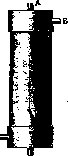
RENK APPARATUS (Renk) is used to investigate the permeability of soil and building materials to air. The R. apparatus, used for soil research (see illustration), consists of a metal cylinder 25-30 cm high and 5-10 cm in diameter. The side walls of the cylinder are solid, impermeable to air, the bottom is made of fine wire mesh; the top opening of the cylinder is covered with the same mesh. A brass cap, equipped with two tubes, is screwed on or placed tightly on the top opening, one of which (A) serves for passing air or some other gas through the soil, the other (B) for a manometer measuring the pressure of the passed air. Another such cap is placed on the bottom of the cylinder. For air permeability research, the cylinder is filled with the soil being tested, the caps are screwed on tightly, and for better sealing the joints are covered with Mendeleev's putty, and air is passed through tube A from a gasometer, maintaining a certain pressure in the manometer. The amount of air passing through is measured by gas meters or a rheometer placed between the gasometer and the R. a. If gas meters or a rheometer are for some reason not available, the air that has passed through the soil is collected after leaving the R. a. in a calibrated gasometer, where it is measured. The results of the research are expressed as the volume of air that has passed through the R. a. in 1 minute. In precise work, this volume should be reduced to 0° and 760 mm mercury pressure and then, using the formula given below, converted to the 'permeability coefficient'.
Renk's research showed that the degree of soil permeability to air depends on the size of soil particles, but not on the total number of pores in it. The larger the soil particles, the more air passes through it, all other conditions being equal. A high content of fine clay particles greatly reduces the air permeability of the soil. Moistening fine-grained soil makes it difficult for air to pass through, while moistening coarse-grained soil has little effect on its air permeability. The R. a. is also used to investigate the air permeability of various building materials: wood, brick, cement, lime, etc. From the material being tested, a piece of regular cylindrical shape is cut, its side surfaces are covered with a layer of air-impermeable putty, and the brass caps described above are placed tightly on both ends. The air permeability research is conducted in the same way as when testing soil. The air passed through is recommended to be pre-dried by passing it through a flask with sulfuric acid. Having determined the number of liters of air that passed through the tested material in unit time, the 'permeability coefficient' is calculated by the formula: C = (p '_p . , where C is the desired permeability coefficient, Q is the volume of air passed in liters, d is the thickness of the tested piece in meters, q is the surface in cm2 of the tested piece through which air was passed, Pg - P0 is the pressure difference in kg per 1 cm2 surface. When evaluating the results obtained, one can be guided by the data in the table (pp. 617-613). Wetting building materials, even on the surface, greatly reduces their air permeability. Glue painting has the same effect. Varnishing, glazing, and oil painting make the materials completely impermeable.
Related articles
Mentioned in
Cite this page
“Remission.” Soviet Medical Encyclopedia. English translation of Bolshaya Meditsinskaya Entsiklopediya, 1st ed. (Moscow, 1928–1936), ed. N. A. Semashko. https://sovietmedicalencyclopedia.pages.dev/article/remission/