Pachymeningitis
Historical document, translated for reference. It reflects medical knowledge of the 1920s–30s and is not medical advice.
Summary
Pachymeningitis is inflammation of the dura mater of the brain or spinal cord, with acute, subacute, and chronic forms. The article describes various types including purulent, serous, alcoholic hemorrhagic, and hypertrophic forms, with detailed clinical manifestations and treatment approaches.
Encyclopedia article (1928–1936)
Pachymeningitis cerebral or spinal (pachymeningitis cerebralis, s. spinalis), inflammation of the dura mater of the brain or spinal cord. According to the nature of development and course, acute, subacute, and chronic forms of P. are distinguished. Acute P. (pachymeningitis acuta) is most often purulent. The latter is patho-anatomically characterized by the accumulation of purulent-fibrinous masses or serous-purulent exudate on a certain area of the dura mater. Among the formed elements here, polymorphonuclear cells are mainly found. In cases where the process affects the outer surface of the dura mater, the disease is called pachymeningitis purulenta externa, or peripachymeningitis purulenta. In this case, inflammation of the epidural fat tissue usually also occurs. In the case, however, if the localization of purulent masses is on the inner side of the membrane, they speak of pachymeningitis purulenta interna. The process can be very limited and diffuse. Sometimes the accumulation of pus is so large that such an epidural or subdural abscess, by pressure on the soft membranes and brain substance in this area and causing a number of general and local symptoms, gives a clinical picture of a tumor. Much rarer are multiple epidural or subdural abscesses. Among purulent P., pachym. cerebralis externa is most common. It is essentially not an independent disease and mostly represents a consequence of the transition of the pathological process to the membrane from neighboring parts, e.g., in purulent inflammation of the ear, in traumatic damage to the bones of the skull, i.e., that form of meningitis which complicates various purulent processes. Often in such cases, due to the direct contact of the dura mater and the bones of the skull, their complete adhesion occurs, and the disease proceeds in the form of endocranitis (pachym. ext. cum endocraniitide). An example of subacute P. can be serous. It also localizes either on the outer or on the inner side of the dura mater, expressing inflammatory changes in it, with however the difference that its exudate does not contain pus. Infection and intoxication serve as etiological factors in its development. Among exogenous intoxications, alcohol should be noted, giving a special form - alcoholic hemorrhagic P., characterized clinically by acute development, and anatomically by the predominance of changes in the vessels of the membrane with subsequent hemorrhages. Clinically, the picture of alcoholic P. manifests itself with a state of psychomotor excitement and motor restlessness, as well as severe headache and vomiting. This state is replaced by a comatose one. Epileptic seizures of the Jacksonian type often appear, which sometimes, however, pass into general convulsions. Gradually, paralysis phenomena appear. The latter usually have the character of mono- or hemiplegia, but in severe cases they can also be bilateral. This is accompanied by tenderness of the skull and rigidity of the neck muscles. Stagnant phenomena at the bottom of the eye with hemorrhages into the retina are often noted. In addition to the visual, other cranial nerves usually do not participate in the clinical picture. The disease sometimes proceeds from the very beginning with an elevated temperature. The course is associated with remissions and exacerbations. Alcoholic P. sometimes ends fatally very early. Prolonged forms usually have a poor prognosis. In mild forms, complete recovery occurs. In severe and prolonged forms with a favorable outcome, there are always defects in the functional state of the nervous system. The often observed hemorrhages under the dura mater (e.g., in severe anemias, in hemorrhagic diatheses) should not necessarily be interpreted as P. Clinically, all acute forms of P. of infectious origin manifest themselves with high temperature, severe pain, sharply expressed symptoms of irritation of the nervous system, rapidly replaced by symptoms of loss - anesthesias, loss of reflexes, paralyses. The prognosis of acute and subacute P. is determined by their nature. Among therapeutic measures, in addition to purely symptomatic treatment, intravenous infusions of 40% urotropin, lumbar puncture, and in cases of focal purulent lesions of the epidural fat tissue, sometimes surgical intervention are used. Chronic P. is patho-anatomically characterized by a hyperplastic process, manifested in the thickening of the dura mater and in the formation of extensive deposits on its inner or outer surface as a consequence of hemorrhages and inflammatory changes. Histologically, a picture of proliferation of connective tissue elements of the membrane with hyperplasia of blood vessels is noted. In cases where this process occurs on the inner side of the membrane, they speak of pachym. hypertrophica interna; when it takes place in the outer layers of it, they speak of pachym. hypertrophica externa. Clinically, the greatest importance is attached to that type of P., which, in addition to the indicated hyperplastic changes in the membrane, is accompanied by hemorrhages - hemorrhagic internal pachymeningitis. Much more often than cerebral, spinal forms of P. with a chronic course are encountered in practice. Among them, Charcot and Geoffroy (1869) and especially the latter (1873) distinguished a special form - cervical hypertrophic P. (pachym. cervicalis hypertrophica, see illustration). This kind of P. represents a chronic inflammatory process in the inner layers of the spinal dura mater, accompanied by layered deposition of fibrous tissue and thereby leading, on the one hand, to a significant thickening of it, and on the other - to compression and destruction of the spinal cord and its roots. The soft membranes always also take a certain part in this. The etiological factors are tuberculosis, syphilis, J Of
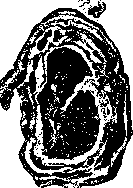
Pachymeningitis cervicalis hypertrophica.
alcoholism, often in combination with each other or with such factors as trauma or cooling. In etiology, however, according to most authors, syphilis has primary importance. The first symptom of the disease is usually pain, which is a consequence of the lesion of the membrane and compression of the roots. There is a sharply expressed tenderness of the meningeal-radicular zone in the cervical region. Following this neuralgic stage, a neuritic stage sets in, manifesting itself with anesthesias, loss of reflexes, pareses with muscle atrophy of the upper extremities. Significantly later, the symptoms of spinal cord lesion gradually emerge, first with the character of compression, and then also its destruction in the form of spastic paraparesis of the lower extremities. Several clinical varieties of this P. are distinguished: the lower brachial type, involving the VIII cervical and I thoracic segments, the upper brachial type, associated with lesions of the V, VI and VII cervical segments, the upper cervical with localization in the highest part of the spinal cord, sometimes even with the involvement of cranial membranes. A unilateral asymmetric form on the anterior, posterior or lateral surface is rarer. Cervical hypertrophic P. in diagnostic terms is differentiated from other diseases associated with compression of the spinal cord (Pott's disease, tumor), meningomyelitis and syringomyelia. In diagnosis, examination of the cerebrospinal fluid and myelography are of great importance. The disease has a tendency to progressive development. In therapy, specific treatment, diathermy, and local mud therapy are applied. In some cases, success from deep radiotherapy has been observed.
Related articles
Mentioned in
Cite this page
“Pachymeningitis.” Soviet Medical Encyclopedia. English translation of Bolshaya Meditsinskaya Entsiklopediya, 1st ed. (Moscow, 1928–1936), ed. N. A. Semashko. https://sovietmedicalencyclopedia.pages.dev/article/pachymeningitis/