Multiple Sclerosis
Historical document, translated for reference. It reflects medical knowledge of the 1920s–30s and is not medical advice.
Summary
Multiple sclerosis is a chronic, progressive disease of the central nervous system characterized by 'sclerotic plaques' developing in many parts of the brain and spinal cord. The etiology remains debated, with theories including infectious origin, viral causes, and hereditary predisposition.
Encyclopedia article (1928–1936)
Multiple Sclerosis (syn. disseminated sclerosis, s. sclerosis disseminata, s. multiplex, sclerose en plaques disseminees), a chronically progressive disease of the central nervous system, occurring with remissions and characterized by the presence of 'sclerotic plaques' developing in many parts of the brain and spinal cord. 'Sclerosis' here should be understood in the sense that in certain places of nervous tissue, mostly in the white matter, myelin disappears and glia proliferates. The main clinical manifestations: spastic paraparesis, intention tremor, nystagmus, scanning speech and a number of other symptoms depending on the location of the plaques. Multiple sclerosis was first described about 100 years ago in Cruveilhier's atlas (1835-42). It presents clinical and pathoanatomical facts that allowed distinguishing a new form. After this, individual observations and descriptions of multiple sclerosis began to appear in the literature. In the works of Turk and Rokitansky (1856), we encounter a newly distinguished form, but the true founder of the doctrine of multiple sclerosis was Charcot (1868). He and his pupil Vulpian gave the classic description of the new disease. Thanks to their anatomical and clinical works, the poorly studied and little-known form until then became a definite nosological unit, quite accessible for correct diagnosis. At the same time, Charcot deserves credit for studying a number of initial and atypical forms (formes frustes), and although Charcot's interpretation is now largely a matter of history, our basic knowledge of multiple sclerosis has grown on the foundation laid by Charcot. The etiology of multiple sclerosis, since the identification of this form, has been the subject of lively discussion. Charcot's school tended to see here an endogenous disease, primary gliosis; this viewpoint was later defended by Strümpel, and in our country by Rossolimo, but the overwhelming majority of researchers then and now stand on the viewpoint of infectious origin of multiple sclerosis. As early as 1872, Westphal noted the connection between disseminated encephalomyelitis and multiple sclerosis; in 1895, Marie came to the conclusion about the infectious origin of multiple sclerosis. He claimed that typhus, scarlet fever, smallpox, diphtheria, erysipelas, cholera, malaria and a number of other infections could lead to the development of multiple sclerosis. Oppenheim added to this 'intoxications by metals and poisons,' and the numerous series of subsequent works also note the importance of strong emotions and significant physical trauma. But the fact that in the anamnesis of many patients with multiple sclerosis it was not possible to find any ordinary infection left the question of the etiology of multiple sclerosis open. Bullock in 1914 turned to experimentation. He injected rabbits with cerebrospinal fluid from a patient suffering from classic multiple sclerosis and obtained spinal paralysis in the experimental animal. Even if he passed the fluid through a filter beforehand, the result was the same. From this he concluded that the basis of multiple sclerosis is a filterable virus. Kuhn and Steiner conducted such experiments in 1917 and also obtained paralysis in rabbits and guinea pigs, but discovered a special spirochete, which they recognized as the causative agent of multiple sclerosis. Steiner recently confirmed his finding of spirochetes in multiple sclerosis. The data presented were checked by other scientists, but the results obtained so far force us to treat the spirochete hypothesis with great caution. Such is the viewpoint of the two greatest authorities in this field, Noguchi and Jahnel. At the same time, it should be emphasized that skepticism regarding the spirochete by no means removes the question of a special causative agent of multiple sclerosis of the filterable virus type. On the contrary, the latter viewpoint has been gaining strength since, as a result of the work of Redlich, Pette, Spiller, Spiel-meyer and others, the line between multiple sclerosis as a chronic form and acute diseases accompanied by demyelination has begun to blur. The search for a special causative agent has not ceased. Levaditi, Rivers, Stuart, Laignel-Lavastine are trying to bring the multiple sclerosis virus closer to the virus of other nervous infections and are engaged in developing sera against multiple sclerosis. Thus, at the present time, the questions of etiology of multiple sclerosis should be considered open in the sense that the causative agent itself has not yet been found, but there is sufficient confidence in the existence of a special virus for a number of acute and chronic nervous diseases, for which the characteristic pathoanatomical process is focal, multiple loss of myelin (Rivers). Recently, Andre-Thomas, Prussak and others described a number of cases of hereditary and familial multiple sclerosis. But they explain heredity only by the presence of weakened soil on which the corresponding infection develops. Davidenkov decisively excludes multiple sclerosis from the number of hereditary forms. Multiple sclerosis is a disease of flowering age: the largest number of cases falls between 20-40 years, but many cases are described where the onset of the disease should be attributed to adolescence and even childhood age. According to American data (Dana), men suffer from multiple sclerosis more often than women. According to Swiss questionnaire data of 1918-1922 (Akkermann), the morbidity of multiple sclerosis is 1.96 per 10,000 population, with women getting sick somewhat more often than men. Among diseases of the nervous system, multiple sclerosis occupies a prominent place. Thus, Bunker gives for America 0.45%, Berlin data - 0.85%, Hamburg - 1%, Scotland - 2% of multiple sclerosis in relation to all nervous diseases. Among the so-called neurotics in Kislovodsk we found 2-4% of multiple sclerosis. One can think that in our Union multiple sclerosis also gives European-wide morbidity figures. Along with such a significant number of multiple sclerosis cases in Europe and in the USA, there are data on comparative well-being in this respect in Japan, Madagascar and Egypt (Mikheev).
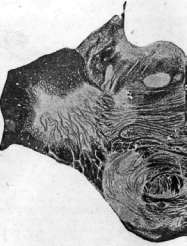
The pathoanatomical changes in multiple sclerosis are extremely characteristic and partly visible even macroscopically: changes in the soft meninges, edema, and in old cases, significant thickening. The spinal cord and brainstem in prolonged cases are narrow/flattened, atrophied. Sometimes through the thickened soft meninges, individual sclerotic plaques are visible, ranging in size from a pinhead to 2-3 cm2. On the cut surface, such plaques are sharply outlined, grayish or gray-red in color, irregular in shape and of dense consistency. Plaques are scattered throughout the central nervous system, but are especially abundant in the spinal cord and large in the brainstem. In the white matter of the hemispheres, in the corpus callosum and around the lateral ventricles, a large number of sclerotic plaques can also be found. Cases are described where plaques were present only in the spinal cord or medulla oblongata or in the cerebellum, but this is a great rarity. Usually plaques are found everywhere and not only in the brain substance, but also in the cranial nerves, spinal roots and comparatively rarely in the peripheral nerve trunks. Plaques are located sometimes in the white, sometimes in the gray matter, and sometimes in both together. True, the number of plaques in the white matter predominates, and in the spinal cord there are more in the lateral columns, closer to the periphery; usually no system or symmetry in the arrangement of plaques can be noted. The contours of individual plaques are sharply demarcated from the surrounding tissue. On microscopic examination, the main feature of the process in multiple sclerosis immediately catches the eye, consisting in the fact that the myelin sheaths of nerve fibers undergo severe destructive changes. Therefore, when staining the preparation for myelin, we get unstained areas of various sizes, having the appearance of bald patches.
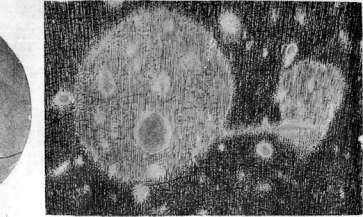
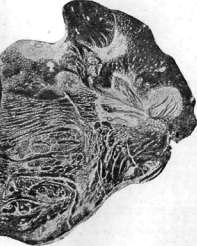
Figure 1. Focus - 'plaque' of multiple sclerosis in the convolutions of the cerebral hemisphere; the focus has captured not only the white matter, but also part of the cortex. Fig. 2. The same focus as in Fig. 1, after staining for myelin (according to Spiel-meyer). Figure 3. Atrophy of the temporal side of the optic nerve papilla in multiple sclerosis (according to Dana). Figure 4. Areas in the pons that have lost myelin in multiple sclerosis. Figure 5. White matter of the cerebral hemisphere; areas that have lost myelin (according to Spiel-meyer).
Thus, in Fig. 4, a whole series of such plaques is visible in the pons, in Fig. 5, two large areas and many small ones located in the white matter of the hemisphere, and in Fig. 1, such a sharply demarcated area has captured the cortex and white matter in the convolutions of the hemisphere. When an area devoid of myelin is stained for fibrous glia, the opposite effect is obtained: in these same plaques, a dense felt of glia that has replaced the myelin is then found. Figure 2 is like a positive to the negative in Fig. 1. Both preparations were made from the same place. The second characteristic feature in the microscopic picture of M.S. is the comparative preservation of the axis cylinders in the plaques themselves despite the death of the myelin. A distinct impression is obtained that the harmful agent affecting the myelin has a special affinity for it, while the axis cylinders, although they swell and sometimes become mottled, usually do not lose their continuity. As a result of this phenomenon, secondary degeneration of nerve fibers is not pronounced and is mainly observed within the lateral columns of the spinal cord. As for the nerve cells located in the area of the plaques, besides weakly expressed degenerative changes in them, nothing else is usually found. The dynamics of the pathological process are extremely important and very characteristic. One can easily distinguish a fresh plaque from an old one on preparations. Cases of so-called acute M.S. have been described, where all plaques developed relatively quickly and the patients soon died. In such fresh plaques, all stages of myelin breakdown with characteristic progressive changes from the glia, whose function in this process consists of removing breakdown products and gradually organizing a glial scar, can be easily detected. In these fresh plaques, there is also a reaction from the mesodermal tissue. Diffuse changes are observed around the plaque, mainly in the perivascular spaces—signs of inflammation with lymphoid infiltration and plasma cells. But in old plaques, where the process can be considered completed, only a sharply demarcated glial scar—plaque with myelin-deprived, thinned axis cylinders passing through it (Dojnikov)—is visible. At this stage, the wall of the blood vessels usually thickens and becomes hyaline. The described pathological-anatomical picture leaves no doubt that in M.S. we have such a chronic, specifically nervous parenchymatous inflammation, in which degenerative phenomena in the form of demyelination of nerve fibers (resp. periaxial process) come to the fore, followed by a developed reaction of the glia. The questions of pathogenesis constitute at present the core of the problem of M.S. From Charcot's view of M.S. as an endogenous disease, primary gliosis, one had to abandon it in connection with the growth of our knowledge about non-specific nervous infections. After the works of Strümpell and Müller, no one any longer speaks of primary endogenous proliferation of glia as the cause of M.S. In 1929, Pette, and in 1932, Rivers distinguished 6 groups of nervous infections and allocated one of them specifically for diseases where the characteristic pathological moment is demyelination of nerve fibers. Rivers included Schilder's disease, acute M.S., and chronic M.S. in this group. It is true that at present the fact of demyelination is no longer pathognomonic for any one form. The overwhelming majority of nervous infections and intoxications are accompanied by similar changes, but the group distinguished by Rivers has as its main and dominant feature the loss of myelin with the relative preservation of axis cylinders. Thus, the isolation of M.S. as a special form due to a demyelinating process supposedly unique to it is incorrect. M.S. has been placed in the series of infectious-toxic nervous processes. It remains to speak of the routes of spread of the infectious-toxic agent in M.S. If the site of application of the harmful agent is primarily the myelin, and the reactions from the glia and mesoderm are only secondary, then how is the harmful agent delivered to the myelin. Pette advocates the route through the circulatory system, Falkiewicz adds transmission through the subarachnoid space, Guillian, Bertrand, and Marinesco thought the same. According to Guillian, the topography of the foci speaks for the favorite spread of infection along the perivascular spaces, subarachnoid spaces (in the spinal cord), and around the ventricles. The fact that changes in the blood vessels usually occur very late seems to speak for extravascular routes. The works of Speransky give reason in M.S. to think of nerve trunks and roots as possible transport lines for infection not only to the center but also in the reverse direction. This may more easily explain the presence of plaques on the cranial and peripheral nerves. Finally, the presence in the cerebrospinal fluid in M.S. of a special lipolytic enzyme acting on myelin (Brickner) also speaks for the extravascular spread of the infectious-toxic agent in M.S.
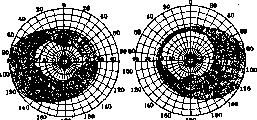
Clinical picture. Intentional tremor, nystagmus, and scanning speech—these are the three symptoms on the basis of which, since Charcot's time, it has become possible to diagnose M.S. without error. But the point is that this 'Charcot's triad' is characteristic only of far-advanced and typical cases of M.S. If we were now to be guided by these requirements, only 10% of M.S. cases would be detected, and the remaining overwhelming mass of undoubted M.S. cases would be missed. Marburg attempted to give a broader formula. His 'triad' sounds as follows: 1) slow onset and slow course, 2) multiplicity of foci and clinical manifestations, and 3) remissions. It is not difficult to see that this formula is indeed broad but lacks specific clinical content. To give a clinical picture of M.S. is not easy, since the abundance and scattered nature of the foci, some that arise quickly and also quickly recede, others that tend to slow and persistent expansion, cause a variety of clinical pictures of the disease. M.S. can imitate any other organic nervous disease. The onset of M.S. in most cases is difficult to detect. Several years pass during which there are a series of purely neurotic complaints: general weakness, headaches, reduced work capacity, emotional lability, and all this persists very stubbornly, even progresses, without visible causes. Objective examination of such patients gives serious organic symptoms: knee reflexes are increased, abdominal reflexes are either completely absent or partially preserved but are weak and quickly fade; a slight nystagmus can be detected. Especially characteristic in the initial stage are lability of the psyche, endless worries about one's neurotic condition, which does not respond to treatment. And only a careful approach to such patients allows one to decipher them as initial cases of M.S. After a sharp external shock in the form of infection or physical or psychic trauma, the disease usually gives a series of new manifestations, sometimes in the form of several epileptic seizures or temporary paraplegia, or transient sensory disturbances in the form of paresthesias and disorders of pelvic organs. Headache, diplopia, and temporary blindness, which can easily be confused with hysterical amaurosis, should be especially noted during this period. All these new manifestations have one basic property—they are not persistent and can quickly disappear. But gradually the main characteristic symptomatology begins to establish itself. Patients complain of rapid fatigue, especially when walking; the arms weaken: patients cannot hold anything in their hands for a long time, the object drops. During this period, the disease resembles myasthenia gravis or intermittent claudication, but the tendon reflexes in the lower extremities are sharply increased, spasticity is clearly expressed, abdominal reflexes are absent, there are cloni and the Babinski reflex. Along with these motor disorders, intentional tremor appears in the form of small increasing oscillations, especially in the fingers of the hands during active movements, for example, in the finger-to-nose test, horizontal nystagmus when looking to the side. Speech also becomes atactic, 'scanning,' i.e., drawn out, broken into separate syllables and letters, and at the same time slightly monotonous and insufficiently modulated. In the initial stages of the disease, there are some disorders of sensitivity (unstable paresthesias), further one can detect disorders of deep and vibratory sensitivity, especially in the lower extremities. From the side of the eyes, changes appear quite early—transient diplopia and amaurosis that lasts two to three weeks and then passes, or a temporary paresis of one of the oculomotor nerves lasting only a few days. The main and persistent changes are found from the side of the fundus of the eye and the visual fields, there is pallor of the temporal halves of the optic disc (Fig. 30) and narrowing of the visual fields (Fig. 6). Both these symptoms are not mandatory for all cases of M.S., but
Figure 6. Drying up of the visual fields in multiple sclerosis. Bilateral atrophy of the optic nerves. (According to Knoblauch.)
The presence of these confirms the diagnosis of M.S. Finally, the psyche in M.S. during this period presents a series of characteristic changes. The general background is neurotic, labile, with very frequent hysterical-type reactions, and involuntary laughter and tears. At the beginning of the disease, when organic symptoms are only discovered through careful objective examination, M.S. patients are long treated for 'neurosis.' Later, patients show deeper mental shifts. A pronounced unfounded euphoria is quite evident, along with a general childishness of interests and behavior.
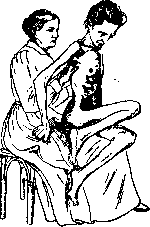
Such are the general outlines of symptom development in M.S. Given that the M.S. plaques are abundant, whimsically located, sometimes undergo regression, but always leave the axis cylinders and ganglion cells untouched, the described symptomatology easily develops. In advanced cases, foci in the anterior lateral columns of the spinal cord produce spasticity. Plaques in the pons and cerebellum produce ataxic components of the disease, while lesions of the optic nerves, chiasm, and cords give ocular disorders. The process may remain for years, and sometimes for a lifetime, in the first stage of the disease. The most common form is the one described above. M.S. here develops slowly, with long pauses and remissions. The third variety is a markedly severe form: spastic paraparesis and even paraplegia (Fig. 7), intention reaching the point where the patient cannot hold a glass of water, cannot eat, cannot do anything due to coarse jerking movements; monotonous, broken into syllables, scanned speech, and mental weakness with obsessive laughter and crying. Such a severe form in all respects occurs in only 10% of all cases. Finally, purely spinal forms of M.S. are encountered, where the entire picture resembles myelitis or a spinal cord tumor due to the plaques being located almost exclusively in the spinal cord. Among other symptoms, we can note among motor disorders epileptiform seizures, myoclonias, and spasms; on the ocular side, ptosis and strabismus have been described; sensory disorders, besides deep and vibratory sensitivity, are usually not severe, nevertheless various anesthesias in the areas of peripheral nerves have been repeatedly observed (Astvatsaturov). Among the sensory cranial nerves, the optic nerve sometimes gives retrobulbar neuritis. Sometimes the cochlear nerve (hearing impairment) and the vestibular nerve (dizziness) are affected, though not deeply; among coordination disorders, ataxia in the lower extremities must be noted. This ataxia causes a spastic-paretic gait and Babinski's asynergy. Intention can reach a severe degree, and then we are no longer talking about tremor, but about a series of swinging, tense, jerking movements in the entire hand when attempting to do something. Finally, mental changes sometimes reach the form of marked infantilism. With such a varied picture, diagnosing M.S. sometimes presents great difficulties, and M.S. can be confused with a whole range of other diseases. Errors here are even today far from rare. In the initial stage of M.S., it is often diagnosed as neurosis. Malaria that has been contracted often leaves behind nystagmus and mild intention and can simulate M.S. (Zalkind). As is known, this gave Sobolev reason to consider the plasmodia of malaria as the causative agent of M.S. Spinal forms are taken for myelitis, then for lateral sclerosis, then for tumors of the spinal cord. Hereditary cerebellar ataxia can proceed as typical M.S. The main support points for diagnosis are the following symptoms: high tendon reflexes in the absence of abdominal reflexes, even hints of intention and nystagmus, and later spasticity in the lower extremities, pallor of the temporal halves of the optic nerve papillae with normal general sensitivity, the chronic nature of the disease course with remissions when seemingly very severe symptoms disappear for months and years. Laboratory investigations so far little help in diagnosis. The cerebrospinal fluid in the vast majority of cases shows no protein or cytological deviations from normal (Wilder), although cases with significant pleocytosis with normal protein reactions have been described (Krol). Guilla considers positive benzoreaction with negative RW as typical for M.S. Krol and Ginzburg note the presence of positive mastic reaction in 75% of all M.S. cases with negative other reactions. But even these methods do not make it possible to diagnose M.S. early, and in later stages the matter is clear even without these complex laboratory investigations, but it is necessary to note the frequency of this dissociation in the fluid in M.S. We have in multiple sclerosis very often positive colloid reactions with all other negative ones. Prognosis. Undoubtedly in a number of cases multiple sclerosis for years remains within the so-called prodromal stage, i.e., the picture of the disease does not go beyond the neurotic state with some barely outlined organic symptoms. These cases perhaps give a considerable number of recoveries and can be interpreted as abortive forms of M.S. Other cases, on the contrary, proceed very rapidly and are separated into a special group 'acute M.S.' Such patients die within one year after a series of apoplectic seizures. Finally, in cases where after the prodromal stage the entire characteristic symptomatology of M.S. imperceptibly establishes itself over 2-3 years, the disease proceeds chronically with long remissions, and the average duration of life of these patients ranges from 10 to 30 years, and they die either from bedsores, cystitis, or from intercurrent diseases. The capacity for work of M.S. patients is severely impaired. Indeed, initial forms in this respect are comparatively more favorable. But even these patients are unstable, unable to withstand systematic strain, often forced to give up work due to severe subjective neurotic condition, but during remissions they work again. Later, spastic parapareses and intention put such patients out of commission for a long time. Such chronic cases need well-organized, adapted to their capabilities work therapy, since these patients mentally degenerate more than any other nervous organic patients. Treatment. For this disease not only is there no specific therapy, but even symptomatic means and measures are questionable in terms of their effectiveness. Relatively recently, salvarsan therapy began to be applied. Since one could think of a spirochete as the causative agent of M.S., salvarsan should have given the so-called group effect. During the last 10 years this experiment has been widely conducted, all preparations from the Ehrlich-Wassermann laboratory have been used, but no one obtained serious results. The successes of malaria therapy for general paralysis could not but cause attempts to treat M.S. with malaria. There is no confirmation of the favorable influence of malaria in M.S. Russian authors were less inclined to try malaria therapy for M.S., and those attempts that were made gave no results. In recent years, in connection with active searches for the causative agent of M.S., a whole series of immune sera have been proposed (Stewart, Lépine-Lavastine), but the matter is only in the initial stage of development. Among other more or less significant attempts to combat M.S., we should mention radiotherapy. Whether this method will give serious results, the future will show. Apart from the mentioned radical attempts, only strengthening measures remain. M.S. patients should avoid physical and mental fatigue. Their life must be strictly regular. Emotional traumas affect them particularly sharply. Of strengthening means, arsenic injections are indicated. Symptomatically, urotropin, iodine, belladonna, and small doses of mercury (Hydr. protojodur in pills) are used. Electrical treatment should be avoided, as well as vigorous water treatment. Resorts attract many M.S. patients, but the benefit they receive there is questionable, and sometimes the effect is directly the opposite. In the face of M.S., the neurologist is essentially powerless to this day. But since, on the one hand, these patients are extremely suggestible, and on the other hand, prone to give remarkable remissions, one can find in the literature references to cases of healing from this or that measures which upon verification are not confirmed (e.g., 'successful' treatment of M.S. by nasal operations). In view of the unclear etiology of the disease, questions of prevention of M.S., both public and personal, are completely undeveloped.
Related articles
Mentioned in
Cite this page
“Multiple Sclerosis.” Soviet Medical Encyclopedia. English translation of Bolshaya Meditsinskaya Entsiklopediya, 1st ed. (Moscow, 1928–1936), ed. N. A. Semashko. https://sovietmedicalencyclopedia.pages.dev/article/multiple-sclerosis/