Impieng
Historical document, translated for reference. It reflects medical knowledge of the 1920s–30s and is not medical advice.
Summary
Impieng is a febrile disease observed in Korea, primarily affecting the impoverished population. The disease is characterized by a sudden onset of high fever, severe muscle pain, and prostration, with a clinical course that resembles relapsing fever but lacks spirochetes.
Encyclopedia article (1928–1936)
IMPIENG (more correctly yempyeng), a specific febrile disease encountered in Korea. Impieng is a seasonal disease, beginning at the end of March or April and ceasing approximately in the middle of July (isolated cases are noted in other months of the year as well). Impieng (first described by Landis and Matignon) affects primarily the poorest strata of the population. The main mass of patients was provided by village residents arriving in Seoul in search of work. Etiology. The disease in Korea is considered highly contagious. In the hospital in Seoul, undoubted cases of nosocomial infection with Impieng were observed. The routes of infection have not yet been established, and the causative agent of this disease is also unknown. Searches for spirochetes in the blood yielded negative results.
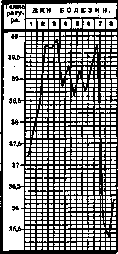
Clinical picture. The incubation period has not been precisely established, but it does not exceed 10 days. The disease usually begins immediately with a headache (primarily in the forehead area) and dull muscle pains throughout the body, especially severe in the area of the back muscles and in the legs. Sometimes at the beginning of the disease, there is slight shivering; the temperature immediately rises to 40° and higher, the pulse is slowed, the skin is dry, the face is pale with an earthy tint; severe weakness appears. To this, anorexia and nosebleeds are often added. By the fifth day of the disease, the patient is already in a state of complete prostration ("falls in a heap on the floor"), the temperature remains high the whole time and only on the 7th or 8th day, during profuse sweating, falls to normal and below (see figure). The pulse, slowed at the beginning of the disease, subsequently becomes accelerated, weak, and thready. In mild cases, the tongue is slightly coated, with the tip and edges remaining free of coating and having a pinkish color; in severe cases, the tongue is covered with a black-brown crust, entirely covered in bleeding cracks; the lips are dry and cracked. Patients exhibit sharply increased thirst. In the febrile period, slight enlargement of the spleen and tension of the abdominal walls in the area of the spleen and liver are noted. In the majority of patients, excitation of the nervous system is noted; consciousness is preserved but suppressed; sometimes there is delirium and finally coma. Rarely, bulbar phenomena are observed. There are no rashes. After the crisis, all symptoms gradually disappear, but the weakness persists for some time. Recovery is usually slow. Among complications, one should note: jaundice, which appears in many patients usually on the second day after the crisis and is especially sharply expressed in individuals who had nosebleeds. Sometimes there is bronchitis, albuminuria, and relatively more rarely, pareses and paralyses. In two cases of Impieng in pregnant women, premature births were observed, with one of the women in labor dying from hemorrhage.
Mortality among Koreans is significant. The cause of death is usually complications: pneumonia, uremia, etc. The disease, as the authors note, resembles relapsing fever. In differential diagnosis, one must base it on the following symptoms: 1) acute onset of the disease, 2) absence of jaundice in the febrile period, 3) characteristic coated tongue, 4) nosebleeds, usually on the 5th-6th day, 5) anemia, 6) absence of relapses, and 7) absence of spirochetes. Treatment. There is no specific treatment. Quinine, opium, pilocarpine, and other preparations did not yield positive results. The authors recommend hot baths and the administration of calomel. In view of the lack of clarity regarding the conditions of infection for this disease and the unknown nature of the causative agent, practical measures for combating it have not yet been developed. However, keeping in mind that this disease affects the poor strata of the population, one of the main measures of control should be a general improvement in sanitary and living conditions.
Related articles
Cite this page
“Impieng.” Soviet Medical Encyclopedia. English translation of Bolshaya Meditsinskaya Entsiklopediya, 1st ed. (Moscow, 1928–1936), ed. N. A. Semashko. https://sovietmedicalencyclopedia.pages.dev/article/impieng/