Clonus
Historical document, translated for reference. It reflects medical knowledge of the 1920s–30s and is not medical advice.
Summary
This article from the 1928–1936 Soviet Medical Encyclopedia describes clonus as rhythmic, rapid contractions of muscles or muscle groups, distinguishing between spontaneous hyperkinesias and those provoked by external stretching. It details various clinical types, such as foot clonus and patellar clonus, noting their significance as indicators of central nervous system and pyramidal tract lesions.
Encyclopedia article (1928–1936)
CLONUS, rhythmic and rapid contractions of a particular muscle or muscle group. A distinction should be made between clonic twitches caused by external stimuli and clonic twitches occurring spontaneously. The latter include, for example, blepharoclonus (clonic twitching of the upper eyelid), clonus of the tongue, and other tic-like twitches in the region of the face, neck muscles, and limb muscles, all kinds of myoclonic twitches, clonic convulsions of a Jacksonian seizure, and clonic convulsions of the second phase of a genuine epileptic seizure. The origin of all these hyperkinesias is quite diverse; they may depend on a lesion of the extrapyramidal system (myoclonic twitches so frequently observed as a result of epidemic encephalitis) and on irritation of the cortex (Jacksonian epilepsy), and they may also have a psychoneurotic origin—pseudoclonuses (especially in the constitution of obsessive-compulsive states). Of great importance to the clinician are clonuses caused by external stimulation, specifically by the rapid, jerky stretching of the corresponding muscles. These include foot clonus, patellar clonus, big toe clonus, hand clonus, and chin clonus. The presence of these clonuses indicates a state of sharply increased reflex excitability and usually the presence of an organic lesion of the central nervous system (pyramidal tract). But it should be borne in mind that phenomena closely mimicking true clonuses can also occur in neuroses. However, such pseudoclonuses are very rare and for the most part can be distinguished from true clonuses
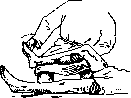
Figure 1. Method of eliciting foot clonus.

Figure 2. Method of eliciting patellar clonus.
by their irregular tempo, lack of rhythmicity, and rapid fatigability. Foot clonus (Figure 1) is elicited by a rapid jerky displacement of the foot in the direction of dorsal flexion and holding it in this position with the application of some force, which should not prevent its clonic twitches. On the other hand, this force should not be too weak either, since the stimulus in that case will not possess sufficient intensity to obtain the reflex. Choosing the proper degree of force is a necessary and not always easily achievable condition for detecting both this and other clonuses. Clonus of the big toe, observed very rarely, is elicited by its dorsal flexion. When eliciting patellar clonus (Figure 2), the patient must lie on their back with legs straightened; the patella is grasped by the examiner's thumb and index finger and jerkily displaced downward. Hand clonus is elicited by its extension, and chin clonus by displacing the chin downward, causing stretching of the masticatory muscles and the appearance of clonic twitches in them.
Related articles
Mentioned in
Cite this page
“Clonus.” Soviet Medical Encyclopedia. English translation of Bolshaya Meditsinskaya Entsiklopediya, 1st ed. (Moscow, 1928–1936), ed. N. A. Semashko. https://sovietmedicalencyclopedia.pages.dev/article/clonus/