Natural Experiment
Historical document, translated for reference. It reflects medical knowledge of the 1920s–30s and is not medical advice.
Summary
The natural experiment is a psychological research method that occupies a middle position between objective observation and laboratory experimentation. It combines natural observation conditions with the precision and scientific rigor of experimentation while preserving the naturalness of human behavior.
Encyclopedia article (1928–1936)
Natural Experiment, as a method of psychological research, occupies an intermediate position between the methods of objective observation and laboratory experiment. It seeks to combine the naturalness of observation conditions with the precision and scientific rigor of experimentation. The natural experiment allows, while preserving the naturalness of human behavior, to study it experimentally, that is, to cause various acts of this behavior at will, varying their conditions or repeating the experience in the same situation several times. The method of natural experiment was first proposed by Prof. A. F. Lazursky of the St. Petersburg Psycho-Neurological Institute in application to children. Lazursky's idea was that each type of a child's school activities is based on a certain functionally related form of behavior (psychological phenomenon, as Lazursky called it). Therefore, on the basis of analyzing a schoolchild's educational activities, it is possible to draw conclusions about his behavior in psychological terms; for example, good or poor memorization and reproduction of a poem indicates good or poor memory of the child; a drawing provides grounds for conclusions about his creativity, etc. Lazursky, together with his colleagues, gave a corresponding functional analysis of the entire school day's activities, selected the most typical tasks from them, brought them into a system, and thus organized an experiment, calling it natural on the grounds that it takes place in the natural conditions of children's school life. However, Lazursky did not have the opportunity to fully develop the methodological side of the natural experiment. To the same extent, the materials of the experiment were developed by him in relation to the pre-revolutionary school. Therefore, in his version, this method has become significantly outdated by the present time. A continuer of Lazursky's work was V. A. Artemov, who gave a fully developed methodology of the natural experiment applicable to the modern labor school. According to Artemov, the natural experiment is conducted in the following types of school work: 1) eating processes (for closed institutions); 2) games and gymnastic exercises; 3) meetings, rallies and various celebrations; 4) processes of pictorial and graphic drawing; 5) various types of manual labor; 6) processes of memorization and reproduction; 7) solving mathematical problems; 8) writing compositions; 9) oral storytelling; 10) analysis of a read or heard story; 11) natural science; 12) social science. - In these activities, the following forms of behavior are studied: 1) instincts, 2) emotional reactions, 3) motor skills, 4) setting and inhibition, 5) formation of conditional connections of reactions and their reproduction, 6) thinking, 7) creative processing of experience. A total of forty different forms of behavior are examined. - The material for the experiment is compiled on the basis of the programs of the People's Commissariat of Education. It has two variants for each school group - urban and rural, each of which in turn is divided into two editions (one for the beginning of the school year, the other for the end). Like any experiment, the natural experiment has three stages of its implementation: preparation for the experiment, its conduct, and processing of the results obtained. - Preparation for the experiment consists in preparing the appropriate premises and materials for the experiment. - The conduct of the experiment consists in offering children experimental tasks and registering their behavior. The latter is carried out using a special protocol, which subsequently serves as the basis for processing the results of the experiment. Registration and processing are carried out using five
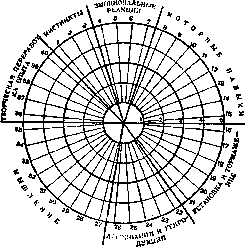
special stages of development of various forms of behavior. - Processing of results consists in attributing forms of behavior, on the basis of the results of the experiment and observation, to the corresponding stage of development. The final results of the experiment are entered on
a special graph, the so-called "star" (see figure). In the presented version, the natural experiment has typological tasks. The type of behavior of a schoolchild is determined by finding the following values: 1) structural combination of individual forms of behavior; 2) the "total area" of talent as a relation to the conditional average development of this group; 3) D-values as the difference between the maximum and minimum development of individual forms of behavior; 4) dynamics of development per unit of time (development coefficient). It should be borne in mind that the natural experiment is applicable to the study of any area of behavior of an individual and a collective. From this point of view, the natural experiment is of particular interest to a physician, since it is possible, based on the type described, to propose a special edition of the natural experiment for various cases of clinical study of the behavior of patients, in relation to which ordinary observation is insufficient, and laboratory experiment is impossible. In recent times, there have been a number of new methodological attempts in German holistic psychology, so-called Gestalt psychology, some of which correspond to a certain extent to the natural experiment.
Related articles
Mentioned in
Cite this page
“Natural Experiment.” Soviet Medical Encyclopedia. English translation of Bolshaya Meditsinskaya Entsiklopediya, 1st ed. (Moscow, 1928–1936), ed. N. A. Semashko. https://sovietmedicalencyclopedia.pages.dev/article/natural-experiment/