Natural Selection and Natural Experiment
Historical document, translated for reference. It reflects medical knowledge of the 1920s–30s and is not medical advice.
Summary
This entry from the 1928–1936 Soviet Great Medical Encyclopedia defines natural selection as the Darwinian mechanism of evolutionary adaptation through variation, heredity, and the struggle for existence. It also defines the natural experiment as a psychological research method that bridges objective observation and laboratory experimentation by studying behavior in natural settings.
Encyclopedia article (1928–1936)
NATURAL SELECTION, or selection, is a process occurring in nature as a result of the combined action of three factors: variability, heredity, and the struggle for existence (see), a process through which, according to Darwin's theory, the evolution of organic forms takes place in the direction of their greatest adaptation to the environment. Darwin arrived at the theory of natural selection by analyzing the method by which man has bred domestic animals and cultivated plants that are useful to him or serve for his pleasure. By gathering information from knowledgeable breeders and gardeners and by conducting his own experiments and observations, Darwin became convinced that the key to explaining the origin of breeds lies in man's power to produce artificial selection among them. The possibility of selection lies, in his opinion, in the phenomena of variability, in the fact that the descendants of the same parents differ from each other by personal peculiarities inherent to them. Consciously, and even more often unconsciously, man preserved and saved, leaving for breeding or seed, only those individuals that were distinguished by their useful qualities needed by man and that subsequently transmitted their qualities to their offspring by virtue of heredity. Darwin applied this principle of selection to wild animals and plants living in freedom. But what can replace the selecting human? How can one explain that in nature organisms are often distinguished by extraordinary adaptation to surrounding conditions, by a purposiveness of organization, which was previously explained by definite goals in the creation of organisms? Darwin found the resolution to the question in the factor of the "struggle for existence," which is a logical consequence of the excess of offspring born into the world over the number of parents who gave them life (the so-called "multiplication in geometric progression"). Thus, the change of organisms in nature, especially in the direction of adaptation to the environment, was and is accomplished, according to Darwin, in the following way. Since the children of the same parents differ from each other by various peculiarities, then in competition, in the struggle for life (and this competition inevitably arises by virtue of the excessively large number of births), only the most adapted forms are preserved, i.e., children distinguished by qualities more advantageous in the struggle for existence. By virtue of heredity, they transmit these qualities to their children. But in the following generations, new differences again arise among the descendants by virtue of variability; again the struggle for existence preserves the most adapted forms, which transmit their improved qualities to the offspring, and so on. Thus, through the slow and imperceptible accumulation of small changes, organisms are perfected and adapted. Darwin called this combined action of the principles of variability, the struggle for existence, and heredity natural selection. Thus, the history of changes, or the evolution of organisms, is explained not by "final causes" or "final goals," not by supernatural intervention, but by a chain of causal connections. In Darwin's opinion, the struggle for existence is especially strong among closely related forms. Rivalry is the stronger, the more similarity there is in the way of life and properties of the rivals. Conversely, rivalry weakens with the acquisition of new and different peculiarities. Let us take an example: if wolves in some locality feed on deer and sheep, chasing after them, and if to catch a deer requires special speed, and to kill a sheep requires special strength, then the wolves that are especially fast and the wolves that are especially strong will win in the struggle for existence. The greater the speed of some wolves, the more they will be able to specialize in catching deer, and the greater the strength of others, the more these others will be able to specialize in sheep. All forms of wolves that possess neither special speed nor special strength will not be preserved in the struggle for life and will die out. Between the two remaining extreme groups (fast and strong), competition will weaken, because each of these groups will switch to a special food. And the less rivalry there will be, the more sharply the extreme forms will differ from each other. This is how Darwin imagined the origin first of varieties, and then from varieties—species. Darwin called this conclusion of his theory the principle of "divergence of character and extinction of intermediate forms." Average forms, in Darwin's opinion, are in worse conditions in nature. Only extremes are preserved, specializing in some respect and thereby reducing competition in the struggle for life. The more diverse the descendants of any species are, the more they differ among themselves in habits, structure, and general constitution, the greater the number of places in nature they will win. Darwin applies this principle—divergence of character—not only to species belonging to one genus and originating, in his opinion, from some extinct species due to the intensification of the difference between its varieties, but also to the origin of larger subdivisions of the animal and plant kingdoms (genera, families, orders, etc.) from corresponding smaller ones (from species, genera, families). The theory of natural selection has been repeatedly subjected to criticism. The most important objections are as follows. Kölliker, Wigand, Spencer, Bateson, and many others pointed out that insignificant changes, not representing any essential advantages for an animal or plant, cannot be used by selection. Therefore, selection cannot influence their strengthening. Selection also does not explain the emergence of many organs, since the initial stages of the development of these organs are completely useless. Darwinists rightly object to this that for selection, it is often not the magnitude of the variation that matters, but the role that this variation plays in the life of the species. They also point to critical moments in the life of a species when even small deviations can play a large role. Finally, they point out that a trait that is initially indifferent can develop by virtue of correlation (see) in parallel with the development of a useful trait, until it acquires dimensions sufficient to prove useful to the species and be subject to the action of selection. The second objection, that it is never possible in individual cases to prove selection in detail, because the struggle for existence is too complex a phenomenon, also does not refute the theory, because the latter is derived deductively from the phenomena of geometric progression of reproduction, variability, and heredity, and does not rely on traced cases of its application (see Struggle for existence). Lit.—see lit. to the article Darwinism. A. Nekrasov. NATURAL EXPERIMENT, as a method of psychological research, occupies an intermediate position between the methods of objective observation and laboratory experiment. It seeks to combine the naturalness of observation conditions with the precision and scientific nature of an experiment. The natural experiment allows, while preserving the naturalness of human behavior, to study it experimentally, i.e., to evoke at will various acts of this behavior, varying their conditions or repeating the experiment in the same situation several times. The method of the natural experiment was first proposed by Prof. A. F. Lazursky of the St. Petersburg Psycho-Neurological Institute in relation to children. Lazursky's idea was that every type of a child's school activity has at its base a certain functionally related form of behavior (a psychic phenomenon, as Lazursky said). Therefore, on the basis of an analysis of a schoolchild's pedagogical activities, it is possible to draw conclusions about his behavior in psychological terms; e.g., good or bad memorization and reproduction of a poem indicates the good or bad memory of the child; a drawing provides grounds for a conclusion about his creativity, etc. Lazursky, together with his collaborators, provided a corresponding functional analysis of the entire day of school activities, selected the most typical tasks from them, organized them into a system, and thus organized an experiment, calling it natural on the grounds that it takes place in the natural conditions of the school life of children. However, Lazursky did not have the opportunity to fully formalize the methodological side of the natural experiment. Equally, the materials of the experiment were developed by him in relation to the pre-revolutionary school. Therefore, in his version, this method is now significantly outdated. A successor to Lazursky's work was V. A. Artemov, who provided a fully developed methodology of the natural experiment in relation to the modern labor school. According to Artemov, the natural experiment is conducted on the following types of school work: 1) eating processes (for closed institutions); 2) games and gymnastic exercises; 3) meetings, rallies, and all kinds of holidays; 4) processes of pictorial and graphic drawing; 5) various types of manual labor; 6) processes of memorization and reproduction; 7) solving mathematical problems; 8) writing essays; 9) oral storytelling; 10) analysis of a read or heard story; 11) natural science; 12) social studies. In these activities, the following forms of behavior are investigated: 1) instincts, 2) emotional reactions, 3) motor skills, 4) set and inhibition, 5) formation of conditioned connections of reactions and their reproduction, 6) thinking, 7) creative processing of experience. V. Artemov.
In total, forty different forms of behavior are examined. The material for the experiment is compiled on the basis of the programs of the State Scientific Council. It has two variants for each school group—urban and rural, each of which in turn is divided into two editions (one for the beginning of the school year, the other for the end). Like any experiment, the natural experiment has three stages of its implementation: preparation for the experiment, its conduct, and the processing of the obtained results. Preparation for the experiment consists in preparing the appropriate premises and materials for the experiment. Conducting the experiment consists in proposing experimental tasks to the children and registering their behavior. The latter is carried out with the help of a special protocol, which subsequently serves as the basis for processing the results of the experiment. Registration and processing are carried out with the help of five
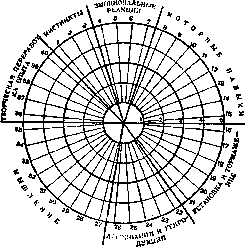
special stages of development of various forms of behavior. Processing of the results consists in assigning forms of behavior, on the basis of the results of the experiment and observation, to the corresponding stage of development. The final results of the experiment are entered onto
a special graph, the so-called 'star' (see figure). In the described edition, the natural experiment has typological tasks. The type of behavior of a schoolchild is determined by finding the following values: 1) the structural combination of individual forms of behavior; 2) the 'total area' of giftedness as a ratio to the conditional average development of a given group; 3) the D-value as the difference between the maximum and minimum development of individual forms of behavior; 4) the dynamics of development per unit of time (coefficient of development). It should be borne in mind that the natural experiment is applicable to the study of any area of behavior of an individual and a collective. From this point of view, the natural experiment is especially interesting to a physician, since it is possible, according to the type described, to propose a special edition of the natural experiment for various cases of clinical study of the behavior of patients, in relation to whom ordinary observation is insufficient, and a laboratory experiment is impossible. Recently, there has been a whole series of new methodological attempts in German holistic psychology, the so-called Gestaltpsychologie, some of which to a certain extent correspond to the natural experiment.
Related articles
Mentioned in
Cite this page
“Natural Selection and Natural Experiment.” Soviet Medical Encyclopedia. English translation of Bolshaya Meditsinskaya Entsiklopediya, 1st ed. (Moscow, 1928–1936), ed. N. A. Semashko. https://sovietmedicalencyclopedia.pages.dev/article/natural-selection-and-natural-experiment/