Oil
Historical document, translated for reference. It reflects medical knowledge of the 1920s–30s and is not medical advice.
Summary
This article provides a comprehensive classification of oils, focusing primarily on edible fatty oils of plant and animal origin. It details their chemical composition, production methods, refining processes, and factors affecting quality and spoilage.
Encyclopedia article (1928–1936)
Oil. The term O. denotes products of the most diverse composition: fatty oils (fats) of plant and animal origin, essential oils, mineral oils, and products having nothing in common with oils, such as copperas oil and others. Only fatty oils, which have primarily food value, will be considered here. Properly speaking, fatty oils are fats that have a liquid consistency at 15°, while properly speaking, fats are products that have a solid or semi-solid consistency at this temperature. However, this division has exceptions and cannot claim perfection. In Russian and foreign literature, the double, 'joint' terminology ('fats and oils') is more often used. At present, the following classification of oils is usually used, based on the technical principle of Ubbelohde.-1. Plant oils (phytosterin-containing fats). A. Liquid oils: a) non-drying oils with a high content of oleic acid and a low content of saturated acids; iodine number below 100; these include olive, almond, and peanut oil; b) oils containing ricinoleic acid with a high content of unsaturated hydroxy acids, for example castor oil; c) slightly drying oils (cruciferous); iodine number about 100; contain erucic and oleic acids; d) semi-drying oils with a relatively significant content of linoleic acid in the presence of oleic and oxyoleic acids; iodine number close to 130 (corn oil, as well as sesame and cottonseed oil); e) drying oils containing unsaturated acids: linolenic, linoleic, iso-linolenic, and eleostearic acids, with correspondingly high iodine numbers (hemp oil -157-166, linseed oil -171-190). B. Solid oils (fats): a) with a high content of stearin and glycerides of non-volatile acids [Japanese wax (more correctly not wax but fat) and nutmeg oil]; b) with a noticeable content of glycerides of volatile acids (coconut oil, palm kernel oil).- 2. Animal oils- (fats). A. Liquid oils (fats): a) oils from terrestrial animals with predominantly oleic acid (horse hoof fat, bone oil, liquid pork and beef tallow), with solid glycerides removed and with an iodine number below 80; b) oils from marine animals (mostly called blubbers); contain unsaturated acids (clupanodonic, therapeutic acids, etc.). They are divided into 1) liver fats, which contain significant amounts of cholesterol and other components of bile; these include cod liver oil, shark liver oil (see Fish oil); 2) fats containing few solid glycerides and less cholesterol than liver fats (whale, seal fats). B. Solid oils (fats): a) rich in stearin (beef, mutton tallow); b) fats with volatile acids (butter oil, etc.). Synthetic fats must be singled out into a separate group, which includes a) hydrogenated oils and b) synthetic fats in the narrow sense.- Much less frequently for the classification of oils and fats are used a) the principle of chemical composition, b) the principle of the degree of drying of oils, c) the principle of natural classification of plant oils (Ivanov). Plant oils are obtained mainly from oilseeds, as well as from the pulp of fruits, embryos of seeds, and other parts of plants (roots, bulbs, tubers, stems, etc.) by pressing or extraction (see Oil production). Plant oils are most often liquid in consistency: the exception is solid oils of tropical countries (coconut, palm kernel, etc.); they consist mainly of simple glycerides of oleic, linolenic, and linoleic acids, as well as palmitic and stearic acids; in individual oils, in addition, their specific fatty acids are found: in coconut oil - caproic, caprylic, and capric acids, in peanut oil - arachidic and lignoceric acids, in mustard oil, in oil from grape seeds - erucic acid. In addition to bound fatty acids, free fatty acids are also found in oils. Besides glycerides, oils contain so-called unsaponifiable substances. The latter include higher alcohols of the aromatic series (sterols), coloring and fragrant substances that determine the specific odor and taste of certain oils. Due to insufficient purification, plant oils often contain some amount of protein and pectin substances, resins, carbohydrates, mineral substances, and moisture. Of the sterols, phytosterin (C27H46O) is best known, which occurs in all plant oils (0.2-1.2%). Among the coloring substances, chlorophyll, carotenoids, and others are found. The nature of the fragrant substances is not established with sufficient accuracy; very small amounts of essential oils are found in some plant oils. Protein and other organic and mineral substances and water, forming the so-called 'slime', can be found even in completely transparent oils. The content of 'slime' increases in oils made from immature and moist seeds.-The qualitative and quantitative chemical composition of oils changes depending on the type of oil plant, geographical growing conditions, conditions of raw material collection, technical production, storage, transportation, etc. Oil obtained from seeds is not yet a finished product and must undergo refining. Oil refining is a set of production processes leading to the elimination of cloudiness, sediment, removal of free acids, improvement of the organoleptic properties of the oil, achievement of transparency, weakening of the intensity of coloration, achievement of a pleasant odor and taste. It increases the stability of the oil during storage. Refining is mandatory for food oils obtained by extraction. Foreign food oils are released to the market only after appropriate purification and refining; in the USSR at present the overwhelming majority of food oils are not refined. In some years (for example in 1926-27) the quality of vegetable oil (sunflower) sold in the USSR was so low that it was often unfit for food (significant cloudiness, sediment, moldiness, rancid taste, etc.). Oil refining includes the following methods: a) settling, b) filtration, c) washing the oil to remove soluble protein, pectin, and mucilaginous substances, sometimes associated with the addition of coagulants, d) dehydration, e) cooling to a low temperature. Sometimes also used are a) saponification of free acids with alkalis or their distillation, b) treatment with H2SO4, K2CO3 or Na2CO3, steam, c) bleaching. Refined oils are used as so-called table, salad oils for canning, perfumery, margarine industries, as well as for the production of hydrogenated oils. It should be noted that in the refining of food oils, chemical means are used relatively rarely (except for cotton, bean, etc.); refined oils must be carefully freed from any traces of chemical substances and soaps. The following plant oils are used for food consumption: sunflower, hemp, linseed, bean, mustard, rapeseed, peanut, sesame, camelina, poppy, corn, olive, coconut, palm kernel, cocoa.-Some plant oils have poisonous properties.-Oils from seeds of the Euphorbiaceae family: oil from the purging nut (not used for food) contains the poisonous toxalbumin-curcin. Croton oil is also poisonous, as well as a number of oils from seeds of cruciferous plants (oil from seeds of wild radish, watercress, black and white mustard) and others. The harmful effect of some oils, for example from cruciferous seeds, is destroyed by heating to a high temperature or by steam treatment, as well as by thorough refining. Spoilage of plant oils is caused by physico-chemical as well as biological factors: the former include light and O2 of the air, the latter include enzymes (lipase), molds and bacteria (see Fats). Biological factors exert their unfavorable effect on oils mainly in cases of insufficient purification and the presence of impurities (water, organic substances, etc.). According to research by the Moscow Sanitary Institute (1926-27) in 1 cm3 of plant oils, from 300 to 22,000 colonies of bacteria were found; in 3 samples, molds were detected.-Contamination of oils can occur during pressing, extraction, careless refining (sand, oilseed meals, solvents-gasoline, etc., mineral acids, etc.).-Falsification of oils concerns only the most valuable oils and consists in replacing or adding foreign, cheaper oils, adding mineral oils (rarely, coloring with copper salts and coal dyes. To prevent spoilage and contamination, oils should be stored, transported, and sold in clean and completely dry tanks or in iron cans, drums, and canisters, as well as in barrels of oak, beech, and aspen staves or in transparent glassware. Wooden barrels should be enameled, and the enamel should be thoroughly dried. The temp.
The temperature of oil during pouring and storage should not exceed 25° to avoid dissolving the enamel. The sale of vegetable oil is subject to general sanitary requirements applicable to the trade of food products; the most sanitary method is the dispensing of vegetable oil in original glass containers or from special oil dispensing tanks; dispensing oil from barrels with hand pumps should be avoided. Vegetable oils used for food must be edible, clean, free from foreign impurities and contaminants, and must be obtained from high-quality and mature seeds; the conditions and technology of production must meet the general sanitary requirements applicable to enterprises manufacturing food products. Cleaning and washing of barrels, oil pipelines, and oil storage facilities must be accompanied by scalding with saturated steam; all measures must be taken to protect oil tanks, tanks, and pipes from contamination; the cleanliness of premises, steam coils (for warming solidified oils), and sampling probes must be ensured; for personnel in oil storage facilities, clean smocks and special footwear must be available. The nutritional value of vegetable oils (see Fats), their digestibility is not inferior to that of butter, and their caloric value is even higher: 100 g of vegetable oil correspond to 925 calories, while 100 g of cow's butter correspond to 785 calories (Schall). Lipovitamins A and D are found in vegetable oil in small quantities or are completely absent; Lipovitamin E is found in corn oil (obtained from corn germ), palm oil, cottonseed oil, and oil from wheat grains; linseed, coconut, sesame, mustard, and almond oils are poor in vitamin E (Sure). Hydrogenated oils are solid fats at ordinary temperatures, obtained from liquid oils by catalytic hydrogenation, in which hydrogen is added to unsaturated (liquid) acids, as a result of which liquid glycerides are converted into solid ones. The process can be expressed as follows: C3H3(C18H33O2)3 (triolein) + 3H2 = C3H5(C18H35O2)3 (tristearin), or C3H5(C18H31O2)3 (triglyceride of linolenic acid) + 6H2 = C3H5(C18H35O2)3 (tristearin), etc. However, the course of the reaction is not so elementary—isomers of oleic acid are also formed: elaidic and isooleic acids, etc. The technology of the hydrogenation process is as follows: the pre-refined oil is heated in a boiler or directly in the hydrogenation apparatus (autoclaves) to a temperature above 140° (160-180° and 250°) and then mixed with a catalyst, usually nickel, prepared in a special way (freshly reduced metal nickel, finely distributed in particles of infusorial earth and ground in the oil to be hydrogenated) and added in an amount of 0.2-0.5%. Through the apparatus filled with oil and catalyst, a stream of hydrogen, usually obtained from water gas in special gas generators, is passed under pressure of several atmospheres. Samples of oil are taken from time to time to determine the degree and course of hydrogenation. After obtaining the desired degree of oil solidification, hydrogenation is stopped and the oil is pumped into special tanks to remove the catalyst impurity, which is achieved by settling and subsequent filtration of the oil or centrifuging, treatment with Fuller's earth, etc. The duration of hydrogenation is 2-6 hours. Hydrogenated oils are used for the needs of soap-making, candle-making, margarine industries, etc. It should be noted that hydrogenated oils have greater stability during storage. Hydrogenation causes a significant change in the structure of the fat molecule, converting oil into a fat product that differs not only in its physicochemical but also physiological properties (for example, after hydrogenation, the strong laxative effect of castor oil and the toxicity of croton oil, due to their content of ricinoleic and crotonoleic acids, disappear). The specific weight increases compared to the original oil; refraction decreases, acidity does not change, the saponification number slightly decreases, the Reichert-Meissl number does not change, the iodine number decreases and can be brought to 0. The color reactions of vegetable oils (Halphen, Belier, etc.), after hydrogenation, often disappear or are altered. Phytosterol and cholesterol do not change. Insufficiently purified hydrogenated oils often contain nickel; in food oils, nickel content is found in quantities from 0.01 mg to 6 mg per 1 kg. Its quantity increases from improper filtration and when the original oil contains free fatty acids. Food hydrogenated oils must have satisfactory organoleptic properties; they must not contain nickel [negligible traces of Ni are permissible (not more than 0.5 mg per 1 kg of sample)]; their melting point must not be higher than 36° and acidity not higher than 1° Kötstorfer. The digestibility of hydrogenated oils is not inferior to that of vegetable oils and generally depends on the melting point, averaging about 95-97%. During hydrogenation of oils, lipovitamins are destroyed. When mixing certain hydrogenated oils with fats containing vitamin A (butter, fish oil), the latter is significantly inactivated (Fridericia, Sjorslev). Synthetic fats have almost no practical application at present. During the war in Germany, glycol esters of fatty acids were prepared and introduced into margarin in amounts of 2-10%. Their digestibility (if they are present in the fat mixture in no more than 50% relative to all fats) is almost 90% (Franck). In recent years, methods have been proposed for obtaining anhydrides of fatty acids to replace fats; it has also been possible to obtain higher fatty acids from paraffin, etc. Cow's oil is obtained from the fat of cow's milk by churning cream or sour cream (rarely milk). By its origin and method of preparation, cow's oil is divided into oil from unfermented cream (butter or sweet cream butter) and oil from fermented cream ('export' and 'Holstein'), oil from pasteurized and oil from unpasteurized cream. Depending on salting, all these types of oil are divided into salted and unsalted oil. Whey butter is prepared from the cream separated from whey remaining in cheese production. This variety is rarely found in sale; it is not very stable during storage. Rendered oil (Russian, Siberian) is cow's oil prepared by rendering fat from sour cream or butter; it is almost pure milk fat (98-99.5%). Renewed oil ('renovated butter', 'Process-butter', etc.) is a product of processing rancid old, sometimes spoiled, butter into 'fresh', edible butter. There are a number of methods for preparing this type of oil, from the simplest (washing with water, lime water with subsequent removal of lime soap, salt solution and milk) to more complex ones [defective butter is melted, settled to remove salt, casein, etc., vaporized or aerated, churned with milk and cooled with ice water, resulting in butter similar to butter, subjected to the same processing methods (pressing, salting and packaging)]. The composition of 'renewed' oil does not differ significantly from butter; their physical properties are different: when melted, the curd particles formed are uniform and not grainy, in 'renewed' oil they are grainy and fluffy; when frying, oil foams calmly, 'renewed' oil splashes in spurts; in melted form, oil is transparent, 'renewed' oil is not transparent (at moderate temperature). 'Renewed' oil abroad is often used for falsification (mainly in the USA) of fresh butter. Blend (English blend - mixing different varieties of goods) is butter prepared by mixing (in special apparatuses) different varieties of butter to obtain a product homogeneous in its organoleptic and other characteristics, corresponding to certain retail trade brands. This type of oil processing for retail trade is common in England, Germany, Denmark, France, etc. In the USSR, 'renewed' oil and 'blend' are not found in sale. Butter at 18° consists of unmelted milk fat, which is a connected mass of the smallest fat globules and the impurities of skimmed milk (so-called buttermilk) distributed in it in the finest and most uniform manner. The composition of butter: 82-85% milk fat, 0.5-1.0% milk sugar, 0.6-0.7% protein substances, 0.2% mineral substances and 12-15% water. The properties and chemical composition of butter are not constant depending on the methods of production, subsequent processing, feed of cows, care for them, and probably also on the age and breed of the latter, etc. Milk fat contains (Crowther and Hynd) butyric acid-4.27%, caproic acid-1.64%, caprylic acid-1.16%, capric acid-1.19%, lauric acid-5.01%, myristic acid-16.43%, palmitic acid-14.83%, stearic acid-3.40%, dihydroxystearic acid-0.38%, oleic acid-44.42%.
The high content of volatile and water-soluble fatty acids (8-9%), as well as the fact that all other animal fats and most vegetable fats contain mainly palmitin, stearin, and olein, forms the basis of laboratory methods for identifying milk fat and for detecting the adulteration of the latter with foreign fats. The constants of milk fat, based on its characteristic complex composition, vary within rather wide limits, which is explained by the variability of the composition of cow's oil. The most characteristic constants for milk fat-see Fats. Under ordinary conditions of sanitary-chemical control of cow's oil, with familiarity with the physicochemical properties of the oil usually available on the local market, the constants provide the laboratory worker and sanitary physician more or less reliable data for judging the purity of the oil. The arithmetic difference between the Reichert-Meissl number and the saponification number is called the Hehner number, and for milk fats it is close to 200. Milk fat differs from others not only in its peculiar chemical composition but also in taste, digestibility, and assimilability. Butter oil contains a significant amount of lipovitamin A and a small amount of lipovitamin D; compared with other dairy products as well as with animal fats (except liver fats), its vitamin A content is the highest. Vitamins B and C are present in cow's oil in negligible amounts or are absent; vitamin E is present in small amounts. The vitamin A content varies with the seasons: it has been proven that summer oil (more or less yellow in its natural, uncolored state) contains more vitamin A than oil from winter supplies. The reason is that cows in summer feed on fresh pasture feed rich in vitamin A, while in winter they feed on dry feed in which the vitamin A content is significantly reduced. The vitamin A content in clarified oil, as well as in 'renewed' oil, is significantly reduced due to vigorous oxidative and thermal processes associated with remelting, aeration, vaporization, etc. The presence of vitamin D can be increased in oil by exposing cows or milk to ultraviolet rays. The presence of other components in oil (not fat) plays a minor role in the nutritional evaluation of cow's oil, but from the standpoint of economic and sanitary interests, their significance is more serious. Residual buttermilk in the oil largely determines the smell and taste of butter oil and at the same time provides a favorable medium for the development of microorganisms. As for the quantity and type of microorganisms in oil, the main role is played by the properties of the raw material-milk and cream (raw, pasteurized, nature of the starter); then the conditions of production, packaging, etc., are also important. The number of microbes in commercial oil varies within very wide limits: between tens of thousands and tens of millions per 1 g, and generally depends on the age of the oil: in sweet cream butter, the number of microorganisms increases during the first period and then gradually decreases, while in oil from soured cream, the initial, rather large number of microbes does not increase but gradually decreases. In long-stored and spoiled oil, the bacterial population becomes negligible or even absent. Fresh sweet cream butter has the same microflora as milk (see); when stored at low temperatures, water bacteria (Bac. fluorescens, Bac. liquefaciens, Bac. aquatilis communis, etc.) that get into the oil during washing usually develop; when stored at room temperature, lactic acid bacteria of the Bac. lactis acidi Leichmann type develop; these are later replaced by other lactic acid rods and simultaneously yeasts and molds (Torula forms, Oidium lactis, Penicillium glaucum, Mucor mucedo, Cladosporium butyri, etc.).-Oil from soured cream initially has almost a pure culture of Bac. lactis acidi, and then the above-mentioned yeasts and molds also develop in it. In general, during storage of oil, a gradual dying out of the lactic acid microflora and an increase in microflora consisting of various non-spore-forming rods, yeasts, molds, etc., are observed; the moment of equalization of these groups approximately coincides with the appearance of the first signs of spoilage.-The flora of clarified oil consists of molds, accidental yeasts, and aerobic bacilli that have come from the air, especially Bac. subtilis and anthracoid bacilli. Depending on the type of oil being prepared, the significance of microorganisms for the process of manufacturing and storing oil varies: for sweet cream butters, all types of microorganisms mostly play a negative role, especially during storage; for oils prepared from soured cream, Bac. lactis acidi Leichmann and lactic acid streptococci are necessary production elements; the latter influence the increase in oil yield, the obtaining of the aroma and taste characteristic of these types of oil, and a certain increase in the stability of oil during storage due to the presence of biological antagonism with some, mostly harmful to oil, microbes. All other microbes, and especially mold fungi, reduce the quality of oil, causing more or less early spoilage of it.-The fight against mold damage to oil is an urgent problem of the dairy industry of the USSR. In 1926 and 1927, mold damage to oil caused great damage to our butter export. Similar 'mold epidemics' of oil were experienced in the USA in 1916-17 and in Denmark in 1920. Deficiencies in butter-making technology, poor equipment, sanitary shortcomings in premises and production are the main causes of defective oil, including moldiness. Based on the experience of the USA, Denmark, and research by Russian authors, it can be assumed that contamination of oil from the air is negligible; the main source of mold contamination is apparently milk, utensils, equipment, and often water, then unsatisfactory storage conditions for oil (high temperature and relative humidity) and horse-drawn transport; in moldiness, the packaging (hoops), parchment, and mold-contaminated salt also play a role. Biological as well as photochemical factors are the causes of the normal course of changes in oil during its storage, called 'spoilage' of oil, and accidental changes called 'defects' of oil. Spoilage of oil can manifest in the direction of: 1) increased acidity, 2) rancidity, and 3) salting of oil. All these processes are not sufficiently well studied. The increase in acidity of oil may depend on the increase in lactic acid and the cleavage of fatty acids due to the activity of bacteria. The latter are the cause of further breakdown of fatty acids and glycerol with the formation of products of their dissociation (aldehydes, ketones, oxyacids), which cause rancidity of oil ('rancid' smell and taste). Rancidity is not necessarily associated with increased acidity. Fluorescent bacteria (psychrophiles-Bac. fluorescens, B. putidus) and molds (Oidium lactis, Cladosporium butyri, Penicillium glaucum) are considered responsible for the rancidity of oil. Other authors (Haag) believe that microorganisms do not directly participate in the formation of rancidity.-Salting of oil consists in the oxidation of unsaturated fatty acids; when oil is salted, it whitens, and its smell and taste resemble stearin; the cause of salting is the action of light and oxygen of the air. Traces of iron or copper in oil can also cause similar salting phenomena.-The putrid taste of oil depends on the infection of oil with putrefactive microflora (some species of manure bacteria, proteolytic bacteria, fluorescents, etc.), which is facilitated by infected milk, cream, poor-quality water, and unsatisfactory production conditions. The 'bitter' (not rancid) taste of oil is caused by various reasons: bitter and spoiled feed, rusty utensils, salt with a high content of magnesium salts, cream affected by molds and wild yeasts or obtained from milk of cows with streptococcal mastitis, development of bacteria from the intestinal, potato, butter acid, and other groups. The appearance of these bacteria is a clear indicator of poor quality of the raw material and unsanitary production conditions.-The fishy taste of oil is also mainly the result of sanitary-hygienic defects in production and microbial contamination of the raw products. Other defects of oil that significantly spoil its appearance, smell, and taste-staleness, spotted greenish oil-are mostly caused by various mold fungi. The epidemiological significance of oil is determined by the possibility of pathogenic microbes passing into the oil, although oil is not such a favorable environment for them as the raw material-milk and cream. The typhoid bacillus can live in oil for 24-26 days, the paratyphoid bacillus for 33 days, the cholera vibrio for 20-35 days, the dysentery bacillus for 9 days, the coccus of Malta fever for up to 21 days, and the tuberculosis bacillus for 1-3 months. Petri, when examining 102 samples of oil in Berlin, found tuberculosis bacilli in 32.2%. Separated milk and buttermilk in the preparation of oil from infected material also contain pathogenic microbes [experiments with typhoid bacilli (Brack, Washburn, Rowland); an epidemic of typhoid fever in a suburb of Hamburg due to the consumption of infected buttermilk].--The bacteriological method of hygienic evaluation of a food product by the number of microorganisms, often used for milk, is still considered an open question for oil by some authors.
Some (Masu, Hood, and White) proposed evaluating oil based on the content of mold and also yeast fungi. Apparently, more practical are the proposals to introduce standards for bacterial content in raw and pasteurized cream used in the production of oil. For preserving oil, the only permissible chemical preservative is table salt; all others (boric, salicylic, benzoic, sulfuric acids, formalin, etc.) are impermissible. In France, Italy, and Australia, the temporary addition of boric acid to oil is permitted. Table salt must meet the requirements of OST 175. - Coloring of oil... has long existed to imitate the natural yellowish color of summer oil, which under natural conditions depends on the carotene and xanthophyll contained in pasture feed and passing into milk. In the USSR, coloring of oil with dyes permitted by the People's Commissariat of Health for coloring food products is allowed. Annatto (solution of orlean pigment in sesame oil) and turmeric are permitted. The dye for coloring oil is standardized (OST 453). - Falsification of oil mostly consists of either excessive water content in it (up to 25-30%, sometimes up to 71%) or the addition of foreign fats (lard, 'renewed', coconut, palm kernel oil, margarine). Cream oils in our country were rarely falsified with foreign oils, since this requires special equipment, while melted oil has always been subject to such falsification. Such crude falsification of oil as the addition of chalk, flour, cottage cheese, etc., now occurs extremely rarely. In connection with the concentration of production and sale of oil in cooperatives and state organizations, cases of oil falsification in general have significantly decreased. The production of cow's oil consists briefly of the following: milk is processed in separators (Fig. 1) to separate the cream. The separator is a cylinder rotating around a central axis, in which a series of conical plates are inserted with distances between them of 3 mm. Milk poured into the cylinder, due to centrifugal force (the cylinder makes 5-6 thousand revolutions per minute), is divided into two layers: the central one-cream and the peripheral one-skim milk, flowing out through different outlet tubes. It should be noted that in the separator cylinder, the so-called separator slime accumulates, consisting of elements of milk, dirt particles: feed, manure, hair, flakes of skin, leukocytes, as well as bacteria and fungi; bacilli tbc, when present in milk, accumulate in significant quantities in this slime; therefore, the latter should not be fed to pigs, as is usually the case. Frequent and thorough cleaning and washing of the separator from 'slime' is of great importance for the quality of the cream. The obtained cream is pasteurized or goes into production raw. For sour cream oils, the cream is soured with a pure culture (Bacillus lactis acidi Leichmann, Streptococcus lacticus) or with a starter from sour milk and is subjected to 'ripening'. Fresh or soured cream goes to the butter churn (Fig. 2), where it is beaten by various impact devices. After beating, the oil is processed, consisting of pressing the oil to remove buttermilk (residual cream), sometimes associated with washing with water and often with salting. Pressing is done on manual or mechanical oil processors (Figs. 3 and 4). Coloring of oil is done in the butter churn.-The production of melted oil consists in rendering the milk fat from oil or sour cream. The raw material is not always impeccable: a mixture of defective oil or sour cream with good quality oil often goes into rendering. Rendering is done in different ways: over an open flame, in a water bath, or in a steam bath. During rendering, volatile fatty acids and other volatile fat decomposition products are removed with water vapor, usually added to the oil during the production process. In the same water, the non-volatile components of cow's oil dissolve, and coagulated protein substances also accumulate. For more complete removal of decomposition products from defective oil, water vapor, CO2 is passed through the melted oil, it is treated with alkalis, etc.
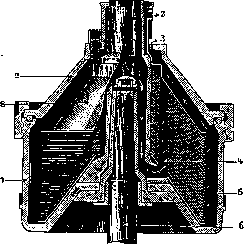
Figure 1. Course of separation in a cylinder: 2- place for entry of whole milk; 2-outlet opening for cream; 3-same for skim milk; 4-plates; 5-place for accumulation of dirt; 6'-axis of the cylinder; 7- body of the cylinder; 8-upper plate; 9- cylinder cap.
to 71%) or to the addition of foreign fats (lard, 'renewed', coconut, palm kernel oil, margarine). Cream oils in our country were rarely falsified with foreign oils, since this requires special equipment, while melted oil has always been subject to such falsification. Such crude falsification of oil as the addition of chalk, flour, cottage cheese, etc., now occurs extremely rarely. In connection with the concentration of production and sale of oil in cooperatives and state organizations, cases of oil falsification in general have significantly decreased. The production of cow's oil consists briefly of the following: milk is processed in separators (Fig. 1) to separate the cream. The separator is a cylinder rotating around a central axis, in which a series of conical plates are inserted with distances between them of 3 mm. Milk poured into the cylinder, due to centrifugal force (the cylinder makes 5-6 thousand revolutions per minute), is divided into two layers: the central one-cream and the peripheral one-skim milk, flowing out through different outlet tubes. It should be noted that in the separator cylinder, the so-called separator slime accumulates, consisting of elements of milk, dirt particles: feed, manure, hair, flakes of skin, leukocytes, as well as bacteria and fungi; bacilli tbc, when present in milk, accumulate in significant quantities in this slime; therefore, the latter should not be fed to pigs, as is usually the case. Frequent and thorough cleaning and washing of the separator from 'slime' is of great importance for the quality of the cream. The obtained cream is pasteurized or goes into production raw. For sour cream oils, the cream is soured with a pure culture (Bacillus lactis acidi Leichmann, Streptococcus lacticus) or with a starter from sour milk and is subjected to 'ripening'. Fresh or soured cream goes to the butter churn (Fig. 2), where it is beaten by various impact devices. After beating, the oil is processed, consisting of pressing the oil to remove buttermilk (residual cream), sometimes associated with washing with water and often with salting. Pressing is done on manual or mechanical oil processors (Figs. 3 and 4). Coloring of oil is done in the butter churn.-The production of melted oil consists in rendering the milk fat from oil or sour cream. The raw material is not always impeccable: a mixture of defective oil or sour cream with good quality oil often goes into rendering. Rendering is done in different ways: over an open flame, in a water bath, or in a steam bath. During rendering, volatile fatty acids and other volatile fat decomposition products are removed with water vapor, usually added to the oil during the production process. In the same water, the non-volatile components of cow's oil dissolve, and coagulated protein substances also accumulate. For more complete removal of decomposition products from defective oil, water vapor, CO2 is passed through the melted oil, it is treated with alkalis, etc.

Figure 2. Butter churn.


Figure 3.
Figure 3 and 4. Oil workers for churning butter. Refined defective oil can to some extent correct the smell and taste of the product. General sanitary and technical requirements for butter-making enterprises are as follows: location on dry territory with sufficient slope, remote from enterprises and livestock yards that pollute the air and soil; abundant supply of pure water, going directly into the churns for cooling oil, for washing oil, etc. For storing oil, good refrigerators should be available; supply of clean ice should be a special concern of the enterprise. Questions of rational and uninterrupted removal of waste water also require great attention. In a butter factory, the following minimum production premises must be provided: 1) a reception room for milk and cream, isolated, with a separate entrance; 2) a room for heating milk, separator and pasteurizer; 3) a room for churning and processing oil and packaging it; 4) a room for storing and souring cream; 5) a washing room for utensils; 6) an oil storage room, connected with an icehouse; 7) a room for the engine, boiler and steam generator. In addition, there should be separate rooms for the office, changing rooms, inventory and a completely isolated toilet. Cream departments may consist of three rooms: a reception room for milk, a separator room and a room for storing cream, connected with an icehouse. The interior finishing of rooms, cubic capacity, ventilation, relative humidity, lighting, etc., are set forth in the 'Rules on the maintenance of butter factories and cream departments attached to them' (published by the People's Commissariat of Health and the People's Commissariat of Agriculture of the RSFSR under No. 91 mv-8/IV 1927, Bull. NKZ, No. 9, 1927). The oil melting room should consist of 3 rooms: 1) the actual oil melting room, 2) a storage room and 3) a washing room. In addition to general requirements, attention must be paid to the proper design of local ventilation. Basic sanitary requirements for apparatus, inventory and utensils: easy accessibility and possibility for thorough cleaning and washing, absence of 'dead' spaces, corners, absence of harmful substances in the material from which the inventory is made, or quite sufficient protection against possible transfer of such substances into the oil being produced.-Parchment for packaging oil must meet the requirements of OST 151. Before use, parchment is washed and soaked in brine; stored protected from dust.-B arrels for oil should be made of appropriate quality material (OST 152); hoops-birch, Caucasian plane tree, hoops-willow. Burlap for external packaging of barrels should be impeccable in all respects. Before use, hot water is poured into the barrels for 20 minutes, and then washed with strong brine; sometimes washed with lime water (1 g of unslaked lime per 50 g of water) followed by thorough rinsing; finally, the inner walls of the barrels are rubbed with fine salt. For the prevention of mold, the most effective measure is scalding with live steam and paraffining of the barrels. Storage of oil should be carried out in sufficiently spacious rooms without access to daylight at a certain temperature and relative humidity: for short-term storage of oil, temperature from 0° to +4°, relative humidity 75%; for long-term storage, temperature from +2° to -4°, relative humidity 80-85%. Barrels with oil should not be placed directly on the floor, but on special stands; between barrels, free circulation of cold air should be ensured.-Transportation of oil in hot weather should be carried out in the evening or at night with protection from heating and rain; watering the cargo with water for cooling in summer should not take place, as it often leads to mold formation in oil. In railway transport, the most important thing for oil is the speed of communication, sufficient number of refrigerators at transfer points and isothermal cars. - Retail sale of oil should comply with sanitary and hygienic requirements for the trade of milk and dairy products. To combat mold epidemics in oil, in addition to rationalization of production from a sanitary point of view, disinfection is resorted to; the best and most accessible method is whitewashing the walls, ceiling and floor with 10-20% lime milk. Formalin and SO2 in rooms with low temperature do not give the desired effect. Sanitary and hygienic control over oil on the spot consists primarily in organoleptic examination, sometimes sufficient to reject and remove oil from circulation as a poor quality product. In most cases, laboratory examination of oil is necessary. When examining and characterizing large batches of oil, about 10% of the total amount of oil should be examined organoleptically or in the laboratory. When opening the packaging, the condition of the latter is inspected, the appearance of the outer surface of the oil, the presence and development of mold, contamination, etc. Then a dry and clean probe (sampler) is used to cut a column from the oil. With barrel packaging, the probe is inserted into the oil diagonally, starting the immersion 6-8 cm from the edge of the barrel and bringing the probe to the level of the middle of the barrel; with box packaging, at a distance of 4-6 cm from the end face of the box, parallel to its side surface. First, the smell of the oil is examined along the entire length of the column, then the taste, which should be characteristic of this type of oil; the color of good quality oil should be uniform throughout the mass: from slightly yellowish to straw-yellow (cream and cheese-making) and from straw-yellow to amber-yellow (clarified); the consistency of cream oil should be homogeneous, without salt crystals, at 10-15° dense, plastic; when cut, the oil should give a slight gloss on the surface with evenly appearing moisture. Droplets of liquid appearing on the surface of the oil when a knife is inserted should not be cloudy; the amount of droplets cannot serve as a criterion for assessing moisture content: salted oil releases them more than unsalted, although it usually has lower moisture content. Clarified oil at 15-20° should have a soft consistency and when melted be transparent and not give a precipitate. It is recommended to perform organoleptic tests with oil that has reached a temperature of 12° to 18°.-For l a b o r a-tory examination, a sample of oil is taken with a horn spatula, with which a thin layer of oil is cut along the entire length of the probe; the oil is placed in a glass jar with a ground stopper; the total weight of the sample should be at least 100 g. Sanitary and hygienic control over oil in the laboratory aims to establish the good quality of oil in terms of normal water content, absence of spoilage, addition of preservatives and foreign fats; in special cases, it is necessary to determine toxic substances and pathogenic microbes. L e g a l r e g u l a t i o n s o i l in the USSR. There is an all-union standard (OST 661), which provides for the determination, classification, technical specifications, physico-chemical properties and grades, packaging and labeling, rules for sampling, methods of laboratory research of cow's oil. Cow's oil offered for sale for direct consumption must have (according to OST) the composition and qualities indicated below: Components Cream and cheese-making oil salted unsalted Clarified oil Moisture not more than ... 15.5% 1 15.5% 1% 2% 1 - Fat not less than ... Free fatty acids in fat by Kettstorfer: 82% ! 83% 98% for the domestic market not more than .... * 3° 8° for the foreign market not more than .... .4° 3° 6° The constants of cow's fat were given above. Preservatives (except table salt) are prohibited. In addition, there are OSTs for materials of butter production: OST 175 for table salt, OST 151 for parchment, OST 152 for birch hoops, OST 153 for paint for coloring oil. For the RSFSR, the NKZdr. and the People's Commissariat of Agriculture have issued the above-mentioned rules on the maintenance of butter factories. All-union standards also exist for the following vegetable food and medicinal oils: sunflower (OST 81, 87), flax (OST 83, 87), hemp (OST 85, 87), rapeseed (OST 337, 87), bean (OST 338, 87), cottonseed (OST 165, 167), mustard (OST 224), coconut (OST 172, 174), castor (OST 220, 223). n. Orlov. Oils have found significant application in microscopic, especially in histological technique. Many essential oils of plant origin have the property of clearing sections (after treatment with alcohol), dissolving collodion, which is used in the preparation of histological preparations. The most widespread oils are: origanum, bergamot, lavender, clove, cedar. The latter is also used as an immersion medium for objectives. Of mineral origin oils, the most important is vaseline oil as a lubricant for the mechanisms of various apparatus, e.g. microtomes, microscopes, etc.
Related articles
Mentioned in
Cite this page
“Oil.” Soviet Medical Encyclopedia. English translation of Bolshaya Meditsinskaya Entsiklopediya, 1st ed. (Moscow, 1928–1936), ed. N. A. Semashko. https://sovietmedicalencyclopedia.pages.dev/article/oil/