Paraganglia
Historical document, translated for reference. It reflects medical knowledge of the 1920s–30s and is not medical advice.
Summary
Paraganglia are organs located near sympathetic ganglia that develop from sympathetic ganglion cells and contain chromaffin cells. They are classified into 'old' and 'new' types based on development, with the adrenal medulla being the most prominent 'new' paraganglion.
Encyclopedia article (1928–1936)
PARAGANGLIA (paraganglion-околоуз-лие), a name given on a topographical basis to organs located directly near sympathetic ganglia or within the ganglia themselves. These organs develop from mother cells of sympathetic ganglia, then become delimited from their maternal tissue, acquiring a number of specific characteristics and properties. The name P. was given to these organs in 1903 by Kohn (Kohn A.) in connection with the study of the development process of these organs and the discovery of 'new' P. in different parts of the sympathetic nerve trunk and in prevertebral ganglia (see figure). The main characteristic of the parenchyma of P. is the chromaffinotropism of the cells that compose it; hence their name 'chromaffin cells', i.e., cells having a biochemical affinity for chromium salt solutions, under the influence of which a visible specific granulation forms in the protoplasm of the cells. As a result of this ability, the parenchyma of P. when treated with chromium solutions acquires a dark brown or dark brown color (Betz, Henle), which also allows macroscopically distinguishing these, sometimes very small organs (the size of a millet seed and larger) from other tissues that do not possess the property of chromaffin reaction. Using this property of paraganglia, Zuckerkandl (1901) discovered the abdominal aortic P.-paraganglion aorticum lum-bale. Later other paraganglia were discovered. Kohn combined numerous P. into one system of organs-the chromaffin system (см.), which also included the medulla of the adrenal glands as the adrenal P.-paraganglion suprarenale.
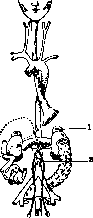
Diagram of the distribution of constant and non-constant paraganglia in the human body (paraganglia are indicated by dots): 1-paraganglion suprarenale; 2-paraganglion aortae lum-bare. In recent years it has been established (Ivanov G.), that part of P. develops in the postembryonic period, and another in the postfetal period, after birth and up to the onset of sexual maturity. The first group of P. is like the 'milk' part of the chromaffin system; it develops up to 1-2 years of age (according to Ivanov, parag. produx, s. necessarium). Then in these P. reduction processes occur, and by the age of 5-10 years they almost disappear (according to Ivanov in a reduced state-parag. redux, s. decadens). This includes, besides a number of small P., the abdominal aortic P., which, developing earlier than others, is the maternal soil for the development through migration and budding off of cells of other neighboring P.; it reaches maximum growth by the end of the first year of life, then gradually reduces. The second group of P. is lifelong; these organs develop in parallel with the development of the first group of P., but this development ends only with the onset of puberty, and complete reduction does not occur even in old age. This mainly includes the medulla of the adrenal glands and a number of microscopic inclusions in the ganglia of the sympathetic nervous system. The specific chromaffin granulation of the protoplasm of P. cells is the carrier of an adrenaline-like substance that enters the general blood stream through the veins. Based on the history of development of P., their innervation and function, P. are divided, according to Ivanov, into 'old and new' P. (paleo- and neoparaganglia). To the new P. belongs the medulla of the adrenal glands, the remaining P. are old, they are characteristic of lower vertebrates (fish), in which P. are located segmentally, and there are no adrenal glands as a complex formation. Constant and childhood P. are organs of adrenalinopoiesis, the medullary part of the adrenal glands with age occupies among them an outstanding, but not exclusive and not unique position both in morphol. and in fnkts. relation; this should not be forgotten especially in surgical intervention on P. for their hypothetical hyperfunction, when the object of extirpation (according to Oppel) is the left adrenal gland. In former times carotid and coccygeal glands were also referred to P. (Kohn), however, recent research (Castro and others) has established that these formations do not belong to P. (see Carotid gland). For details on ontogeny, phylogeny, morphology and physiology of individual P., as well as on hypertrophy of chromaffin substance, see Chromaffin system, Adrenal gland.
Related articles
Mentioned in
Cite this page
“Paraganglia.” Soviet Medical Encyclopedia. English translation of Bolshaya Meditsinskaya Entsiklopediya, 1st ed. (Moscow, 1928–1936), ed. N. A. Semashko. https://sovietmedicalencyclopedia.pages.dev/article/paraganglia/