Phacoscope
Historical document, translated for reference. It reflects medical knowledge of the 1920s–30s and is not medical advice.
Summary
The phacoscope is an instrument designed by Helmholtz for observing Purkinje-Sanson images during accommodation. It consists of a triangular box with blackened inner walls and three cut-off corners, used to study changes in the lens curvature during accommodation.
Encyclopedia article (1928–1936)
Phacoscope, an instrument proposed by Helmholtz for observing Purkinje-Sanson images during accommodation; it represents a box with blackened inner walls of triangular form, whose corners are cut off by three planes. In one of the planes (Fig. 1) there is a round opening, at which the observed eye is placed. Directly opposite it in the opposite wall, a quadrangular window with a thin needle-point is made. The subject through the opening either fixes the needle-point or, relaxing accommodation, looks far away along the same direction at some sufficiently distant point. By such an arrangement, the subject's eye and two fixation points are set in a straight line. If now, against the wall with two glass prisms embedded in it, facing each other with their bases, a light source is placed, then three pairs of reflexes (glints) will appear on the subject's eye: the brightest pair (Fig. 2) (a) from the cornea, the second pair somewhat dimmer and larger in size from the anterior surface of the lens (b) and finally the dimmest, barely distinguishable pair from its posterior surface (c). The first two reflexes will represent direct images, as reflections from convex surfaces, the third - reverse, as from concave. If now the observer, placing his eye at opening B, will look at the subject's eye during the period of fixation on a distant point, then he will see three A B pairs of points reflecting from it 'a 'b 'c 'a 'b 'c' and at this time the observer notes that the reflex from the cornea in the form of the brightest points has not changed (a), the pair following it (b) has moved forward and between them and the images themselves have become smaller - the anterior surface of the lens has become more convex and approached the cornea; finally the third pair (c), although very inconspicuous, has nevertheless somewhat approached each other and become brighter (Fig. 2, B). All this indicates an increase in the convexity of the lens and moreover GL. ob. its anterior surface. D. Romashov.
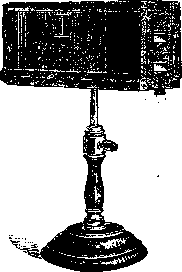
Figure 1.
represent direct images, as reflections from convex surfaces, the third - reverse, as from concave. If now the observer, placing his eye at opening B, will look at the subject's eye during the period of fixation on a distant point, then he will see three A B pairs of points reflecting from it 'a 'b 'c' and at this time the observer notes that the reflex from the cornea in the form of the brightest points has not changed (a), the pair following it (b) has moved forward and between them and the images themselves have become smaller - the anterior surface of the lens has become more convex and approached the cornea; finally the third pair (c), although very inconspicuous, has nevertheless somewhat approached each other and become brighter (Fig. 2, B). All this indicates an increase in the convexity of the lens and moreover GL. ob. its anterior surface. D. Romashov.
Figure 2.
represent direct images, as reflections from convex surfaces, the third - reverse, as from concave. If now the observer, placing his eye at opening B, will look at the subject's eye during the period of fixation on a distant point, then he will see three A B pairs of points reflecting from it 'a 'b 'c' and at this time the observer notes that the reflex from the cornea in the form of the brightest points has not changed (a), the pair following it (b) has moved forward and between them and the images themselves have become smaller - the anterior surface of the lens has become more convex and approached the cornea; finally the third pair (c), although very inconspicuous, has nevertheless somewhat approached each other and become brighter (Fig. 2, B). All this indicates an increase in the convexity of the lens and moreover GL. ob. its anterior surface. D. Romashov.
represent direct images, as reflections from convex surfaces, the third - reverse, as from concave. If now the observer, placing his eye at opening B, will look at the subject's eye during the period of fixation on a distant point, then he will see three A B pairs of points reflecting from it 'a 'b 'c' and at this time the observer notes that the reflex from the cornea in the form of the brightest points has not changed (a), the pair following it (b) has moved forward and between them and the images themselves have become smaller - the anterior surface of the lens has become more convex and approached the cornea; finally the third pair (c), although very inconspicuous, has nevertheless somewhat approached each other and become brighter (Fig. 2, B). All this indicates an increase in the convexity of the lens and moreover GL. ob. its anterior surface. D. Romashov.
represent direct images, as reflections from convex surfaces, the third - reverse, as from concave. If now the observer, placing his eye at opening B, will look at the subject's eye during the period of fixation on a distant point, then he will see three A B pairs of points reflecting from it 'a 'b 'c' and at this time the observer notes that the reflex from the cornea in the form of the brightest points has not changed (a), the pair following it (b) has moved forward and between them and the images themselves have become smaller - the anterior surface of the lens has become more convex and approached the cornea; finally the third pair (c), although very inconspicuous, has nevertheless somewhat approached each other and become brighter (Fig. 2, B). All this indicates an increase in the convexity of the lens and moreover GL. ob. its anterior surface. D. Romashov.
represent direct images, as reflections from convex surfaces, the third - reverse, as from concave. If now the observer, placing his eye at opening B, will look at the subject's eye during the period of fixation on a distant point, then he will see three A B pairs of points reflecting from it 'a 'b 'c' and at this time the observer notes that the reflex from the cornea in the form of the brightest points has not changed (a), the pair following it (b) has moved forward and between them and the images themselves have become smaller - the anterior surface of the lens has become more convex and approached the cornea; finally the third pair (c), although very inconspicuous, has nevertheless somewhat approached each other and become brighter (Fig. 2, B). All this indicates an increase in the convexity of the lens and moreover GL. ob. its anterior surface. D. Romashov.
Related articles
Cite this page
“Phacoscope.” Soviet Medical Encyclopedia. English translation of Bolshaya Meditsinskaya Entsiklopediya, 1st ed. (Moscow, 1928–1936), ed. N. A. Semashko. https://sovietmedicalencyclopedia.pages.dev/article/phacoscope/