Ophthalmometer
Historical document, translated for reference. It reflects medical knowledge of the 1920s–30s and is not medical advice.
Summary
An ophthalmometer is an optical instrument for measuring the radii of curvature of the eye's refractive surfaces (cornea and lens). The article describes the basic principles of ophthalmometry and details several models including the Helmholtz ophthalmometer and the Javal-Schiotz ophthalmometer, with emphasis on clinical applications for measuring corneal astigmatism.
Encyclopedia article (1928–1936)
OPHTHALMOMETER (from the Greek ophthalmos - eye and metron - measure), an optical instrument designed for measuring the radii of curvature of the refractive surfaces of the eye (cornea and lens). The basic principle of ophthalmometry is as follows: the surfaces of the eye's refractive media are mirror-like and, like any spherical mirrors, under certain conditions give diminished images of nearby objects. The size of the image obtained in the mirror depends on three factors: the size of the object, the distance of the object from the mirror, and the radius of curvature of the mirror. Therefore, if the size of the object, the distance of the object from the mirror, and the size of the image are known, one can easily calculate the radius of curvature of the mirror r by the formula: r = -A×B/(A-a), where A and a are the sizes of the object and its image, and B is the distance of the object from the mirror. A and B are easily accessible to measurement, and therefore ophthalmometry ultimately comes down to measuring the size of the image obtained from a certain object upon reflection from the various surfaces of the eye's refractive media. This measurement is usually performed with the aid of a telescope, in which between the objective and eyepiece is inserted a special device for measurement that splits the image.
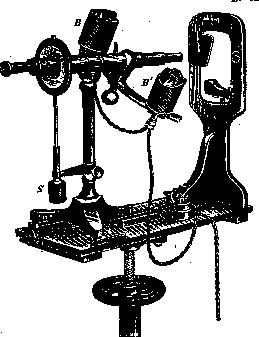
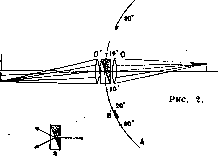
The prototype of all O. is the1 ophthalmometer of Helmholtz. It is a very precise instrument that played an enormous role in its time, as it was the first to obtain accurate information about the radii of curvature of the refractive surfaces of the cornea and lens, on the basis of which all our knowledge of the eye's refractive apparatus has been built. Due to the complexity of the research and the associated calculations, however, the Helmholtz ophthalmometer did not acquire clinical significance. For clinical purposes, the ophthalmometer of Javal-Schiotz has great importance: (The general appearance of the apparatus is shown in Fig. 1, and the path of rays in it in Fig. 2.) This O. consists of a telescope, inside of which between the objective and eyepiece as a splitting device are inserted two prisms joined by their hypotenuses so that they form a parallelepiped. To the middle of the telescope is attached a graduated rotating arc, on each side of which there is one sliding figure, in front covered with milk or colored glass. These glasses are illuminated from behind by an electric light bulb. Measurement is performed in a dark room. The patient is seated at the apparatus from the side of the objective, with his head fixedly positioned on a special stand located right in the center of the O. arc. When the subject being examined looks straight into the tube, images of both figures are obtained on his cornea (one has the form of a ladder and the other is a rectangle). Thanks to the splitting device, the physician sees through the telescope two ladders and two rectangles, of which only the two middle figures (ladder and rectangle) are of importance for measurement purposes. During measurement, by means of a special screw, both figures are moved apart or together along the O. arc until in the corneal "image" the two middle figures come into contact. At this moment, the radius of curvature of the anterior surface of the cornea in millimeters can be read off the arc.
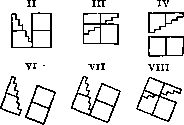
The clinical significance of the Javal-Schiotz ophthalmometer consists in that it allows one to determine the degree of corneal astigmatism extremely easily and quickly, for which the following procedure is used: after setting the middle figures into contact with the arc in the horizontal position, the arc is then rotated by 90°. If there is no corneal astigmatism, the figures do not change their mutual position and remain in contact. In the presence of corneal astigmatism, the mutual position of the figures changes, and they either separate or overlap. The degree of overlap easily determines the degree of corneal astigmatism due to the fact that the apparatus is constructed so that each step of the ladder corresponds to one diopter. The different mutual positions of the middle figures of the corneal image at different moments of measurement are shown in Fig. 3.
On a somewhat different principle is built the keratometer of Sutcliffe, which also 44 & serves for determining corneal astigmatism. It has the advantage that in it, at one setting, without any additional rotations, the degree of astigmatism can be established.
The radii of curvature of the lens surfaces can be comparatively quickly and simply established by the ophthalmophonometer of Tscherning. This apparatus, however, has not yet found clinical application.
E. Tron.
Related articles
Mentioned in
Cite this page
“Ophthalmometer.” Soviet Medical Encyclopedia. English translation of Bolshaya Meditsinskaya Entsiklopediya, 1st ed. (Moscow, 1928–1936), ed. N. A. Semashko. https://sovietmedicalencyclopedia.pages.dev/article/ophthalmometer/