Plant Fibers
Historical document, translated for reference. It reflects medical knowledge of the 1920s–30s and is not medical advice.
Summary
This article examines plant fibers as evidence in forensic medicine and criminology, detailing the microscopic characteristics and chemical reactions of various plant fibers including cotton, flax, hemp, jute, and others, with comparisons to animal fibers and silk.
Encyclopedia article (1928–1936)
Plant fibers, as material evidence, can be objects of forensic medical examination and criminology. Most frequently subjected to research are fibers of cotton, flax, hemp, jute, and less frequently - of cannabis, nettle, New Zealand flax, coconut fibers, raffia, fibers of jute, sea grass, and others; plant fibers also include artificial silk (viscose).- Cotton fibers are obtained from the hairs of seeds of the genus Gossypium; under a microscope they appear as flat ribbons, spirally twisted, with a channel in the middle, sometimes slit-like and interrupted, sometimes wide, up to 2/» of the entire thickness of the fiber (see figure, B); they consist of cellulose and are covered with a cuticle, which from Schweitzer's reagent (ammoniacal solution of Cu) swells, tears, forming rings and constrictions; from iodine with H2SO4 and zinc-chloride-iodine, the fibers turn blue; thickness of fibers 0.015-0.025 mm, length varies. Occasionally "gray fibers" are encountered, underdeveloped ones; they lack bends and do not stain.- Flax fibers from the stems of Linum usitatissimum L.: when split into fibers, they resemble a straw with thickenings similar to joints, with indistinct longitudinal spiral striation and a narrow cavity (see figure, L); length of fibers 30-66 mm, thickness 0.010-0.026 mm. A characteristic distinguishing feature of flax fibers from other plant fibers is the smooth, pointed tip and swelling of the fibers in Schweitzer's reagent: it becomes much thicker, revealing a zigzag cavity;
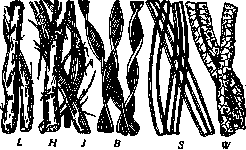
L-flax; H-cannabis; J-jute; B-cotton paper; S-silk; W-ordinary wool.
iodine-sulfuric acid stains flax fibers blue.- Fibers of cannabis from the bast of Cannabis sativa are quite similar to flax fibers and difficult to distinguish; their shape is either ribbon-like or cylindrical, ends are either pointed, rounded, or flattened; the cuticle sometimes forms folds similar to an accordion (see figure, H). When treated with Schweitzer's reagent, the cavity forms whimsical bends, and iodine with sulfuric acid stains cannabis fibers greenish-blue or dark blue, zinc-chloride-iodide - violet.- Jute fibers are cylindrical, with unevenly thickened walls, obtained from the stems of many varieties of Corchorus; the fiber is penetrated by numerous longitudinally running canals containing air, has a blunt rounded end, sometimes bifurcated (see figure, J); its width is 0.026-0.156 mm; iodine stains the fibers yellow, which from HjSOa turns brown; from the action of phloroglucin and HCl it is stained bright red when the cells become woody.- Less frequently encountered fibers of Indian hemp from Hibiscus cannabinus L. have wide cells with insignificant thickenings, blunt rounded ends and a narrow lumen; thickness 0.015-0.025 mm.- Fibers of Manila hemp from the stems of Musa species are flattened, with a narrowed blunt apex and a gradually widening toward the middle canal; thickness of fiber 0.016-0.039 mm, from iodine they are stained yellow, from the addition of sulfuric acid - golden yellow to greenish tint. - Fibers of Chinese hemp from the bast of various Sida species (family Malvaceae) are diverse, with sharply varying canal and walls; along or somewhat obliquely to the longitudinal axis of the fibers, pores are visible; thickness of fibers 0.015-0.025 mm.- Fibers of nettle from the stem of Urtica nivea L. are described differently due to the great diversity of the outer appearance of the cells; their thickness is 0.04-0.11 mm.- Fibers of New Zealand flax from the leaves of Phormium tenax are whitish-colored, bulbously swollen toward the middle, with longitudinal striation, 0.008-0.019 mm thick. Phloroglucin and hydrochloric acid stain them a delicate violet color; a distinguishing feature of New Zealand flax from our flax and cannabis is the different color from nitric acid and chlorine: the first gives blood-red color, flax does not change, and cannabis takes a light yellow color. Other plant fibers are very rarely objects of forensic research and are distinguished by the naked eye. Plant fibers differ from animal fibers, besides their structure (see Hair), by the absence when burned of the characteristic smell of burned horn and by the fact that they do not fuse from the action of heat.- Natural and artificial silk fibers consist of long cylindrical, shiny, structureless threads (see figure, S), thickness of natural silk 0.01-0.07 mm, of artificial (viscose) - depending on the holes through which the threads pass during its production from cellulose mass. Viscose easily swells from water, especially in alkalis, is soluble in Schweitzer's reagent, when burned does not fuse, like natural silk (see Silk).
Related articles
Mentioned in
Cite this page
“Plant Fibers.” Soviet Medical Encyclopedia. English translation of Bolshaya Meditsinskaya Entsiklopediya, 1st ed. (Moscow, 1928–1936), ed. N. A. Semashko. https://sovietmedicalencyclopedia.pages.dev/article/plant-fibers/