Siphon and Scalping
Historical document, translated for reference. It reflects medical knowledge of the 1920s–30s and is not medical advice.
Summary
This article from the 1928–1936 Soviet Medical Encyclopedia describes the physical principles and medical applications of the siphon, particularly in gastric lavage, as well as the surgical concept of scalping and scalp avulsion injuries.
Encyclopedia article (1928–1936)
SIPHON, a device for transferring liquids, consisting of a bent tube open at both ends. The knees of the tube are bent at an acute angle or run parallel. Before transfer, the siphon is filled with liquid, for which a special appendage a extending from the external knee (Fig. 1) is usually used, through which liquid is sucked by mouth from a vessel into both knees. The ends of the siphon are immersed in the vessels. The transfer takes place until the liquid level in the vessel from which the transfer is made is higher than the level of the liquid into which the external end of the siphon is immersed. Atmospheric pressure is transmitted to both ends of the siphon, but in the external knee the pressure of the liquid column opposing the atmospheric pressure is greater than the pressure of the liquid in the internal knee, which is why the liquid will flow out through the external end. The siphon is often used
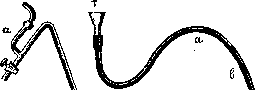
Figure 1.
Figure 2. changed in medicine and technology. In chemical, bacteriological, and other laboratories, there are siphon setups for titrated solutions, for distilled water, and the like; the Soxhlet apparatus for fat extraction is built on the principle of the siphon, and so on. Among the most important applications of the siphon in medicine, it is necessary to point out its use in gastric lavages. A rubber tube ab (Fig. 2) is inserted through the esophagus into the stomach; the external end of the tube is connected to a funnel T, which is initially lowered below the patient's mouth and filled with water or some medical solution. When the funnel is raised, the solution passes into the stomach. If the funnel is now lowered slowly before all the liquid has passed into the stomach, a moment will come when the liquid level in the funnel will be lower than the liquid level in the stomach, and thus conditions for the action of the siphon will be created, and the gastric contents will pass back into the funnel. By pouring out the lavage solution from the latter and replacing it with fresh solution, we have the opportunity to repeat the transfer without interruption and thus pump out all its contents from the stomach. Leiter coolers, used for cooling various parts of the body, are also arranged according to the siphon principle.
D. Romashov. SCALPING (from English scalp - scalp of the head), the tearing off of the scalp of killed or wounded enemies. This custom was found among the wild tribes of North America. The removed piece of skin was kept as a trophy. In medical practice, the term scalping is used to designate extensive flap wounds of the head, when the skin of the hairy part of the head is separated for a considerable extent from the bones of the cranial vault. Such wounds are encountered in various industries when the ends of headscarves or long hairs get into the moving parts of machines and, wrapping rapidly around one or another part of the machine, are torn off with considerable force along with the scalp. Even extensive exposures of the cranial vault skin can be successfully cured by multiple skin grafts. Thiem applied with great success grafts of fairly thick skin flaps cut according to Thiersch from the hairy part of the occiput. The flaps take well and become covered with hair. For the same purpose, the hairy skin of the pubic region was also used (Schönborn). Large scars remaining after such injuries, fused with the periosteum, can cause subjective complaints for a long time. Gradually, the scars can become mobile. For large scars of the head after scalping, a wig can be recommended to protect the skull from temperature effects and hide the disfigurement.
Related articles
Cite this page
“Siphon and Scalping.” Soviet Medical Encyclopedia. English translation of Bolshaya Meditsinskaya Entsiklopediya, 1st ed. (Moscow, 1928–1936), ed. N. A. Semashko. https://sovietmedicalencyclopedia.pages.dev/article/siphon-and-scalping/