SORPTION PHENOMENA
Historical document, translated for reference. It reflects medical knowledge of the 1920s–30s and is not medical advice.
Summary
Sorption phenomena refer to processes involving the absorption of substances by liquids or solids from their surrounding environment. This article distinguishes between three main types of sorption: dissolution or absorption, surface condensation or adsorption, and absorption through chemical bonding.
Encyclopedia article (1928–1936)
SORPTION PHENOMENA (in biocolloids) (from Latin sorbere-to absorb), processes related to the absorption by a liquid or solid of substances present in the contacting medium. Three main types of sorption are distinguished: dissolution, or absorption, surface condensation, or adsorption, and absorption through chemical bonding. These three types of S. y. in their typical forms differ sharply from one another. The main feature that allows one to determine the method of binding of the substance being studied is the quantitative ratio established in the equilibrium state between its concentration in both contacting phases. In the case of absorption, or dissolution, the amount of substance absorbed is proportional to its concentration in the second phase (Henry's law). In other words, the ratio of the concentration of a given substance in both phases represents a constant value; the latter has been named the distribution coefficient. In contrast, in the case of adsorption (see), the concentration of the adsorbed substance increases more slowly than its concentration in the contacting phase. If the latter is denoted by c, then the amount of absorbed substance per 1 g of adsorbent equals C=bcn, where h and n are constants, and n is always less than one (usually values of n lie between 0.1 and 0.6). However, this equation (Freundlich's adsorption isotherm) is only valid if the concentration is relatively low. Otherwise, as shown by Langmuir, the amount of adsorbed substance approaches a certain limit, after which its further increase ceases (saturation of the adsorption layer). Finally, in the case of chemical bonding, all added substance is completely bound (regardless of its concentration) by the absorber until the reaction is complete, after which its content in the absorber remains unchanged. The quantitative relationships existing in these three cases are represented in the figure, in which on the abscissa axis is plotted the concentration of the absorbed substance in the phase contacting the absorber, and on the ordinate axis-its content in the absorber itself. However, not always do such sharp differences exist between different types of sorption that would allow them to be easily distinguished from one another. For example, in the case of dissolution, a direct proportionality exists between the concentrations of the substance being studied in both solvents only if it is in the same molecular state in them. Otherwise, more complex relationships are obtained, similar to those characteristic of adsorption. Thus, benzoic acid consists in water of simple molecules, while in benzene-of associated, double molecules. As calculations show, its concentration in water is proportional to the square root of its concentration in benzene. In a similar way, electrolytes, strongly dissociated in water, are in an undissociated or slightly dissociated state in non-aqueous solvents. Therefore, their ions are practically completely collected in water, while their undissociated molecules are distributed proportionally between both phases. As a result, as the concentration of the electrolyte decreases, simultaneously with an increase in its degree of dissociation, its relative content in water increases. In turn, for adsorption, significant complications often arise. This is particularly the case when surface condensation represents only the first stage of the absorption process, followed by chemical interaction between the adsorbed substance and the adsorbent itself. Finally, in the case of a labile, easily dissociating chemical compound, the amount of chemically bound substance is in equilibrium with its concentration in the solution and changes depending on the latter. Thus, in a number of cases, only a more precise analysis makes it possible to determine to which type of sorption the phenomenon being studied belongs.
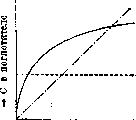
adsorption dissolution chemical compound
Three types of distribution of a substance between two phases. On the abscissa axis is plotted the concentration of the absorbed substance in the phase contacting the absorber, on the ordinate axis-its content in the absorber itself. However, not always do such sharp differences exist between different types of sorption that would allow them to be easily distinguished from one another. For example, in the case of dissolution, a direct proportionality exists between the concentrations of the substance being studied in both solvents only if it is in the same molecular state in them. Otherwise, more complex relationships are obtained, similar to those characteristic of adsorption. Thus, benzoic acid consists in water of simple molecules, while in benzene-of associated, double molecules. As calculations show, its concentration in water is proportional to the square root of its concentration in benzole. In a similar way, electrolytes, strongly dissociated in water, are in an undissociated or slightly dissociated state in non-aqueous solvents. Therefore, their ions are practically completely collected in water, while their undissociated molecules are distributed proportionally between both phases. As a result, as the concentration of the electrolyte decreases, simultaneously with an increase in its degree of dissociation, its relative content in water increases. In turn, for adsorption, significant complications often arise. This is particularly the case when surface condensation represents only the first stage of the absorption process, followed by chemical interaction between the adsorbed substance and the adsorbent itself. Finally, in the case of a labile, easily dissociating chemical compound, the amount of chemically bound substance is in equilibrium with its concentration in the solution and changes depending on the latter. Thus, in a number of cases, only a more precise analysis makes it possible to determine to which type of sorption the phenomenon being studied belongs.
d. Rubinstein. , NIPPLE, a rubber cap of elongated shape, with one or more openings in the upper end, which fits onto the neck of a special bottle, used in artificial feeding of an infant, for sucking out milk. As early as the 18th century in Russia, a cow's N., or "teat," was used, which was tied to the drilled narrow end of a cow's horn, while milk was poured into the wide end, and in this way the child was fed. Special vessels (clay, glass, tin, silver, etc.) were widely used, having the shape of a small coffee pot with a lid or a small jug with an elongated tubular spout, through which the child sucked, thus the vessel replaced both the bottle and the N. Finally, with the use of rubber N., a number of modifications have been created both in the shape of the N. itself and in its connection with the milk vessel. The N., which is generally accepted at present in our Union, must be made of red or gray rubber without any harmful impurities, without odor; vulcanized rubber cannot be used either. Nipples are produced in 2-3 sizes without openings, which are made before use by piercing the tip of the N. with a heated needle. The opening should be small, so that milk drips from it at a speed of approximately 10 drops per minute, so that when sucking the child must perform some work and milk enters the stomach in small portions. The N. must be kept in maximum cleanliness: after feeding it is removed from the bottle, rinsed with hot water, boiled, and kept until next use in a closed vessel. In addition to the N. used for feeding mixtures, it is necessary to mention: 1) N.-pacifier. It was widely used in infants, mainly among the peasant population of tsarist Russia, but with the successes of socialist construction and organizations for the protection of motherhood and infancy, it has passed into the realm of tradition and museum exhibits. Pieces of bread or crackers were chewed, moistened with saliva, and tied in a cloth, which was then given an elongated nipple shape; with such a nipple in its mouth, the child could stay for a whole day. 2) Pacifier, consisting of a regular rubber nipple without an opening with a bone ring fitted onto it, is still quite widely used at present. Its use is undesirable, but provided that the rules of pedantic cleanliness are observed, in individual cases (e.g., in neuropathic children) it can be considered permissible.
Related articles
Mentioned in
Cite this page
“SORPTION PHENOMENA.” Soviet Medical Encyclopedia. English translation of Bolshaya Meditsinskaya Entsiklopediya, 1st ed. (Moscow, 1928–1936), ed. N. A. Semashko. https://sovietmedicalencyclopedia.pages.dev/article/sorption-phenomena/