Turpentine Oil
Historical document, translated for reference. It reflects medical knowledge of the 1920s–30s and is not medical advice.
Summary
This article from the 1928–1936 Soviet medical encyclopedia details turpentine oil, describing its preparation, physical properties, chemical composition, and historical medical applications.
Encyclopedia article (1928–1936)
TURPENTINE OIL, Oleum Terebinthinae (Ph. VII), turpentine, represents an essential oil obtained by steam distillation of various kinds of turpentine (see Balsams); on our trade market it is also called retort turpentine. According to Ph. VII, two sorts of T. m. are distinguished: 1) 01. Tereb. crudum, simple T. m., sulfur turpentine, turpentine obtained by steam distillation of ordinary turpentine (Terebinthina communis) from various kinds of Pinus; 2) 01. Terebinth, rectificatum, purified T. m., purified turpentine, purified turpentine oil, obtained by steam distillation of 1 part of turpentine mixed with 6 parts of lime water, in which not more than three quarters of the taken turpentine is distilled off (previously French turpentine — 01. Tereb. gallicum — was used instead). Purified colorless T. m. is a transparent, colorless, strongly refracting (nD = 1,467-1,478) mobile liquid of a peculiar odor, sharp and scratching taste, sp. gr. 0,855-0,876, right or left rotation ([α]D = most often between +10° and +24°); boils between 155-180°; dissolves in 7 parts of 90° alcohol, easily in ether and fatty oils (dissolves phosphorus, sulfur, resins, uncured rubber, etc.). In air T. m. thickens, yellows, takes an acidic reaction and acquires oxidative properties (in the presence of moisture); this oxidized turpentine, having added four atoms of O to a molecule of pinene, easily gives off two, oxidizing various substances, which is why it was incorrectly considered "ozonized," capable of enriching the air with ozone (ozonators for toilets, e.g. Rachkovsky's, etc.); in reality peroxide compounds are formed, oxygen carriers, capable of directly oxidizing more stable compounds, with the formation of H2O2, but not ozone. This is the basis for the application of oxidized T. m. in burns and per os poisoning by phenol, phosphorus, arsenic, etc. The composition of T. m. is very variable both depending on the species of coniferous tree from which T. m. was obtained (various species of Pinus, Abies, Larix), and on the method of obtaining (from turpentine, rosin, stump retort, furnace, etc.); usually the main component of it is α-pinene (in our turpentines — up to 80%) and β-pinene in a much smaller amount, A3- and zH-carotenes (not sylvesterene, as was thought earlier), dipentene and some other terpenes, a little sesquiterpenes [in the oxidized ones there are also peroxide, C10H16O4(?), ketone-verbenone, C10H14O and other insignificant components]. Structural formulas of the main turpenes of turpentine: C10H16 (CH3)2C' H8C-GH-----CH8 H8C- α-pinene HC=C(CH3) H2C- (CH3)2C β-pinene -C(CH3)= -CH H2C CH-CH8 =CH -CH A3-carotene
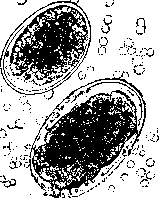
Above — Necator americanus egg; below — Trichostrongylus diminutus egg.
oil, obtained by steam distillation of 1 part of turpentine mixed with 6 parts of lime water, in which not more than three quarters of the taken turpentine is distilled off (previously French turpentine — 01. Tereb. gallicum — was used instead). Purified colorless T. m. is a transparent, colorless, strongly refracting (nD = 1,467-1,478) mobile liquid of a peculiar odor, sharp and scratching taste, sp. gr. 0,855-0,876, right or left rotation ([α]D = most often between +10° and +24°); boils between 155-180°; dissolves in 7 parts of 90° alcohol, easily in ether and fatty oils (dissolves phosphorus, sulfur, resins, uncured rubber, etc.). In air T. m. thickens, yellows, takes an acidic reaction and acquires oxidative properties (in the presence of moisture); this oxidized turpentine, having added four atoms of O to a molecule of pinene, easily gives off two, oxidizing various substances, which is why it was incorrectly considered "ozonized," capable of enriching the air with ozone (ozonators for toilets, e.g. Rachkovsky's, etc.); in reality peroxide compounds are formed, oxygen carriers, capable of directly oxidizing more stable compounds, with the formation of H2O2, but not ozone. This is the basis for the application of oxidized T. m. in burns and per os poisoning by phenol, phosphorus, arsenic, etc. The composition of T. m. is very variable both depending on the species of coniferous tree from which T. m. was obtained (various species of Pinus, Abies, Larix), and on the method of obtaining (from turpentine, rosin, stump retort, furnace, etc.); usually the main component of it is α-pinene (in our turpentines — up to 80%) and β-pinene in a much smaller amount, A3- and zH-carotenes (not sylvesterene, as was thought earlier), dipentene and some other terpenes, a little sesquiterpenes [in the oxidized ones there are also peroxide, C10H16O4(?), ketone-verbenone, C10H14O and other insignificant components]. Structural formulas of the main turpenes of turpentine: C10H16 (CH3)2C' H8C-GH-----CH8 H8C- α-pinene HC=C(CH3) H2C- (CH3)2C β-pinene -C(CH3)= -CH H2C CH-CH8 =CH -CH A3-carotene
A4-carotene HC = C(CH3)-----CH8 CH3.C :CH8 H2C-CH2 dipentene T. m. introduced into the organism acts analogously to phenols, but much weaker; being excreted from the organism by the kidneys (in the form of conjugated pairs, giving the urine a violet odor), it simultaneously causes increased secretion of urine, disinfecting the urinary tract at the same time; in large doses (more than 10.0 pro die) it causes changes in the kidneys. Besides, T. m. is partly excreted by the lungs, at the same time increasing the secretion of bronchial mucus and thereby facilitating expectoration, as well as partly disinfecting the surface of the respiratory tract. Locally it acts irritantly on the skin and on mucous membranes, as well as antiseptically. -Application of T. m.: 1) externally as an irritant and diverting agent in neuralgias, rheumatism, gout, etc. in the form of ointments (see Ointments); 2) in the form of inhalations or inhalations in putrid bronchitis, lung gangrene, lung phthisis — as an antiseptic and limiting (in large doses) the secretion of bronchial mucus; in diphtheria, etc.; inhalation form should include spraying a room with turpentine where the patient is, as well as the beneficial influence of air of pine forests in chronic catarrhs of the lungs and phthisis; 3) internally in appropriate processes in the lungs, in cystitis, gonorrhea, in neuralgias (e.g. in sciatica) by 0.5-1.5 pro dosi, 2-3 times a day in drops in milk or in the form of gelatin pearls with turpentine. Special attention should be paid to the condition of the kidneys when prescribing T. m. - Besides its medical significance T. m. has a huge technical application in the manufacture of varnishes, paints, technical waxes, creams, pastes, etc.; in the pharmaceutical and perfume industry — for the manufacture of synthetic camphor, terpene hydrate, terpineol, etc. Pine oil (C.M.) is close to turpentine oil.
A. Klingmüller — Application of turpentine in the treatment of inflammatory processes was proposed in 1917 by Klingmüller. Initially turpentine in the form of a 25% emulsion in olive oil in an amount of 0.5-1.0 was introduced by a fine needle to the bone along the posterior axillary line 2-3 fingers below the iliac crest in gonorrheal lesions of the joints and urethra. Such injections were repeated every 5 days for 2-3 weeks. Later this remedy was applied not only in gonorrhea but also in various inflammatory diseases of the female genital sphere. The initially proposed composition of turpentine emulsion underwent various modifications over time. To reduce the pain of injection, novocaine was proposed to be added; French turpentine was replaced by Russian turpentine for technical reasons. Cherepakhin used the following prescription: 01. Terebinthini rossic. rectif. 15.0, Chinini muriat. 0.5, Novocaini 0.5, 01. Oliv. provinciale 84.0. Under the influence of turpentine emulsion injection, according to the conclusion of many authors, the general well-being improves (decrease in pain, peaceful sleep, appearance of appetite, fall of t°, often critical) and inflammatory tumors and infiltrates in the connective tissue dissolve quite quickly. Applying this method, Cherepakhin could note shortening of the acute period of the disease. In cases of chronic inflammatory processes the temperature reaction was often absent and the course of the disease was slow and sluggish. Usually a local reaction is noted, which is manifested by increased pain in the lower abdomen, in the back, in the legs, etc. These pains usually disappear after a day, less often later. In some cases, on the contrary, a decrease in pain is noted, which previously extremely disturbed the patients. According to Cherepakhin's observations, the best results of treatment were observed in acute inflammatory processes of the genital sphere of various origin (contraindicated in tuberculosis inflammatory processes). The application of turpentine is less effective in chronic inflammatory processes. The absence of local reaction, temperature reaction, leukocytosis 6-8 hours after the introduction of turpentine emulsion indicates the futility of treatment. In contrast to the sometimes enthusiastic reviews about the therapeutic effect of turpentine emulsion application, Pankow speaks very cautiously about the results of treatment, obtaining even better results without the application of turpentine. Sonnenfeld believes that better results can be obtained from the application of turpentine emulsion if injections are made at shorter intervals. The application of turpentine emulsion usually does not affect the kidneys. At present, lactotherapy has almost completely displaced the application of turpentine emulsion. A special kind of therapy with turpentine called "fixation abscess" was proposed in 1892 by Fochier; he initially assumed that the infection is fixed in the purulent focus at the place of turpentine injection. A number of Fochier's followers obtained good results applying fixation abscess in the treatment of puerperal and other infectious diseases. But in general "fixation abscess" did not find wide application and many clinics relate to it negatively. Turpentine is introduced under the skin of the abdomen in doses from 1 to 4 cm3. At the place of injection after a few hours redness, an infiltrate and finally a focus of softening with pus formation appear. The appearance of a rapid reaction according to Fabre indicates a favorable prognosis, with a delayed reaction the prediction worsens. Since the absorption of pure turpentine occurs slowly, in severe cases requiring rapid action, Fabre begins treatment with the introduction of Serum Terebinthini (a 1% solution of a mixture of turpentine and alcohol is added to heated physiological solution; 200 cm3 of such a solution is introduced under the skin). Under the influence of such application of turpentine, protein splitting occurs at the site of tissue damage, its absorption and ultimately an action analogous to protein therapy (autoprotein therapy).
D. Gudim-Lenkovich.
Related articles
Mentioned in
Cite this page
“Turpentine Oil.” Soviet Medical Encyclopedia. English translation of Bolshaya Meditsinskaya Entsiklopediya, 1st ed. (Moscow, 1928–1936), ed. N. A. Semashko. https://sovietmedicalencyclopedia.pages.dev/article/turpentine-oil/