Van Slyke Methods
Historical document, translated for reference. It reflects medical knowledge of the 1920s–30s and is not medical advice.
Summary
This article from the 1928–1936 Great Medical Encyclopedia describes the analytical laboratory methods developed by Donald Van Slyke for determining blood reserve alkalinity and measuring amino nitrogen.
Encyclopedia article (1928–1936)
VAN SLYKE METHODS. A. The method for determining reserve alkalinity is based on the displacement of carbon dioxide from blood plasma by sulfuric acid, after which the volume of the carbon dioxide is measured. For the apparatus, see figures 1 and 2. Reagents: 1) 1% ammonia solution (free of CO2), 2) 10% sulfuric acid, 3) octyl alcohol (secondary), 4) mercury 1,600 g. Procedure: 3 cubic centimeters of oxalated plasma are saturated with CO2 in a separating funnel A (see figure 2) by repeated inhalation through d of air; glass beads are placed in B to trap moisture from the expired air. The determination is carried out in the apparatus (see figure 1) filled with Hg up to a and b to displace the air. With stopcock f open, the mercury in b is washed with ammonia (1) to remove traces of acid, the solution is removed, 1 cubic centimeter of the prepared plasma is introduced under the remnants, and through stopcock E

into the graduated tube F, there are successively introduced 0.4 cubic centimeters of water, 0.5 cubic centimeters of water containing 1/4 drop of octyl alcohol, 0.5 cubic centimeters of H2SO4 (2), and water is added up to the 2.5 mark. Stopcock E is closed. Bulb H is lowered until the liquid passes into d, and the mercury reaches stopcock f. Stopcock f is closed, and the apparatus is shaken 15 times to liberate CO2. By turning the stopcock, gcd is connected, by lowering H almost all the liquid passes into d, g connects it, and H is raised until the mercury in the bulb is level with the graduated tube. The volume of liberated CO2 is read off and calculated using tables or the following formula: x = \frac{v (100.8 - 0.27t)}{760 \cdot (1 + 0.0038t)} - \frac{v_1 \cdot B_1}{760}, where x is the volume of CO2 in cubic centimeters reduced to 0° and 760 mm Hg, B is the read barometric pressure, t is the temperature, v is the measured volume. Under normal conditions, the amount of CO2 ranges between 55 and 70 volume percent. It is used to determine the state of acidosis or alkalosis in the organism. The method is accurate and fully satisfies clinical needs. Van Slyke and Neill proposed a method for determining reserve alkalinity by measuring CO2 pressure at a constant volume.
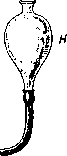
Figure 1.
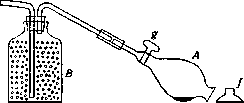
Figure 2.
of free N, measured in a gas burette: R - CH . NH2 - COOH + HNO2 = R - CH.OH - COOH + H2O + N2. For the apparatus, see figures 3 and 4. Macro- and micro-apparatus have been proposed. Reagents: 1) 50 g of potassium permanganate and 25 g of potassium hydroxide per 1 l of water, 2) 30 g of sodium nitrite per 100 cubic centimeters of water, 3) glacial acetic acid. Procedure: 1. Air
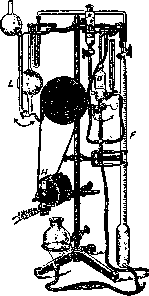
Figure 3.
is expelled from the apparatus. F is filled with water. A is filled to the mark with acetic acid, which is introduced into B, then B is filled from A with solution (2). The resulting nitric oxide displaces air through stopcock c, which is left open. After closing this stopcock and opening stopcock a, motor II, connected to B, is set in motion. Shaking continues until the liquid level in B reaches the mark 20 cm. Stopcock a is closed, and stopcock c connects B with I. 2. Decomposition of the substance containing amino groups. A definite quantity of the test liquid is introduced through burette B into B. Shaking of B is carried out for 5 minutes to 2 hours. 3. Absorption of nitric oxide and measurement of free N. Opening stopcock a, the gas is transferred from B into B, and thence, by changing the position of stopcock c, into the Hempel pipette L, filled with solution (1), which absorbs the nitric oxide. The motor is connected to L. Shaking for 1 minute. The nitrogen remaining unabsorbed is transferred back into F and its volume is measured there. A blank test is performed beforehand; the volume of nitrogen liberated in the blank test is subtracted from the volume of nitrogen obtained in the main test. The weight of the obtained N is calculated according to the tables attached to the apparatus. The method is used to determine amino groups in protein hydrolysates, in blood, and in urine. It is very accurate for the quantitative determination of amino groups in pure solutions of amino acids or polypeptides, and less accurate when determining them in mixtures.
Yu. Gefter.
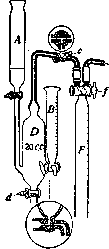
Figure 4. Detail of the apparatus depicted in Fig. 3.
Related articles
Mentioned in
Cite this page
“Van Slyke Methods.” Soviet Medical Encyclopedia. English translation of Bolshaya Meditsinskaya Entsiklopediya, 1st ed. (Moscow, 1928–1936), ed. N. A. Semashko. https://sovietmedicalencyclopedia.pages.dev/article/van-slyke-methods/