Inhalation
Historical document, translated for reference. It reflects medical knowledge of the 1920s–30s and is not medical advice.
Summary
This article from the 1928–1936 Soviet medical encyclopedia defines inhalation as a method of introducing medicinal substances into the body through breathing. It covers natural and artificial inhalation methods, including the use of gases, vapors, and atomized liquids for treating respiratory and other conditions, while noting the historical development and the state of inhalation therapy in the early 20th century.
Encyclopedia article (1928–1936)
INHALATION (from Latin inhalare—to breathe in), a method of introducing medicinal substances into the body by inhaling them. Inhalations can be natural and artificial. Natural inhalations include breathing rarefied air in the mountains, staying in an atmosphere saturated with salt—on the seashore or near cooling towers, inhaling balsamic vapors and ozone in coniferous forests, hydrogen sulfide or CO2 near springs emitting these gases, etc. Sick humanity has been treated with such natural inhalations since ancient times; Hippocrates himself recommended them.
For the artificial saturation of inhaled air with various medicinal substances, the latter must be mixed with air in the form of smoke, gas, steam, dry dust, or moist or oily mist. Inhalation of smoke from burning medicinal substances is the most ancient. Inhaling smoke for therapeutic purposes is prescribed mainly for bronchial asthma. During an attack, patients inhale smoke from burning paper impregnated with saltpeter or from burning so-called Abyssinian powder, which contains various narcotics. Smoking tobacco, opium, and hashish is also a form of narcotic smoke inhalation. When inhaled, smoke penetrates deep into the lungs along with the air; therefore, in addition to its effect on the mucous membranes, it is absorbed by the pulmonary alveoli and assimilated by the entire body.
Inhalation of gases that penetrate deep into the lungs also acts on the entire body (CO poisoning and general anesthesia). For therapeutic purposes, inhalation of oxygen is used for asphyxia and difficult breathing in severely ill patients, and carbon dioxide is used for diseases of the upper respiratory tract, namely for hypertrophic and atrophic rhinitis, hay fever, and other types of vasomotor rhinitis, and mainly for functional disorders of the olfactory nerve (Parrel). Hydrogen sulfide for inhalation has long been used at French resorts (Luchon, Cauterets), in Pyatigorsk, and in Matsesta. The therapeutic effect of inhaling sulfur waters is explained by the fact that when water is atomized, the released hydrogen sulfide is oxidized by atmospheric oxygen and forms colloidal sulfur and thiosulfuric acid. Inhaling sulfur in this form replenishes the lack of sulfur in the body. French balneology believes that the protection of the respiratory tract is a function of sulfur; its absence threatens the cell with death from exhaustion (Kryukov). Radium emanation is recommended for inhalation in cases of gout, as the emanations dissolve uric acid salts and promote the excretion of purines.
Compressed and rarefied air for inhalation is used both from individual apparatuses and in hermetically sealed chambers. Air compressed to 1/7 of an atmosphere is prescribed for chronic bronchial catarrh, bronchial asthma, emphysema, stenosis of the upper respiratory tract, anemia, chlorosis, and chronic adhesive catarrh of the middle ear. It is contraindicated in organic heart diseases. Water vapors for inhalation have been used for a long time, mainly for acute diseases of the upper respiratory tract. For false croup in children, until recently, steam inhalation was used. With steam
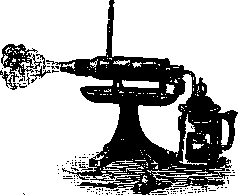
is also used for

and by this method
Figure 1. The most commonly used are those of Saenger and Siegl (Fig. 1). Apparatuses with steam temperature regulation have been proposed (Hering, Bulling; Fig. 2). Instead of steam, medicinal liquid can be atomized with compressed air. The simplest device for this is an ordinary atomizer with two bulbs; there are many improved atomizers (Saenger,
Figure 2. Park Davis, etc.). The main merit of an apparatus should be to atomize the stream as finely as possible; there is still no agreement on how deeply water dust penetrates into the larynx and bronchi. In any case, the finer the dust (and in inhalation rooms it can be brought to the fineness of mist with the help of machines), the deeper the medicinal solutions penetrate. Oil can also be atomized into a fine mist with compressed air
Figure 3.
There are various manual oil atomizers (Fig. 3). Recently in Germany, oil inhalers have been adapted to the motor of a pantostat or to separate small motors (Fig. 4). With a [name] apparatus connected to a cylinder with CO2 or O2, one can also inhale atomized oil through a mask.
Dry powdered substances inhaled for therapeutic purposes undoubtedly penetrate deep into the lungs and are assimilated by the body. The most perfect method for this is the evaporation of mineral waters and saline solutions by means of special machines, whereby salts in the form of the finest dust are inhaled both through a mask from individual apparatuses and passively in a closed inhalation room. In view of the fact that dry fine dust, brought to the fineness of tobacco smoke, is well assimilated by the body, such inhalations with salts from mineral waters are recommended mainly for lesions of the lymph glands, weakened nutrition, anemia, lymphatism and exudative diathesis, and other constitutional diseases, predominantly in childhood (Grishkevich). Inhalation agents are divided into the following groups according to their action. 1. Mucus-dissolving agents. These include soda and NaCl. These agents act especially well in natural solutions from mineral springs. Artificial solutions should not be too strong—no stronger than 0.3-0.6%. These inhalations are indicated for tracheitis, pharyngitis, and laryngitis with abundant mucus secretion, for difficult expectoration, accumulation of phlegm in the throat, etc. In acute processes, especially with fibrinous deposits, inhalations with calcium chloride are useful. 2. Astringents. These include Tannin 1%, Alumnol 1-2%, Alumen aceticum 0.2-2%. To all these solutions, 10-20% glycerin is added for softening. 3. Emollients. These include various oils, such as: Ol. Olivarum, Ol. Amygdalarum, Ol. Vaselini medicinale, emulsions of these oils, with the addition of Ol. Pini, Ol. Eucalypti, Menthol, etc. Emollient inhalations are prescribed to reduce the tension of inflamed mucous membranes, for viscous thick

Fig.
phlegm, for the drying of crusts in the nose and nasopharynx, and for any atrophic processes. As anesthetics, Dionin, Tinctura Opii, and Aqua Laurocerasi are added to solutions; for dry dust inhalations—Orthoform and Anaesthesin. Disinfecting aqueous solutions for inhalation include Natrium biboricum, Natrium benzoicum in 0.2-0.5% dilution, Resorcin 0.5-1%; oil solutions—Thymol 0.1-0.3%, Eucalyptol, Menthol—in the same dilution, Chloretone inhalant (Park Davis), Acetozone inhalant, etc. In infectious diseases, pyocyanase is inhaled. Inhalation therapy has recently been used for tuberculosis of the larynx and lungs and represents, if not a curative, then at any rate an auxiliary means to general and local treatment. Usually, for inhalation in tuberculosis, creosote, creolin, guaiacol, Peruvian balsam, and menthol are prescribed, mostly in oil or emulsion solutions (Kopylov, Forestier). Inhalations with lignosulfite are considered a specific remedy against tuberculosis. The action of lignosulfite consists in delaying the growth of virulent bacteria; furthermore, it promotes the cleansing of the lungs from phlegm by drying out the inflamed mucous membrane (A. Schmidt). Inhalations with lignosulfite are recommended for ulcerative tuberculous processes of the larynx and for pulmonary tuberculosis. They are contraindicated in hemoptysis. Inhalation therapy, dating back to deep antiquity, developed rather weakly for many centuries and only in the 19th century attracted the attention of practical physicians. At present, almost all European resorts and major cities (in the USSR—in Kislovodsk, Pyatigorsk, Matsesta, and Sevastopol) have well-equipped inhalation rooms. Nevertheless, scientifically, inhalation therapy is still poorly developed. In none of the European clinics, including those in the USSR, are there well-equipped inhalation rooms, and no research work is being conducted in this direction.
Related articles
Mentioned in
Cite this page
“Inhalation.” Soviet Medical Encyclopedia. English translation of Bolshaya Meditsinskaya Entsiklopediya, 1st ed. (Moscow, 1928–1936), ed. N. A. Semashko. https://sovietmedicalencyclopedia.pages.dev/article/inhalation/