Vibrios
Historical document, translated for reference. It reflects medical knowledge of the 1920s–30s and is not medical advice.
Summary
This article from the 1928–1936 Great Medical Encyclopedia discusses the morphology, biology, classification, and pathological significance of vibrios, including the Asiatic cholera vibrio and various saprophytic and water-borne forms.
Encyclopedia article (1928–1936)
VIBRIOS (from Latin vibrare - to vibrate), plant microorganisms having the appearance of curved rods and often resembling commas, whence (especially for cholera V.) the name "comma bacilli" (German Kommabacillus) originated. The shape of vibrios presents various deviations from the main type of "curved rod": from barely curved rod forms to forms representing almost a complete circle. When several vibrios join or during their unfinished division, S-shaped forms are formed. Vibrios, according to Cohn's old classification, belong to one of the main types of microorganisms; according to the classification of Lehmann, Neumann, and the American Bacteriological Society (1925), vibrios constitute a special genus of the family Spirillaceae from the order Eubacteriales. Vibrios belong to microorganisms ranging from 0.4 to 3.0 µm in length and from 0.2 to 0.5 µm in thickness. Vibrios (with few exceptions) are motile thanks to flagella which they possess at both ends (amphitrichous) or one flagellum at one end (monotrichous) (see Figure 1). The movement of vibrios is extremely lively, progressive, and rotational. Vibrios are Gram-negative; they stain well with aniline dyes, especially fuchsin (carbol fuchsin diluted with water 1:10). Vibrios do not form spores, they multiply in the presence of free oxygen (i.e., they are aerobes), the optimum temperature for their growth is 37° for pathogenic forms and 20–22° for saprophytic ones. The best liquid nutrient medium for vibrios is a peptone solution (1%). Under all conditions of their reproduction, the reaction of the medium must be distinctly alkaline. All vibrios grow in broth, causing its turbidity and often forming a film on its surface; on other nutrient media, they multiply depending on the variety of vibrio. Among vibrios, there are many varieties possessing various enzymes (diastatic, peptidolytic, coagulating, vitellase). Vibrios exhibit sharply expressed phenomena of variability, which is especially clearly seen in the group of pathogenic forms. Under the influence of external influences, vibrios yield various forms, morphologically and biologically distinct from the main type; these forms can remain stable through many generations, representing clearly expressed mutants (forms El-Tor, non-
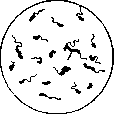
Figure 1. Vibrio with a single flagellum, pathogenic to man.
liquefying gelatin, non-agglutinating, pigmented forms). According to G. Enderlein, such forms must be considered not as mutants, but as stages of cyclogeny of vibrios. The latter view has few supporters. Among vibrios, there are pathogens and saprophytes. Pathogenic vibrios are pathogenic under natural conditions for man (V. of Asiatic cholera, V. Finkler-Priori), for animals (V. Metchnikovi-Gamaleia - for birds) and in experiments for laboratory animals [V. of Asiatic cholera, V. Metchnikovi (see Figure 3), V. berolinensis - from the Spree water, V. strictus Kutscher - from water, V. schuylkilliensis - from the river of the same name, V. danubicus - from the Danube, V. Wolfii - from secretions in chronic endometritis, V. sputigenus - from sputum, V. liquefaciens - from water]. The last seven vibrios according to Bergey are pathogenic for laboratory animals; according to Lehmann and Neumann, they are non-pathogenic. Regarding V. Finkler-Priorit, there is a similar divergence of opinion. Non-pathogenic vibrios. The majority of vibrios belong to non-pathogenic species and are predominantly inhabitants of waters. These include: Vibrio tyrogenes Deneke, isolated from cheese; V. Milleri, isolated from a carious tooth; V. aquatilis - water vibrio, described by Migula and Günther (1892) and subsequently repeatedly found in waters as a microorganism having many varieties. Here also belongs a group of luminous and phosphorescent vibrios isolated from water, such as V. albensis - Elbe vibrio, V. indicus (Bac. phosphorescens) Fischer, isolated from West Indian waters, further V. luminosus - luminous microbe of Beijerinck from the North Sea, V. balticus - luminous microbe of Fischer from Baltic waters. Non-pathogenic species include non-motile vibrios, such as V. nasalis Weibel, V. lingualis, V. parvus, V. pyogenes. To this group belong vibrios producing various pigments (V. flavus - yellow, V. aureus - golden, V. flavescens - yellowing). Standing apart is V. alcaligenes, which is classed by many in the typhoid-colon group, where it bears the name Bac. faecalis alcaligenes. Lehmann and Neumann propose to finally remove it from the typhoid-colon group and transfer it to the vibrio group, which cannot yet be agreed upon. Of the listed vibrios, only some are of the greatest importance for pathology and epidemiology. The cholera vibrio was discovered by Koch in 1883 (see Cholera in detail). The cholera vibrio exhibits frequent deviations from the main type, and therefore many forms have been described that were allegedly different from true cholera vibrios. Now all these forms must be considered just as much cholera vibrios as V. El-Tor, isolated in 1905 among pilgrims and markedly hemolytic. The same must be said of V. Nasik, V. romanus. Vibrios morphologically and biochemically similar to the cholera vibrio, but not agglutinated by anti-cholera serum, are called "cholera-like" or "paracholera". These include cholera vibrios that have lost their agglutinability, V. Finkler-Prioris, V. Metchnikovi, and a number of vibrios isolated from feces and water (see Figure 4). Some authors of such cholera-like vibrios call "paracholera" only those that biochemically show typical acid production. V. Finkler-Prioris is a microbe found in enteritis and for a long time without sufficient grounds considered the cause of cholera nostras, morphologically and biologically close to the cholera vibrio (gives a weakly expressed indole reaction). In typical cultures, it gives gelatin stab cultures differing from cholera cultures. According to Chantemesse, the Lisabon vibrio close to it is identical with it and must be considered pathogenic for man. V. Metchnikovi was described by Gamaleia and isolated from chickens. It is extremely close to the cholera vibrio, differing from the latter by high pathogenicity for pigeons, causing animal septicemia (see Figure 5). Many authors deny the possibility of sharply differentiating it from the cholera vibrio and only Pfeiffer points to his "phenomenon" with the help of which it can be distinguished from the cholera vibrio. V. Deneke in its biochemical properties stands midway between the cholera vibrio and V. Finkler-Prioris. V. Deneke is non-pathogenic for animals. According to Kupriyanov, V. Deneke produces dextrorotatory lactic acid in contrast to the laevorotatory cholera vibrio. Water vibrios. During cholera epidemics, vibrios belonging to different groups are isolated from water. Some represent true cholera vibrios, others must be called "cholera-like" because they differ from true cholera vibrios only by the absence of agglutinability in relation to specific anticholera serum, and the third group - properly "water" vibrios, which represent a number of varieties both in morphological and biological relations. The second group of vibrios is occasionally encountered outside of cholera epidemics, but as a rule, they are found not only during cholera epidemics, but also before the epidemic outbreak and after the end of the epidemic. During cholera, some of them must undoubtedly be recognized as true cholera vibrios that have lost their ability to agglutinate. What the role and significance of their findings in the interepidemic time is remains an open question. The last group, proper water vibrios, represents the most numerous among the findings in water. They already differ significantly in morphological and biological relations from the cholera group. Their size ranges from 1.0 to 3–4 µm. They usually have whole bundles of flagella at the ends (see Figure 6); they grow in broth, usually forming films, they liquefy gelatin sharply and rapidly; they are non-pathogenic for animals. Many varieties of such vibrios from various rivers have been described under various names, and according to their morphological and biological properties, water vibrios should be divided into several subgroups. One part of them phosphoresces and is known under the name of phosphorescent bacteria, some of them are morphologically similar to cholera vibrios. Another part represents large specimens easily giving spirilla, and the third part is non-phosphorescent and always retains the shape of a vibrio of various sizes. According to their ability to liquefy gelatin, they can also be divided into several subgroups - from weakly liquefying to strongly and rapidly liquefying. This third group includes
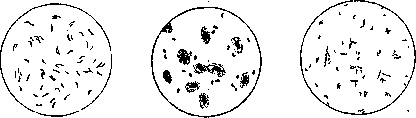
Figure 2. Vibrio from
Figure 3. Vibrio Metchni-
Fig. 4. Vibrio from hu-
water.
kovi in the blood of birds.
man feces.
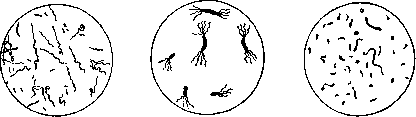
Figure 5. Vibrio in a
Figure 6. Water vi-
Figure 7. Involution-
guinea pig.
brio with many
various forms of vibrios. with flagella. within themselves various organisms known as: Vibrio aquae Migula, Vibrio liquefaciens Bergey, V. danubicus, berolinensis and others. Lit.: Zabolotny D. K., Zlatogorov S. I., Kulesha G. S. and Yakovlev V. I., The Cholera Epidemic of 1908-09 in Petersburg, 'Russian Doctor', 1909, № 12; Stutzer M., Biology of cholera-like vibrios isolated in Voronezh, 'Bulletin of Microbiology and Epidemiology', vol. I, 1922; Ermol'eva S., Phosphorescent vibrios in clinical cholera and their relation to other vibrios, 'Hygiene and Epidemiology', 1925, № 6; Bergey's manual of determinative bacteriology, Baltimore, 1925; Lehmann K. u. Neumann R., Bakteriologie, B. II, B., 1927.
S. Zlatogorov. Vibrissae, coarse, stiff hairs growing in the vestibule of the nose (vestibulum nasi), similar in structure to eyelashes. Their quantity varies depending on age (increases with years), on sex (less in women), and especially on individuality. In comparative-anatomical terms, V. correspond to tactile hairs.
Related articles
Mentioned in
- Babes-Ernst Granules
- Bacteria
- Bacteriohemolysins
- Bacteriological Landscape
- Bacteriolysis
- Bordet-Gengou Reaction
- Cholera (278 Geographical Distribution and)
- Cholera (^OSTRAS,)
- Cockroaches
- Common Cold
- Cytolysins
- Diamines
- Gruber
- Kitasato, Shibasaburo
- Methylguanidine
- Nickel
- Pfeiffer Phenomenon
- Protein Therapy
- Refuse
- Self-Purification of Water Bodies
Cite this page
“Vibrios.” Soviet Medical Encyclopedia. English translation of Bolshaya Meditsinskaya Entsiklopediya, 1st ed. (Moscow, 1928–1936), ed. N. A. Semashko. https://sovietmedicalencyclopedia.pages.dev/article/vibrios/