Volvulus
Historical document, translated for reference. It reflects medical knowledge of the 1920s–30s and is not medical advice.
Summary
This historical article from the Soviet Medical Encyclopedia describes volvulus, a form of acute intestinal obstruction where a segment of the bowel twists around its mesenteric axis. It discusses the anatomical predisposition, particularly the length of the sigmoid colon (S-Romanum) and the mesentery, noting a higher prevalence in Russia and Eastern Europe linked to diet and physical labor.
Encyclopedia article (1928–1936)
VOLVULUS, one of the types of acute intestinal obstruction, consisting in the twisting of a certain section of the intestine together with its mesentery around the longitudinal axis of the latter. Under normal conditions, volvulus of the small intestine and of the sigmoid colon (S-Romanum) is conceivable. Volvulus of the cecum, or rather of the segment up to the junction of the small intestine, is an exceptionally rare phenomenon and is more often expressed in the form of a kink, incorrectly classified as a volvulus. The transverse colon has its own mesentery, but its great width prevents twisting. Bykovsky, who described a volvulus of the transverse colon, could find only three other cases in the literature. As a developmental anomaly, the cecum and small intestine sometimes retain a common mesentery (mesenterium commune ileo-caeci Gruberi), which creates the possibility of volvulus, in which a larger or smaller section of the ascending colon always participates, and in one of Spasokukotsky's observations, the entire ascending colon and half of the transverse colon were involved. For volvulus to occur, a great length of the mesentery and the smallest possible width are required (C. von Manteuffel). In individuals with a wide chest, narrow pelvis, and elongated abdomen, the mesentery of the small intestine is longer and situated more transversely (Pavlenko), which is why volvulus of the small intestine is observed almost exclusively in men. In addition to congenital predisposition, there is an undoubted acquired one, usually associated with the dietary characteristics of individual races. In Germany, volvulus has always been considered a rare disease, and volvulus of the small intestine exceptionally rare. König recognized this disease as specific to Russia and explained this by the greater length of the intestine. This opinion was confirmed for various nationalities. A number of studies established that the inhabitants of the Baltic, Finland, and Poland are predominantly possessors of long sigmoid colons. However, Tarenetsky as early as 1881 asserted that the length of the S-Romanum increases depending on nutrition not for a nation, but for a given subject. Sozon-Yaroshevich considers the average length of the S-Romanum in persons over 40 years of age to be one and a half times greater than in 20-year-olds, which is confirmed by a number of authors. Some German authors definitely indicate that with the deterioration of the nutrition of the German population during and after the war, cases of volvulus became much more frequent. In the elongation of the intestine, the contraction of neighboring sections plays a significant role. There are known observations of excision of the S-Romanum and the formation of a new one, which once even required a new resection during volvulus (Spasokukotsky). According to Sozon-Yaroshevich, the average length of the S-Romanum under the age of 10 is 31.55 cm, 11–20 years—36 cm, 21–30 years—47.75 cm, 31–40 years—57.27 cm. Kirsner, in 100 fresh cadavers during forensic autopsies, determined the length of the S-Romanum to be from 37 to 85 cm. Some authors for France and England give figures from 12.5 to 84 cm. Most authors attribute this to nutrition with coarse vegetable food. Kirsner found the greatest length in city dwellers to be not 85 cm, but 63 cm. This law also applies to volvulus of the small intestine. In the large hospitals of Moscow, volvulus is observed in isolated cases (for 1923–27, in the autopsy rooms of Moscow, volvulus of the intestines was noted 128 times in 28,916 autopsies of children and adults; in this number, children from 1 to 15 years old accounted for 7,533); meanwhile, during 11 years of work in Smolensk, out of 96 cases of acute obstruction, there were 47 cases of volvulus, and of this number, 28 times it was volvulus of the small intestine (with the exception of two cases, all others were in peasants). This observation is confirmed by Uspensky for Tver, and Sklyarov for the rural population of Ukraine. Along with the length of the intestine, or rather of the mesentery, its narrowness plays an equally important role, especially at the base of the twisting loop. This narrowness is both congenital and acquired, but the comparative rarity of volvulus in children speaks rather for its acquired nature. The cause is Virchow's peritonitis mesenterica circumscripta, mesosigmoiditis, arising on the soil of trauma by coarse fecal masses and constipation, which promote inflammation of the mucous membrane. Graser blames diverticula developing during constipation in the wall of the S-Romanum, at the site of attachment of the mesentery, in which fecal masses stagnate, leading to ulceration, lymphangitis, mesenteriitis, and tissue scarring. All these factors predisposing to volvulus at the same time predispose to its recurrence, which is often repeated. Sometimes one even has to operate for recurrent volvulus twice. Seefisch even attributes the scars of the mesentery not to mesenteriitis, but to repeated incomplete volvulus. In addition to the predisposition existing over many years, immediate causal factors are also necessary for the formation of volvulus. These include strong shaking of the body, strain, excessive filling of the intestine, and the descent of a fecal-filled loop of the intestine in front of another. Payr explains volvulus by uneven filling of the blood vessels. Spasokukotsky assumes as a necessary condition for volvulus the emptiness of the mass of the intestines, due to which the filled loop receives the possibility of movement without resistance from neighboring ones. In people with a well-emptying intestine (peasants) and with infrequent meals, these conditions are created even for the small intestines. It is interesting to compare the frequency of volvulus according to the data of German and Russian surgeons. In Bier's Berlin clinic, out of 250 obstructions, only 12% were due to volvulus and strangulation by bands. Perthes, in 203 cases, found 18 volvulus cases (9%). Braun, in 293 cases in the post-war period, gives 25% volvulus. Grekov (Leningrad) had 511 cases, including 120 volvulus of the sigmoid and 22 of the cecum. Muzeneck (Riga), in 374 cases for 1911–25, had 173 volvulus cases (47%). According to the data of Moscow autopsy rooms for 1923–27, volvulus constitutes 59% of all obstructions. The overwhelming majority of volvulus cases are observed in men, and moreover, of working age, in which all authors agree. The connection with physical labor is also indicated by the observation that for the peasant population of Russia, 2/3 of the cases fall in the summer and only 1/3 in the winter, when the peasants switch to domestic labor and more regular nutrition. Forms of Volvulus: Nothnagel already distinguished several forms of volvulus: 1) twisting of the intestine around its own axis (cecum), 2) twisting of the intestine and mesentery around the mesenteric axis, and 3) twisting of the intestine with the mesentery around another loop. The rarity of the first form and the conditional nature of the third allow us to disregard them. The direction of the volvulus, according to Wilms (which was also confirmed by the Russian school of Wahl), occurs in the clockwise direction 21/2 times more often than in the reverse. For the outcome of the disease, it is of great importance through how many degrees the twist occurs, with twists observed from 180° to 360° and more—up to three full turns. The latter was observed several times on the small intestine (Spasokukotsky). Volvulus belongs to the strangulation type of obstruction. Strongly pronounced strangulation, according to C. von Manteuffel, entails severe damage to the intestinal wall, which very soon becomes permeable to bacteria; gangrene and acute peritonitis develop, which determine the fate of the patient. Volvulus of the small intestine is particularly severe, especially since in 2/3 of the cases the entire intestine twists, less often half, and very rarely a single loop. The delicacy of the mesentery and its vessels causes rapid compression of the latter even with a twist of 180° and the death of the intestinal wall, which is manifested by a very rapid cessation of peristalsis. This circumstance very often leads to the confusion of this form with peritonitis, especially since the abdomen maintains a uniformly distended shape all the time. Death usually occurs before gangrene of the intestines develops. Even untwisting the volvulus with apparent integrity of the intestines does not lead to recovery due to complete paralysis of the intestine. Death occurs in 70–77% of cases. A somewhat different picture is presented by volvulus of the S-Romanum, which is usually prepared over a long period. The thickening and coarsening of the mesentery and intestine and the length of the helical path protect the vessels from complete compression (which, however, is far from being the rule). From a detailed analysis of 48 cases of the Riga Hospital (Yankovsky), it is clear that in 24 cases of gangrene of the intestine, gangrene occurred 5 times after one day, 4 times after two, 3 times after three, and the rest from 5 to 15 days. At the same time, in 24 cases without gangrene, which gave 75% recoveries, in 9 cases from 5 to 9 days passed before the operation. Many cases of even longer periods are known (Sklifosovsky—14 days with a recovery outcome). (For the causes of death, intoxication, exudation, permeability—see Ileus.) Only the phenomena characteristic of volvulus of the S-Romanum without acute compression of the vessels will be described here. They are expressed in significant edema of the intestinal wall, its thickening, and significant dilation, making the intestine look like a car tire (Fig. 1). According to the law established by Stone, Bernheim, Whipple, and Ellis, which states that the phenomena of intoxication are the more acute and severe the higher the site of obstruction, the S-Romanum presents favorable conditions in this respect; in volvulus of the S-Romanum, the patient often surprises with his good condition, despite many days of illness. On the contrary, volvulus of the small intestine is characterized by a rapid development of intoxication and a decline in cardiac activity.
The clinical picture is characterised: subjectively, by acute onset of pain; objectively, by retention of gas and stool. The latter should not be given decisive importance, since a certain amount of stool located below the site of the volvulus may be retained and passed independently or with enemas. The increased peristalsis characteristic of mechanical obstruction very quickly fades in volvulus of the small intestine, and Wahl's sign (local meteorism) is also absent. For the caecum, the presence of a distended elastic swelling in the right half of the abdomen is characteristic (Figure 2). In volvulus of the sigmoid colon, asymmetrical abdominal distension is often noted (Figure 3), and according to C. F. Manteuffel, a circumscribed distension running across the abdomen below the pit of the stomach and belonging to the distended transverse colon. Wahl's sign is more pronounced the less the small intestines are distended. A slower development of clinical symptoms for the sigmoid colon is not always the rule, although a rotation of 180° may not affect even the venous vessels. With severe distension of the intestine, splashing on succussion and the sound of a falling drop on auscultation are often noted. With a rotation of up to 180°, the possibility of spontaneous untwisting is not excluded. In contrast to coprostasis, in this case, it is not stool but mainly gases that are passed. The differential diagnosis between different forms of volvulus, coprostasis, and especially tumours is far from easy. The use of X-rays is recommended, which can give a clear picture even without the infusion of contrast media. Treatment of volvulus must be exceptionally energetic and fall under the management of surgeons. The very old dispute between physicians and surgeons had ground only because of the equally dismal results in the pre-antiseptic era. Cases of untwisting from the use of oil and high enemas have been described. With the current successes of asepsis, expectant treatment is permitted only in the undoubted absence of threatening symptoms in the first days, or rather, on the first day, with a good pulse, peristalsis, and little distension. Waiting is limited to the time required to test the effect of, in the worst case, a prolonged oil enema, and in the best case, a high enema. The latter should be performed in a high knee-chest position with large volumes of water (12–15 glasses). After its introduction, the patient is turned onto their back, and the water is evacuated with a siphon. The passage of gases justifies repeating the attempt. Once surgery is decided upon, it must be performed immediately. Most surgeons at present reject general anaesthesia in favour of local, spinal, and paravertebral anaesthesia, especially with good blood pressure. Grekov, on the contrary, is a proponent of deep general anaesthesia in difficult cases. The incision is made along the linea alba from the pubis above the umbilicus to prevent rupture of the distended intestinal loops. A collapsed caecum directs attention to the small intestines; a distended one forces an examination of the descending colon. Without eviscerating the twisted loops, untwisting is impossible, the determination of the direction of which is now not difficult. In rare cases, untwisting is prevented by fresh adhesions and bands. In volvulus of the sigmoid colon, immediate insertion of a tube into the rectum gives rapid emptying, as a result of which other methods are rarely required. For the small intestines, emptying is dictated by the same considerations as in obstruction in general. The average mortality, according to Grekov, is: 75% for the small intestine, 73% for the caecum, 53% for the sigmoid colon; according to Perthes and Braun, 39% and 35%. With an undamaged intestinal wall, untwisting (detorsio) is a simple and safe operation, giving a low mortality rate. The height of the latter is determined by the degree of poisoning of the heart muscle and changes in the intestinal wall. In gangrene of the caecum and small intestines, resection is solely indicated. One-stage excision of a gangrenous sigmoid colon gives very poor results, and it is wiser to perform it in two stages with exteriorisation of the loop according to Mikulicz, to which Grekov advises adding an enteroanastomosis. Grekov's proposal of evagination, respectively, bringing the gangrenous section out through the rectum, deserves attention. Untwisting of the volvulus is successful only in so far as the affected part of the intestine is capable of restoring its function. In cases of far-advanced paralysis, the creation of a faecal fistula is indicated, especially in volvulus of the small intestines. The latter usually turn out to be severely congested, easily tear under force, and do not tolerate stroking and squeezing, and puncture empties only the nearest loop. If postoperative paralytic obstruction becomes clear, the creation of a faecal fistula should not be delayed. Untwisting of the volvulus does not eliminate the causes that create a predisposition to it and the danger of recurrence, and has brought to life a whole series of proposals. The oldest is suturing the intestine or its mesentery to the peritoneum—colopexy, typhlopexy; for the small intestines, suturing the mesentery to the posterior abdominal wall. Pikin fixes the sigmoid in a pocket of the parietal peritoneum. More expedient are attempts to eliminate the causal factor by shortening the mesentery of the sigmoid colon (sigmoidopexy) with a series of sutures or widening it after the manner of the Heineke operation. The creation of an anastomosis between the limbs of the loop is incorrect, since bringing them closer together increases the chances of volvulus. The most radical method is excision of the intestine, which gives hope of simultaneously getting rid of constipation associated with chronic disease of the large intestine. Against this speaks the significant danger of the operation, which is technically difficult due to the distension of the intestines and changes in the tissues. At recent surgical congresses, primary resection found no defenders among authoritative surgeons of the USSR and Western Europe, but increasing reports from a number of hospital institutions, speaking of large numbers of successful outcomes, put this question on the immediate agenda. Literature—see literature for the article Ileus.
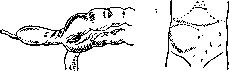
Figure 2.
Figure 3.
Figure 2. Volvulus of the caecum through 180° without symptoms of obstruction. Figure 3. Shape of abdominal distension in volvulus of the sigmoid colon.
Related articles
Mentioned in
Cite this page
“Volvulus.” Soviet Medical Encyclopedia. English translation of Bolshaya Meditsinskaya Entsiklopediya, 1st ed. (Moscow, 1928–1936), ed. N. A. Semashko. https://sovietmedicalencyclopedia.pages.dev/article/volvulus/