Brownian Movement
Historical document, translated for reference. It reflects medical knowledge of the 1920s–30s and is not medical advice.
Summary
Brownian movement is the motion of microscopic particles suspended in liquid, caused by collisions with liquid molecules. First observed by botanist Robert Brown in 1827, this phenomenon provides evidence for molecular motion and has applications in molecular physics, thermodynamics, and cellular biology.
Encyclopedia article (1928–1936)
BROWNIAN MOVEMENT (Brown), the movement of the smallest particles suspended in a liquid, occurring under the action of collisions between these particles and the molecules of the liquid. It was first observed under a microscope by the English botanist Brown in 1827. If a drop of liquid in which the smallest particles are suspended (e.g., particles of gamboge, ink, carmine, or others) is introduced into the field of view of a microscope, one can
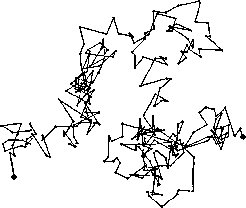
Brownian movement of gamboge particles
in water. The dots mark the positions of the particle every 30 seconds (according to Perrin). observe completely disorderly displacement of them, transitions from place to place, accompanied by continuous trembling. The smaller the size of such particles, the more vividly the phenomenon manifests itself: with sizes over 0.004 mm, movement practically ceases. B. d. makes it possible to trace certain features of molecular motion, inaccessible to direct observation. It turns out that each particle visible in a microscope can be considered as a giant "molecule". The real molecules moving around such a particle strike it from all sides; if the particle is too large, then the effect of all strikes mutually cancels out, and no displacement of the particle can be observed. On the contrary, if the particle is small enough, then from the huge number of strikes it receives, certain ones begin to stand out, especially strong ones—those that are delivered by molecules moving with particularly high speeds. Under the action of such strikes, sharply standing out among the others, the particles come into motion, noticeable in a microscope. B. d. illustrates the character and laws of the thermal motion of invisible molecules. But, besides this, it makes it possible to visually trace the distribution of particles in a field of gravity and to find a complete analogy between such a distribution and the change in the density of air with increasing height above the earth's surface. For this, it is sufficient to introduce a drop of an alcoholic solution of mastic into a capillary tube filled with water. Then the smallest particles of mastic formed in the water will fall under the action of gravity and distribute themselves at different levels in complete agreement with the so-called barometric formula: at the bottom there will be the greatest concentration of particles, and the higher, the less it will be. The study of B. d. served a number of purposes in molecular physics: it turned out to be possible to calculate several universal constants, to study in detail the phenomena of diffusion and osmosis. It received great importance for the exact interpretation of the so-called second principle of thermodynamics.
V. Shuleikin. B. d. in a biological aspect represents considerable interest for studying the colloidal properties of protoplasm in different physiological, resp. physico-chemical, states of cells and can indicate the degree of its viscosity, and indirectly—also its osmotic properties and active reaction of the surrounding environment. The presence or absence of B. d. in cells cannot serve as an indicator of their life or death. Observations by Gaydukov (1910) on various cells of Vallisneria showed that the temporary cessation of intracellular currents of protoplasm, insofar as it is associated with its gelatinization, entails also the suspension of B. d., but since this process is reversible, the liquefaction of protoplasm entails the resumption of both intracellular currents and B. d. For observing B. d. in animal cells, the best object is neutrophilic leukocytes, especially in saliva, in the form of so-called salivary corpuscles. However, in the protoplasm of neutrophils, the movement of granules is observed not only in normally mobile fresh specimens, but also in dying cells, where under conditions of osmotic hypotonia, due to the swelling of protoplasm and a decrease in its viscosity, the movement of granular particles gradually takes on an increasingly chaotic

character of B. d., and the movement continues even outside the cells after their destruction.
Related articles
Mentioned in
Cite this page
“Brownian Movement.” Soviet Medical Encyclopedia. English translation of Bolshaya Meditsinskaya Entsiklopediya, 1st ed. (Moscow, 1928–1936), ed. N. A. Semashko. https://sovietmedicalencyclopedia.pages.dev/article/brownian-movement/