Dermographism
Historical document, translated for reference. It reflects medical knowledge of the 1920s–30s and is not medical advice.
Summary
Dermographism is a vascular reaction of the skin that appears as visible lines when the skin is scratched or stroked. This article describes various types of dermographism (white, red, edematous, reflexive, and black) and their clinical significance in the 1930s understanding of medicine.
Encyclopedia article (1928–1936)
DERMOGRAPHISM, dermographismus (from Greek derma-skin and grapho-I write), "skin-writing," a reactive response from the skin's vasomotors obtained through mechanical irritation of the skin (e.g., when stroking it with a hammer handle or pin) in the form of lines corresponding to the irritation produced. The picture of dermographism changes according to the method of drawing on the skin, the force of pressure on the skin, and the subject's ability to react to irritation (individual, constitutional factor). In general, smooth, delicate, young, well-nourished skin reacts better than rough, dry, aged skin. Local and reflex D. are distinguished, since the skin reaction is limited only to the site of irritation or extends to the surrounding tissue. Types of D.: a) White D. (dermographismus albus-see figure 2) appears 10-20 seconds after light irritation in the form of white (due to angiospasm) stripes on the skin, rising 1-2 mm on both sides of the irritation site; the phenomenon lasts 2-3 minutes; it is easily produced in almost all people, especially well in febrile conditions in asthenic subjects. In a weak form, it is found in many healthy children, sharply increases in children with exudative diathesis (in eczema, pruritus, etc.), as well as conditions accompanied by skin hyperemia (for example, erythema solare), and especially in scarlet fever, where it has some prognostic value. b) Red D. (dermographismus ruber-see figures 1 and 3) is revealed with stronger irritation after 15 seconds in the form of hyperemia stripes, sometimes surrounded by white angiospastic stripes; it remains on the skin sometimes for an hour; it represents a common, generally normal phenomenon; its absence rather indicates a certain weakness of the vasomotor reaction. Bright red D. is characteristic of healthy newborn children; with age it weakens. c) Edematous D. [dermographismus oedematosus (see figure 4), elevatus; urticaria factitia-artificial urticaria]-an individual type of skin reaction in the form of an edematous ridge (1-2 mm in height and 5-15 mm in width) appearing in the skin, developing slowly, sometimes after many minutes, persisting for a long time and disappearing slowly; this is a relatively rare phenomenon, especially in its severe form. Edematous dermographism is a common phenomenon on the forehead in children of the first months of life. d) Reflex D. (dermographismus reflector.) is obtained by stroking the skin with a pin; its appearance is most characteristic with light irritation in the form of a relatively very lively hyperemia or pallor of the skin from all sides of the local, relatively weak irritation; the phenomenon arises after 5-30 seconds, continues from 72 to 10 minutes. The normal red D. in early childhood becomes reflexive in many pathological conditions accompanied by toxemia (for example, toxic dyspepsia, meningitis, sepsis, etc.) and has some diagnostic significance here. e) Black D. (dermographismus niger) represents a unique, rarely observed phenomenon, completely different in appearance and essence from other types of D.; it appears in some persons when a copper or silver plate is drawn across the skin (in particular with a hammer handle from which nickel plating has come off, with a coin) in the form of black stripes; these stripes are easily washed off and represent the smallest black pieces of metal remaining on the skin due to some physicochemical processes that occur when a certain metal is drawn across the skin; here we are dealing with some, apparently chemical, peculiarity of the organism, sometimes this phenomenon depends on cosmetic procedures applied to the skin (powder, fat, paint, etc.). Black D. is a completely different phenomenon compared to the above-mentioned types of D., since the latter represent vascular and vasomotor reactions of the skin. D. in a moderate degree is a normal phenomenon and can only indicate the presence of a more or less lively vascular reaction in a given subject. Some consider that D. is especially often observed in epileptics, schizophrenics, progressive paralytics. Usually it is found more markedly expressed in traumatic neurosis, Basedow's disease. D. can be considered as a state of irritability weakness of the vasomotor apparatus on the basis of a certain excitation of the sympathetic nervous system. A sharply expressed D., in particular edematous, may depend on a local lesion of the brain's vegetative centers, for example, as a result of encephalitis. Reflex D. can serve as an auxiliary symptom in assessing the localization of the process in spinal cord lesions. White D. may turn out to be a characteristic phenomenon in the initial stage of meningitis, pruritus and other diseases with a pronounced increase in the tone of vasoconstrictors. Absence of reflex D. is sometimes observed in severe poisonings (diphtheria, veronal). The doctrine of dermographism cannot yet be considered complete. Making significant conclusions based only on manifestations of dermographism is not possible.
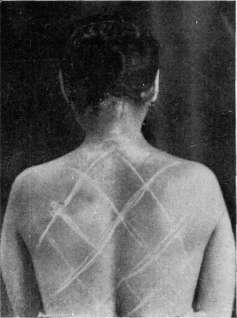
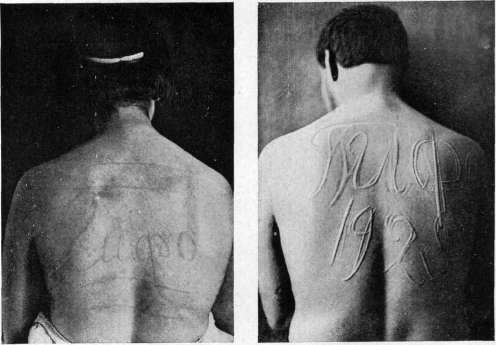
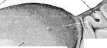
Figure 1. Dermographismus ruber et albus. Figure 2. Dermographismus albus. Figure 3. Dermographismus ruber.
Figure 4. Dermographismus oedema osus. See entry Dermographism.

^.rrr
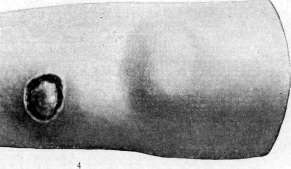
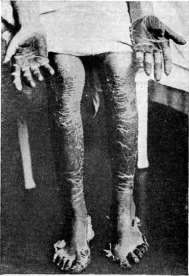
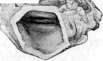
Figure 1. Dermatosis praecancerosa (Morbus Bowen) (From Frieboes.) Figure 2. Salvarsan dermatitis (type of exfoliative erythrodermia). Figure 3. Dermoid cyst (a) of the ovary. The cyst contents contain much hair, fat; b-uterus; c-tubes. (From a specimen of the museum of 1st Moscow State University). Figure 4. Ruptured syphilitic gumma (with "gummy core"). (From the Clinic of skin and venereal diseases of 1st Moscow State University.) See entry Gumma, Dermatitis, Dermoid, Dyskeratosis.
Some consider that D. is especially often observed in epileptics, schizophrenics, progressive paralytics. Usually it is found more markedly expressed in traumatic neurosis, Basedow's disease. D. can be considered as a state of irritability weakness of the vasomotor apparatus on the basis of a certain excitation of the sympathetic nervous system. A sharply expressed D., in particular edematous, may depend on a local lesion of the brain's vegetative centers, for example, as a result of encephalitis. Reflex D. can serve as an auxiliary symptom in assessing the localization of the process in spinal cord lesions. White D. may turn out to be a characteristic phenomenon in the initial stage of meningitis, pruritus and other diseases with a pronounced increase in the tone of vasoconstrictors. Absence of reflex D. is sometimes observed in severe poisonings (diphtheria, veronal). The doctrine of dermographism cannot yet be considered complete. Making significant conclusions based only on manifestations of dermographism is not possible.
Related articles
Mentioned in
Cite this page
“Dermographism.” Soviet Medical Encyclopedia. English translation of Bolshaya Meditsinskaya Entsiklopediya, 1st ed. (Moscow, 1928–1936), ed. N. A. Semashko. https://sovietmedicalencyclopedia.pages.dev/article/dermographism/