Ephedra Vulgaris
Historical document, translated for reference. It reflects medical knowledge of the 1920s–30s and is not medical advice.
Summary
Ephedra vulgaris is a plant from the Gnetaceae family found in temperate zones of Europe and Asia. It contains ephedrine and pseudoephedrine alkaloids, which have effects on the cardiovascular system, smooth muscles, and central nervous system.
Encyclopedia article (1928–1936)
EPHEDRA VULGARIS Rich. (E. monostachya L., E. distachya L., E. helvetica C. A. Mey, yadorny khvoynik, trava Kuzmicha), a plant of the Gnetaceae family, growing in temperate zones of Europe and Asia. Its branches and flowering parts, in addition to phytosterin-like compounds and benzcatechin, contain the alkaloids ephedrine (Ephedrin) and pseudoephedrine (Pseudo-ephedrin)—secondary bases first obtained as hydrochloride salts by Nogai (1887) and Merck (1893). Both alkaloids belong to the group of aromatic aminoalcohols (to which adrenaline also belongs) and are stereoisomers; to a certain degree, one can transform into the other. Their empirical formula is C10H15NO, and their structural formula is: CH(OH)·CH·NH·CH3·C6H5. Thus, they are phenyl-propanol-methyl-amines. Ephedrine (l-Ephedrin) forms colorless crystals that melt at 38-40° and boil (without decomposition) at 255°; it is easily soluble in water, alcohol, ether, and chloroform; its solutions rotate plane-polarized light to the left. The hydrochloride salt of ephedrine forms colorless, needle-shaped crystals; it melts at 215° and is easily soluble in water, less so in ethyl alcohol. Pseudoephedrine (d-Ephedrin) forms colorless crystals with a weak, pleasant odor; it melts at 117-118°; it is easily soluble in alcohol and ether, poorly soluble in cold water; its solutions rotate plane-polarized light to the right. The hydrochloride salt of pseudoephedrine appears as yellowish crystals that melt at 175-176° and are soluble in water and alcohol. Recently, a synthetic, optically inactive hydrochloride ephedrine (Merck's Ephedronin) has been obtained. In their effect on the organism, all three types of ephedrine are qualitatively similar; in terms of strength of action, l-Ephedrin ranks first, being 4-5 times more active than d-Ephedrin and twice as strong as synthetic ephedrine.
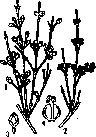
Ephedra vulgaris: 1 and 2 - branches with female (3) and male (4) inflorescences.
Local action. In humans, 40-60 minutes after instillation of a 10% (not weaker!) solution of l-Ephedrin into the conjunctival sac, dilation of the pupil occurs without change in accommodation; the dilation lasts 5-20 hours. The point of application of the action is considered to be the endings of the sympathetic nerve in the m. dilatator pupillae. Irrigation of the nasal mucosa of animals with a 1:1,000 solution reduces experimentally induced swelling of it (the small vessels constrict).- The general (resorptive) action of ephedrine. The characteristic increase in blood pressure in humans reaches a level 35-50 mm Hg above the initial and remains elevated for 3-4 hours, without giving the subsequent decrease that is observed with adrenaline. The increase in pressure occurs from strengthening of heart contractions, the rhythm of which can either increase or (secondarily, from the increased blood pressure) decrease, and from constriction of blood vessels, mainly in the area of the p. splanchnici. It is possible that the increase in pressure also depends in part on the enhanced secretion of adrenaline by the adrenal glands, which is caused by ephedrine. At the same time, it has been proven that ephedrine to a large extent enhances the cardiovascular action of adrenaline. The action on the heart is explained by excitation of the endings of its sympathetic nerves (perhaps also by action on the ganglion stellatum), while the point of application of the action on the blood vessels has not been clarified. Ephedrine exerts an effect on the smooth muscle organs similar to but weaker and longer-lasting than that of adrenaline: the intestine relaxes, the movements and tone of the uterus increase; spasm of the bronchial muscles, caused by muscarin or peptone, is eliminated, and the bronchi dilate. The pupil dilates also when ephedrine is injected under the skin, and on the side with the cut sympathetic nerve, the dilation is weaker than on the untouched side, which speaks for a central action of ephedrine (along with peripheral). On the blood sugar level, ephedrine either has no effect or only insignificantly increases it, sharply yielding in this respect to the analogous action of adrenaline. Preliminary administration of ephedrine does not enhance this action of adrenaline. On the secretion of saliva, ephedrine has no effect; its diuretic action is inconsistent and clearly depends on changes in kidney circulation. With relatively large doses, excitation of the central nervous system (first of all, of the respiratory center) occurs, which in animals gave strong motor excitement, clonic convulsions, increase in body temperature; at the same time, extrasystoles, acute dilation of the heart, fall in blood pressure, increased peristalsis and spasm of the intestine are observed. Ephedrine has not been found in the urine; it is believed that it is completely destroyed in the body. Preparations and indications for their use. 1. Herba Ephedrae vulgaris - a folk remedy in China (for over 5,000 years), in the Caucasus, in southern Siberia, and in the former Samara province for various diseases (constipation, gout, syphilis, etc.); clinical confirmation of such action has not been obtained (Levashov and Zasetsky). In Addison's disease, some have seen success (partial) from the use of an infusion (10.0-15.0:150.0, a tablespoonful 3-5 times a day). 2. Ephedrinum hydrochloricum (less often - Ephedrinum sulfuricum); it is given more often per os (0.04-0.1 per dose), but is also injected into the muscle (0.04-0.05) or under the skin (0.015-0.05); the preparation is well absorbed. Many caution against intravenous administration (0.01-0.015). For sterilization, solutions can be boiled, since the active principle is not destroyed thereby. It is widely used in attacks of bronchial asthma (per os not less than 0.05, action in 15-30 min.); success depends entirely on the severity of the case; in individual cases of Addison's disease, hypotension, and shock, favorable results have been noted. With local application (irrigation of the nasal mucosa with a 3% solution), very good effect has been noted in hay fever and in chronic congestive and hypertrophic conditions of the nasal mucosa. 3. Pseudo-ephedrinum hydrochloricum is used mainly externally (10-12% solution) to cause dilation of the pupil; solutions stronger than 12% irritate the conjunctiva. 4. Ephedronin (Merck's) - synthetic ephedrine; clinical observations on its action are still few. 5. Mydrin (a mixture of 9 parts of ephedrine with 1 part of Homatropin) - in a 10% solution (externally) for diagnostic purposes (in eye examinations); maximum dilation of the pupil lasts only 1½ hours. 6. Scopolamin-Ephedrin (Merck's) - ampoules containing 0.001 of scopolamine and 0.025 of ephedrine. In this combination, the harmful side effect of scopolamine is reduced, while its narcotic action is not impaired.
Related articles
Mentioned in
Cite this page
“Ephedra Vulgaris.” Soviet Medical Encyclopedia. English translation of Bolshaya Meditsinskaya Entsiklopediya, 1st ed. (Moscow, 1928–1936), ed. N. A. Semashko. https://sovietmedicalencyclopedia.pages.dev/article/ephedra-vulgaris/