Galvanotaxis
Historical document, translated for reference. It reflects medical knowledge of the 1920s–30s and is not medical advice.
Summary
Galvanotaxis is the phenomenon of organisms responding to irritation caused by the passage of galvanic current through their environment, resulting in changes in movement direction or growth patterns. This response varies among different organisms, with some moving toward the cathode (positive galvanotaxis) and others toward the anode (negative galvanotaxis).
Encyclopedia article (1928–1936)
Galvanotaxis, galvanotropism, the phenomenon of response in various organisms to irritation caused by the passage of a galvanic current through the surrounding medium. The response manifests as a change in the nature of movement or direction of growth (in plants). Thus, aquatic animals when a weak galvanic current is passed through water either move toward the negative pole, the cathode, to the positive pole, the anode (positive galvanotaxis), or move in the opposite direction (negative galvanotaxis). In rare cases (some infusorians: Spirostomum, Styloni-chia) animals when a current is passed align their longitudinal axis across the direction of the current. The first galvanotactic phenomena of irritation in animals were discovered by Hermann (Hermann, 1885) on tadpoles and fish embryos. These animals when a current is passed align their longitudinal axis in the direction of the current, with their head toward the cathode. Later similar phenomena were observed in other higher animals, but they are particularly widespread in various unicellular organisms (Protozoa). The simplest organisms are studied on a special slide, in a drop of water, between two electrodes. Among the simplest organisms, most infusorians (e.g., Paramaecium, Halteria, etc.), part of the flagellates (Peridinium), and many amebas exhibit distinct negative galvanotaxis. On the contrary, some flagellates (Polytoma, Cryptomonas) and infusorians (Opalina) possess positive galvanotaxis. In plants too, galvanotropic phenomena have been found—namely, the ends of the roots of some plants curve toward the cathode when a weak constant current passes through them for a prolonged period. There are organisms (Chilomonas among flagellates) in which the direction of movement changes depending on the strength of the current.
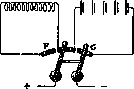
organisms (Chilomonas among flagellates), in which the direction of movement changes depending on the strength of the current.
Related articles
Mentioned in
Cite this page
“Galvanotaxis.” Soviet Medical Encyclopedia. English translation of Bolshaya Meditsinskaya Entsiklopediya, 1st ed. (Moscow, 1928–1936), ed. N. A. Semashko. https://sovietmedicalencyclopedia.pages.dev/article/galvanotaxis/