Giants
Historical document, translated for reference. It reflects medical knowledge of the 1920s–30s and is not medical advice.
Summary
This article from the 1928–1936 Soviet medical encyclopedia describes giantism, a pathological condition characterized by excessive growth of the limbs relative to the trunk and skull. It details the clinical features, causes, and prognosis of the condition, distinguishing it from acromegaly and discussing partial giantism.
Encyclopedia article (1928–1936)
GIANTS, GIANTISM. Giant growth refers to pathological states characterized by intensified growth of the limbs with relative retardation in the development of the trunk and skull and often resembling acromegalic changes in the face and limbs. While the average body length of an adult European fluctuates between 154 and 162 cm, giants aged 18-20 reach a length of 190-200 cm and may continue to grow beyond 220 cm and more even at ages 25-30, when growth in normal subjects has already ceased. Giant growth is more often observed in men than in women and usually begins during the period of sexual maturation. Cases with an earlier onset of excessive growth are of considerable rarity. Giants usually originate from parents of normal stature and at birth differ in stature and weight from other newborns. In childhood they also develop completely normally, but before the onset of sexual maturity a tendency to intense growth begins to manifest in them, during which this intensification of growth may be continuous or occur in periods, with temporary delays or even stops. In terms of psyche and character, giants resemble children. Sexual capacity in giants fades early, and they are usually childless. In many cases, there is an increase in the bones of the face, hands, and feet, which is not characteristic of pure giantism but is characteristic of acromegaly. In these cases, there is not a pure form of giantism but a mixed form of giantism with acromegaly, representing a phenomenon as frequent as the combination of giantism with infantilism. According to the classification of Launois and Roy, giant growth is subdivided into 2 types: 1) acromegalic giantism (see figure), which is a consequence of increased function of the anterior glandular lobe of the pituitary, and 2) eunuchoid or infantilistic giantism with underdevelopment of the sexual organs, in which the primary moment is hypogonadism, and the secondary is hyperpituitarism. According to the observations of Steruberg, in 40% of giants there are acromegalic phenomena. The relationship of giantism to acromegaly is also evident in anatomical changes in the brain appendage, hypoplasia of the sexual glands, and often encountered glycosuria. At autopsies of giants, a significant hypertrophy of the brain appendage is usually found. The weight of the brain in giants is very small in comparison with the weight of their body. Epiphyseal cartilages do not ossify for a long time, the sutures remain open for a prolonged time, and exostoses are often noted. Studies of the skeletons of giants and X-ray examinations of living giants show much in common with acromegaly in the structure of their skeleton in the form of increased size of the Turkish saddle, expansion of air cavities, thickening of the skull walls, prognathism, thickening of the supraorbital and zygomatic arches, kyphoscoliosis, and acromegalic changes in the limbs. Brissaud and Meige, noting the frequent combination of acromegaly and giantism, observed in both giantism and acromegaly an increase in the pituitary and identical clinical data for both diseases in the form of headaches, muscle weakness, suppression of intellect, and weakening of sexual function, consider that acromegaly and giantism represent equivalent diseases, the essence of which lies in a disturbance of the organism's special trophic functions, during which, if the disturbance of these functions occurs in a growing organism with still unossified epiphyseal cartilages, then giantism develops, if, however, the disturbance of trophic functions develops in adult subjects with completed epiphyseal ossification, then hypertrophy of the bones, especially the limbs, occurs and the characteristic picture of acromegaly develops. According to Brissaud's opinion, giantism is acromegaly of the growth period, acromegaly is giantism after the growth period, and according to Cushing, both diseases are caused by hypersecretion of the brain appendage. However, although giant growth and acromegaly are close to each other, they are still not identical, and while for acromegaly adenoma of the anterior glandular lobe of the pituitary, originating from its eosinophilic elements, is characteristic, in giantism the changes in the pituitary are most often limited only to hyperplastic growths of eosinophilic cells, accompanied by hypersecretion of the anterior lobe of the pituitary, as a result of which the secretion of this lobe, entering the bloodstream in excess, causes sharp changes in tissue growth, which leads to the appearance of giant growth. The prognosis in giantism is unfavorable. Giants are short-lived and often die in the prime of life from accidental causes. As a therapeutic measure in cases of acromegalic giantism, cautious application of X-rays is recommended in order to induce regression of the excessively secreting anterior lobe of the pituitary. In the eunuchoid or infantilistic form of giantism, preparations of the sexual glands can be applied as a therapeutic measure. The so-called partial giantism is of interest, under which is understood the increase of any one part of the body, for example, individual fingers, hand, foot, limb, in rare cases even an entire half of the body. In cases of partial giantism, both soft tissues and the bony system participate in the increase. Partial giantism in most cases is a congenital anomaly. - One distinguishes proportional partial giantism, in which the increase is uniformly distributed over all parts and tissues of the organ, and disproportionate partial giantism, in which the increase of the organ occurs unevenly. Cases of giantism in which the hypertrophied organ, born such, grows and increases with the growth of the whole organism, are considered a simple form of partial giantism; cases in which the increase of the organ goes slowly, then as if by jumps, are called a progressive form. The etiology of partial giantism is very obscure. Among the theories attempting to explain the origin of partial giantism, the following deserve the greatest attention: 1) mechanical (Fischer), 2) embryonal, or constitutional (Wieland), and 3) neurotrophic. The mechanical theory attempts to explain partial giantism by the abnormal position of the fetus in the uterus, compression of one or another of its parts by the amniotic membranes or the umbilical cord with subsequent stagnation phenomena in the organ. The embryonal, or constitutional theory explains the intensified growth of the organ by irregularities in the laying out of the organism, consisting in a tendency of one or another part of the body to intensified growth. According to the neurotrophic theory, partial giantism is a consequence of special neurotrophic influences on individual parts of the organism and, according to Lenstrup, is explained by damage to preganglionic sympathetic fibers on one side of the spinal cord. Bauer and Lemos consider partial giantism a phenomenon of degenerative constitution. The prognosis for life in partial giantism is favorable. In the progressive form and excessive increase of the organ, hindering movement and work, sometimes recourse is made to the aid of orthopedics or even amputation, after which in some cases there is a spread of hypertrophy to neighboring organs.
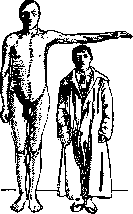
Acromegalic giant (height 2027 cm) and a healthy man (165 cm) (observation of D. M. Rossiyskiy).
One distinguishes proportional partial giantism, in which the increase is uniformly distributed over all parts and tissues of the organ, and disproportionate partial giantism, in which the increase of the organ occurs unevenly. Cases of giantism in which the hypertrophied organ, born such, grows and increases with the growth of the whole organism, are considered a simple form of partial giantism; cases in which the increase of the organ goes slowly, then as if by jumps, are called a progressive form. The etiology of partial giantism is very obscure. Among the theories attempting to explain the origin of partial giantism, the following deserve the greatest attention: 1) mechanical (Fischer), 2) embryonal, or constitutional (Wieland), and 3) neurotrophic. The mechanical theory attempts to explain partial giantism by the abnormal position of the fetus in the uterus, compression of one or another of its parts by the amniotic membranes or the umbilical cord with subsequent stagnation phenomena in the organ. The embryonal, or constitutional theory explains the intensified growth of the organ by irregularities in the laying out of the organism, consisting in a tendency of one or another part of the body to intensified growth. According to the neurotrophic theory, partial giantism is a consequence of special neurotrophic influences on individual parts of the organism and, according to Lenstrup, is explained by damage to preganglionic sympathetic fibers on one side of the spinal cord. Bauer and Lemos consider partial giantism a phenomenon of degenerative constitution. The prognosis for life in partial giantism is favorable. In the progressive form and excessive increase of the organ, hindering movement and work, sometimes recourse is made to the aid of orthopedics or even amputation, after which in some cases there is a spread of hypertrophy to neighboring organs.
Related articles
Mentioned in
Cite this page
“Giants.” Soviet Medical Encyclopedia. English translation of Bolshaya Meditsinskaya Entsiklopediya, 1st ed. (Moscow, 1928–1936), ed. N. A. Semashko. https://sovietmedicalencyclopedia.pages.dev/article/giants/