Medical-Nutrition Points
Historical document, translated for reference. It reflects medical knowledge of the 1920s–30s and is not medical advice.
Summary
Medical-nutrition points were special medical and preventive institutions established in late Imperial Russia to provide medical care and food assistance to agricultural workers during seasonal migrations. These facilities offered free medical treatment, affordable meals, and sometimes lodging to migrant workers while monitoring their health and movement patterns.
Encyclopedia article (1928–1936)
Medical-Nutrition Points, a special type of medical and preventive institution for providing medical and food assistance. Several types of them are distinguished: 1. Medical-nutrition (medical-food) points for agricultural workers. In the second half of the 19th century, in the south and southeast of Russia, in connection with the development of capitalist forms of agriculture, a large movement of agricultural workers began to grow rapidly. The movement was caused by: 1) the small land holdings of peasants in the provinces supplying labor, 2) the surplus of labor force there, 3) the extreme poverty of the peasantry, 4) the absence or insufficiency of labor in the south and southeast of Russia, and 5) the insufficient spread of agricultural machinery. Every spring, hundreds of thousands of agricultural workers moved from the provinces of the Central Chernozem region, from northern Ukraine, and from the middle Volga region to the former Bessarabia, Kherson, Yekaterinoslav, Taurida, Orenburg, Ural provinces, as well as to Samara, Saratov, and the North Caucasus, with the intention of returning after the field work was completed. Annually, about 3 million of these workers moved in an unorganized manner. The former Kherson province absorbed up to 125,000 workers, Samara province - 270,000, the North Caucasus - 250,000. Workers traveled by rail, water (Dnieper, Volga), and dirt roads. Attention was first drawn to the sanitary significance of the movement of worker masses in 1875 by the II provincial congress of doctors of Kherson zemstvo, which was developing a plan to combat syphilis. The XI congress of doctors of the same province in 1888 included supervision of incoming workers in the program of activity of sanitary doctors. In 1889, Dr. M. S. Uvarov developed a program for studying agricultural workers: 1) during travel, 2) at labor markets, and 3) at the place of work. The latter was conducted by examining agricultural economies. Supervision and examination during travel and at labor markets were carried out by special medical-nutrition points. Observation of agricultural workers was a sanitary measure because, due to the difficult conditions of movement and nutrition, agricultural workers 'serve as a favorable environment for all kinds of diseases and, with their mobility, are spreaders of infectious diseases across provinces' (N. I. Tezyakov). The first medical-nutrition point was opened in February 1892 in the city of Yelisavetgrad. The basic principles of supervision adopted by the sanitary organization of the former Kherson province were: 1) absence of compulsion, 2) accessibility and free medical assistance, 3) provision of cheap hot food, 4) registration of passing workers for the purpose of studying the labor movement. In the former Kherson province, the number of medical-nutrition points, gradually increasing, reached 14; in 1897, similar points appeared in Samara province, with the maximum number being 10; in 1899, in the former Yekaterinoslav province, the maximum number was 22, and in the former Simbirsk province - 4; in 1901, in Nizhny Novgorod province - 2; in 1903, in Saratov province - 693
Medical-Nutrition Points
694 with the maximum number of 9; then in Kostroma province - 2. The number of points varied from time to time. They were most stable in Saratov, Yekaterinoslav (see illustration), and Nizhny Novgorod provinces, where they existed until the beginning of the revolution. The activities of M.-p. p. included: 1) outpatient treatment of patients with free distribution of medicines; stationary assistance was provided in the nearest hospital; 2) sale at cost price of hot food, bread, and tea; 3) provision of free lodging (not everywhere, mainly in some points of the former Yekaterinoslav province and some points of the former Saratov province); 4) registration of movement. Outpatient registration revealed that 7.6-14.5% of the registered passing workers were sick. The composition of diseases varied: diseases of the digestive system, vision, motor organs, infectious diseases, and injuries predominated. Nutritional assistance consisted of selling
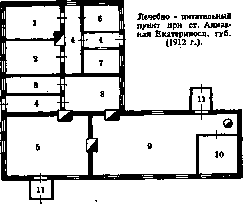
1-examination room; 2-head; 3-storage; 4-corridors; 5-dining room; 6-outpatient clinic; 7-attendant; 8-kitchen; 9-male dormitory; 10-female dormitory; 11-vestibule.
at cost price bread, meals, and tea. There were no fixed food rations. They fluctuated depending on food prices and other reasons. On average, to prepare one meal, the following were used: meat 100.0-150.0, potatoes 200.0-400.0, cabbage 50.0-75.0, bread 400.0. The selling price of a meal was 5-11 kopecks, tea with sugar (2 pieces) 2-3 kopecks; about 10% was distributed free of charge. The scale of activities of medical-nutrition points can be characterized by data from the former Saratov and former Yekaterinoslav provinces. In 1912, in 5 points of the former Saratov province, 44.6 thousand workers were registered, 24.9 thousand meals were distributed, 22.3 thousand portions of tea were served, and 3,730 patients were treated. In 13 points of the former Yekaterinoslav province, 33.2 thousand workers were registered, 26.2 thousand meals were distributed, 50.7 thousand portions of tea were served, 2,126 patients were treated, and 46 thousand people stayed overnight. Card registration determined the age-sex composition of workers, place of residence, direction of movement, time in transit, conditions of employment, earnings. In a number of points, especially in the former Yekaterinoslav province, free lodging was provided. Simbirsk zemstvo made an attempt to introduce mediation functions for hiring workers at the points. Samara zemstvo tried to supply workers with scythes, sickles, etc. at cost price through the points. At all points, sanitary-educational work was carried out, and points in the former Yekaterinoslav province had small libraries. The points were located in rented premises, but there were also specially built temporary, lightweight type buildings (Saratov province, former Yekaterinoslav province). The usual opening time was May-August. Staff: head-doctor or student of the X semester, assistant-student, 2-3 people serving the dining room. Zemstvo allocated 250-750 rubles for the maintenance of a point.
Related articles
Mentioned in
Cite this page
“Medical-Nutrition Points.” Soviet Medical Encyclopedia. English translation of Bolshaya Meditsinskaya Entsiklopediya, 1st ed. (Moscow, 1928–1936), ed. N. A. Semashko. https://sovietmedicalencyclopedia.pages.dev/article/medical-nutrition-points/