Perishable Goods
Historical document, translated for reference. It reflects medical knowledge of the 1920s–30s and is not medical advice.
Summary
This article from the 1928-1936 Soviet medical encyclopedia details the classification, transport, and sanitary regulations concerning perishable goods. It discusses various types of isothermal and refrigerated railway cars, ships, and storage facilities designed to maintain optimal temperatures and preserve food safety.
Encyclopedia article (1928–1936)
PERISHABLE GOODS are defined by transport rules approved by the Main Transport Committee as follows: "Perishable goods are recognized as those products which, under normal conditions representing an environment favorable for the development of harmful microorganisms, require special protection measures during prolonged storage and transportation (prevention of excessive humidity, preliminary cooling during transport, etc.). Perishable goods should also include goods that fear the cold and require special measures for protection against it (storage and transportation in insulated premises and cars)." For the transportation of perishable products on railways, so-called isothermal cars are used, the design of which makes it possible to maintain the temperature inside them at a certain level, which is achieved by cooling the cars in hot weather and heating them in winter, as well as by the corresponding design of the car body itself. In such cars, the walls, floors, and ceiling are made of insulating materials [cork, flax tow (shevelin), felt, pressed hemp hurds (morozin), reed, straw (solomit), waterproof cardboard], sometimes with air gaps between them. The car doors are made of the same material and
equipped with rubber gaskets to achieve tightness when closed. The car is painted white to reduce the absorption of solar rays. Inside the car, near its end walls, either "ice pockets"—latticed, wooden, or metal reservoirs for loading ice through special hatches located in the roof of the car—or "tanks"—
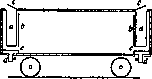
metal solid tanks for loading ice with salt (see Figure 1). The drainage of water from the melting ice takes place Figure 1. Schematic drawing through drain of an isothermal car: a-ice "pockets" pipes with a (or ice and salt tanks); b-partition separating the "pocket" from the car; c-hatch for loading ice; d- siphon for draining melt water (or ice-salt solution); e-pan for collecting melt water (or salt solution). It is discharged into special pans arranged in a checkerboard pattern under the tanks and is retained in them as long as it has a low temperature. The ice storages are separated from the rest of the car by wooden shields that do not reach the floor and ceiling, which favors the establishment of air circulation inside the car (cold air from the ice storage exits through the lower clearance of the partition, and warm air enters the ice storage through the upper clearance). Some refrigerator cars are also equipped with fans to enhance circulation. Cars with ice pockets transport products that do not require a very low temperature (not lower than +2°)—eggs, milk, butter, etc.; cars with tanks are used for goods requiring a lower temperature (down to -3°)—meat, fish. For transporting fruit-
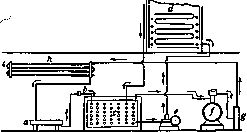
Figure 2. Refrigerating machine with brine circulation: a-tank with ammonia; b-regulating valve; c-tank with brine; d-refrigerator; e-pump; f-compressor; g-oil separator; h-condenser.
fruits, vegetables, and sometimes eggs, "ventilation isothermal cars" are used (equipped with fans or latticed openings in the frontal walls of the car, but without an ice storage). Cars with enhanced circulation of air and brine are used less frequently (see Figure 2). For transporting milk in the United States, special tank cars are arranged (see Figure 3). Sometimes the system of "preliminary cooling" of goods is also additionally used, either in cold rooms or in loaded cars, at special preliminary cooling stations (United States), from which cold air is supplied to the cars through elbow pipelines and, circulating in them, cools the cargo. The design of cold stores in transport does not differ
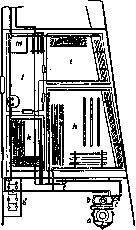
112 Figure 3. Schematic drawing of a refrigerator car for milk transport (USA, Chicago, The General American Car Company): a-metal tanks for milk, with a capacity of 3,000 gallons each; b-system of refrigerator pipes. from the usual ones (see Refrigerators). Only one specific detail should be noted. To avoid the loss of cold when loading a car from the warehouse, a bellows is arranged at the doors of the latter, which, expanding, comes into close contact with the doors of the car, thereby establishing a continuous connection between the cold store and the cold car. When transporting products (particularly meat) not by the carload, but in parcels with passenger trains on American railways, special double metal boxes are used, inserted into wooden boxes, and the space between the walls of the outer and inner box is loaded with finely crushed ice. The transportation of perishable goods on waterways is carried out in special refrigerator vessels, which have special refrigerated chambers. Figure 4 depicts a schematic drawing of a refrigerator on a vessel of the Brunswick Refrigerating Co. (a-steam engine; b-compressor; c-oil separator; e-ammonia reservoir; g-ice-making machine; h-meat transport room; i-fruit and vegetable room; k-butter, milk, and egg room; l-vestibule and meat carcass cutting room; m-meat cutting table).
In the cold season, to maintain the required temperature, isothermal cars are heated using various furnace systems (kerosene, alcohol, coal) installed inside the car in place of ice storages or installed outside the car, with the routing of heated air inside the car Figure 4. through pipes or through the gaps between double floors and walls (Eastman's car). Sometimes steam heating from the locomotive is also used, but this is associated with the termination of heating when the locomotive is uncoupled. For goods extremely sensitive to sharp temperature fluctuations, warm cars are used that have stood in a warm depot before dispatch; these cars, during stops en route (approximately every 24 hours), are again brought into the warm depot, where, with the doors of the car open, the cargo and the car itself are again supplied with heat from the depot air (USA). When transporting in ordinary covered cars (non-isothermal), packing goods in thick paper and covering them with straw or shavings is used as thermal insulation. The temperature of the product and air in the car and the duration of stay of goods en route, permissible for perishable products, are visible from the given table (Komarov). In view of great sanitary significance, the methods of loading cars with various perishable goods, the type of packaging of goods, and other conditions of their transportation in the USSR are established by special rules issued by the Central Transport Committee (NKPS order No. 390 of September 7, 1922) and a number of orders of the NKPS, Narkomzdrav, and Narkomzem. The general part of these rules establishes the concept of perishable goods and methods of transportation (refrigerator cars, mechanically cooled cars, insulated ventilation cars), speaks of the procedure for loading and unloading goods (into pre-cooled cars and premises or without this condition), about the condition of the cars submitted for loading (serviceability in technical, thermal, and sanitary respects), about the procedure for storing goods in warehouses [protection against atmospheric precipitation, sunlight, and extraneous odors (kerosene, tar)]. The special part contains rules for the transport of individual products. Special control is established over the speed of movement of isothermal cars (NKPS order No. 6793). In the event of the discovery en route of external signs of the beginning of spoilage of goods, the question of determining the admissibility of further transit of goods or their liquidation on the spot to avoid complete spoilage is decided by a commission organized by the station master with the participation of sanitary supervision.

Related articles
Mentioned in
Cite this page
“Perishable Goods.” Soviet Medical Encyclopedia. English translation of Bolshaya Meditsinskaya Entsiklopediya, 1st ed. (Moscow, 1928–1936), ed. N. A. Semashko. https://sovietmedicalencyclopedia.pages.dev/article/perishable-goods/