Scoliometer
Historical document, translated for reference. It reflects medical knowledge of the 1920s–30s and is not medical advice.
Summary
A scoliometer is an instrument for researching scoliotic curvature of the spine. The article describes various models including Mikulich's, Beely-Kirchhoff's, Euler's, Schultge's, and methods by Deutschlander and Bernhard.
Encyclopedia article (1928–1936)
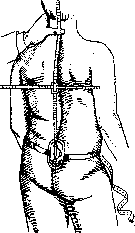
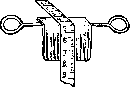
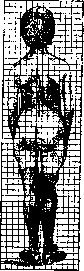
Scoliometer, an instrument for researching scoliotic curvature of the spine. The Mikulich model is widely used. It consists of two flexible metal rulers: vertical and horizontal. The latter can move along the first in vertical and horizontal directions. Both rulers have graduations. The instrument allows determining the height of individual points of curvature, the amount of lateral deviation, the difference in height of the protrusion of individual parts of the back, as well as the height and position of the shoulder blades (fig. 1). Data on lateral deviation of the spine can be plotted as a curve on graph paper, which allows for visual comparison during repeated examinations. The Beely-Kirchhoff instrument is also practical. It consists of a measuring tape that is fixed on the neck and along which a plumb line moves. In addition, there is a small square for determining the amount of anteroposterior deviations of the back (fig. 2) and a stamp for the grid on which the graphical result of the examination is applied (fig. 3).-Euler's instrument consists of a square grid applied to a photographic image of the back being examined (fig. 4).-On the same principle of photographic research are based the methods of Semeleder and Hovorka.-The most accurate representation of curvature is provided by the Schultge scoliometer. However, this instrument is very complex.-Original is the method of "perimetric research of the hump" proposed by Deutschlander and consisting of semi-fig. 5. 2-left side of GYPSIC NEGATIVES, 2-level of the lumbar vertebra; 3-back. The method is demonstrative but cumbersome. In practice, it is more convenient to replace it with Bernhard's method-outlining the contours of the curved part of the body with a flexible zinc strip, which is then traced with a pencil on paper (fig. 5). 6 ---------- p s /30 : i 48-5/2.0
Figure 1.
Figure 2.
Figure 3.
Figure 4.
Related articles
Cite this page
“Scoliometer.” Soviet Medical Encyclopedia. English translation of Bolshaya Meditsinskaya Entsiklopediya, 1st ed. (Moscow, 1928–1936), ed. N. A. Semashko. https://sovietmedicalencyclopedia.pages.dev/article/scoliometer/