Visual Illusions
Historical document, translated for reference. It reflects medical knowledge of the 1920s–30s and is not medical advice.
Summary
This article from the 1928–1936 Soviet Great Medical Encyclopedia defines visual illusions as incorrect perceptions of color, shape, size, and spatial position. It categorizes these phenomena into those caused by optical properties of the visual apparatus, such as irradiation and chromatic aberration, and those resulting from psychological judgments, such as geometric-optical illusions.
Encyclopedia article (1928–1936)
VISUAL ILLUSIONS, incorrect representations of the color, shape, size, and position in space of objects in the external world, arising under the influence of visual impressions. While some visual illusions can be explained by the optical features of our visual apparatus, others have not yet found a sufficiently satisfactory explanation. To optical illusions of the first kind, one must attribute the following: 1. Coloring of the edges of objects viewed from distances greater or less than the distance of clear vision: the phenomenon is explained by chromatic aberration. 2. Irradiation—incorrect judgment about the size of objects depending on the brightness of illumination: strongly illuminated objects seem larger, while neighboring, weakly illuminated ones, on the contrary, seem smaller than their actual size; the phenomenon of irradiation is caused by circles of light diffusion, which expand the field of light sensation. 3. Phenomena of contrast. 4. Entoptic phenomena.—Besides those listed, there occur so-called geometric-optical illusions, at the basis of which lies a whole series of secondary circumstances (movement of eye muscles, nerve impulses, accommodation, etc.) influencing our judgments about size, shape, and direction. Of two lines of equal size, ab and bc (Fig. 1), the first, divided into parts, seems larger. The cause of the phenomenon is found in a deception of judgment caused by the simple sliding of the gaze along line bc and its delay at the places of subdivision (ab). To the same category must be attributed the incorrect judgment about the inequality of two identical squares A and B (Fig. 2), of which B seems to us higher and narrower than A. The Müller-Lyer figure (Fig. 3) also serves as an example of an illusion of extent: segment AB seems shorter than BC. The deception of judgment is caused by the involuntary impulse of the gaze to follow further beyond the limits of line BC in the direction of its lateral appendages and to be delayed before the endpoints of line AB.

Another explanation is given by Einthoven: upon fixation of any point on line AC, the ends of lines AB and BC with their
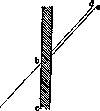

appendages produce blurred images on the retina (circles of light diffusion). The optical centers of these images in the left half are located inward, and in the right—outward from the ends of these lines, which creates the illusion of the inequality of these lines. A series of visual illusions also provides irregularities in the estimation of angles. Of two equal acute angles, the one whose one side has a horizontal direction seems larger to us (Fig. 4). We are inclined to see acute angles as enlarged, and obtuse ones as diminished. An example can serve as the Poggendorff illusion (Fig. 5). By virtue of the fact that the acute angle abc is estimated by us as larger in angular measurement, it seems to us that the continuation of line ab is not line bd, as it is in reality, but line be, lying somewhat lower.
To the same category of visual illusions must be attributed the Zöllner figure (Fig. 6), where the correctness of our judgment about the parallelism of lines is disturbed due to the inclusion of segments forming a series of acute angles with these parallels.
Related articles
Mentioned in
Cite this page
“Visual Illusions.” Soviet Medical Encyclopedia. English translation of Bolshaya Meditsinskaya Entsiklopediya, 1st ed. (Moscow, 1928–1936), ed. N. A. Semashko. https://sovietmedicalencyclopedia.pages.dev/article/visual-illusions/