Argyria
Historical document, translated for reference. It reflects medical knowledge of the 1920s–30s and is not medical advice.
Summary
Argyria is a pigmentation of the skin and mucous membranes resulting from the prolonged internal use or occupational exposure to silver compounds. The condition is characterized by the deposition of reduced silver in the connective tissue, vessel walls, and glandular membranes, leading to a permanent lead-gray or dark-blue discoloration.
Encyclopedia article (1928–1936)
ARGYRIA (from the Greek argyros - silver), pigmentation of the skin and mucous membranes into a lead-gray, dark-violet, and even black color upon prolonged internal intake of silver nitrate. The intensity of this pigmentation depends on the duration of the silver nitrate intake. With very prolonged intake (10-12 years), marked pigmentation of the skin, mucous membranes of the mouth, stomach, intestines, conjunctiva of the eye, followed by mesenteric lymph nodes, glands, and kidneys is revealed. The pigmentation itself is caused by the deposition of fine-grained reduced silver in the paraplastic (interstitial) substance of connective tissue, especially in elastic fibers, followed by the walls of blood vessels and membranes of many glands. The sites of silver deposition in the skin are the upper layers of the connective tissue foundation of the skin, especially in the region of sebaceous and sweat glands and hair follicles; no silver deposits are observed in the epithelial layer of the skin. In the mucous membranes of the gastrointestinal tract, kidneys, liver, and mesenteric lymph nodes, silver deposits are located, mainly, in the vessel walls and
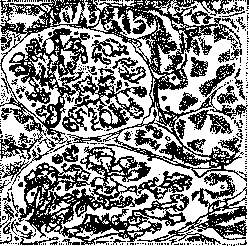
Argyria of the kidneys. Two glomeruli are visible with abundant deposition of silver in the form of black dust in the walls of the glomerular vessels.
connective tissue, and in the liver, in addition, in stellate cells. The question is still unresolved whether silver passes in a reduced form from the intestine through the lymphatic system into the blood and in this form is deposited in the tissues, or whether it reaches the tissues in the form of silver albuminate and is already reduced there and deposited in the form of a black fine-grained mass of metallic silver. Studying cases of argyria in which silver nitrate was taken shortly before death, and cases where the course of treatment was completed 30-40 years ago, it can be noted that initially the deposition of silver occurs, mainly, in the walls of small vessels, capillaries, and only then is silver deposited in the paraplastic substance of connective tissue. Silver deposits in the renal glomeruli and generally in the capillary walls tend to subsequently decrease and even disappear, thanks to possible excretion to the outside (with urine, sweat, etc.) or thanks to movement deep into the tissue. All deposits in the paraplastic substance of connective tissue are persistent and remain such until the end of the patient's life. In addition to cases of generalized argyria, local argyrias of the skin are known, for example, upon coloring the hair for a long time with silver preparations. In the latter case, the skin is colored by reduced silver, which is deposited, mainly, in the upper layers of the connective tissue foundation of the skin and in the hair follicles. Occupational argyria in those working with silver, the smallest particles of which penetrate the skin of the workers' hands, should also be referred to local argyria. After dissolving in the form of silver albuminate, these particles spread in the surroundings and form after reduction black-blue spots ranging in size from a pinhead to a millet grain. As an occupational poisoning, generalized argyria occurs in workers who have long engaged in packaging and sifting lapis, as well as in silvering beads, when the lapis solution, drawn into the mouth through a small tube from the beads, gets into the mouth.
Related articles
Mentioned in
Cite this page
“Argyria.” Soviet Medical Encyclopedia. English translation of Bolshaya Meditsinskaya Entsiklopediya, 1st ed. (Moscow, 1928–1936), ed. N. A. Semashko. https://sovietmedicalencyclopedia.pages.dev/article/argyria/