Dourine
Historical document, translated for reference. It reflects medical knowledge of the 1920s–30s and is not medical advice.
Summary
Dourine (exanthema coitale paralyticum) is a contagious venereal disease of horses and donkeys caused by the protozoan parasite Trypanosoma equiperdum. The 1930s encyclopedia article details its transmission, three distinct clinical periods affecting the genitals, skin, and nervous system, and treatment approaches.
Encyclopedia article (1928–1936)
DOURINE (exanthema coitale paralyticum, polyneuritis infectiosa), infectious venereal disease of horses or sluchnaya nemoch (an Arabic word "dour-ina-dourine" meaning unclean fertilization). The disease arises only through direct contact and is usually transmitted from a sick animal to a healthy one through sexual intercourse. Horses and donkeys are affected by dourine. Dourine is more frequently encountered in southern countries (Africa), and among European countries in Spain, France, and less commonly in Germany and the USSR. However, after the war, dourine spread significantly in these states as well, especially among stud and breeding animals. The causative agent of the disease is a special species of trypanosome—Trypanosoma equiperdum (Doflein) (see figure). The parasite can penetrate the organism even through undamaged mucous membranes (Rouget, Bongert).
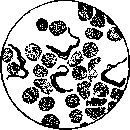
Trypanosoma of the dourine of the horse from mouse blood. Trypanosomes are most often found in the mucous secretion of the vagina and urethra, less frequently in the serous fluid of edematous tumors, and rarely in small numbers in the blood or milk of a sick animal. At the same time, trypanosomes periodically seem to disappear and sometimes are not found even in the secretion of the vagina or urethra in knowingly sick animals. Formerly, dourine was equated with human syphilis, since the course of this disease in horses has some similarity to the course of syphilitic affliction in humans. As with syphilis, three periods of dourine are distinguished. The first period of the disease develops for the most part 6–30 days after mating; in the stallion, the scrotum and prepuce become edematous; the mucous membrane of the urethra reddens, the head of the penis swells, and nodules and ulcers appear on it. In mares, the labia majora and sometimes the clitoris swell strongly, and a mucopurulent discharge from the vagina is observed; spotted redness, small ulcers, and yellow-red nodules are found on the mucosa. In the second period of the disease, which occurs several weeks later, the skin and lymph glands are affected. On the skin in various parts of the body (neck, shoulders, chest, croup, and abdomen) painless, either round and circumscribed or annular swellings, nodules, or hives arise, usually disappearing within a week. At the same time, great sensitivity of the skin surface in the region of individual nerve trunks (n. ischiadicus, nn. intercostales, etc.) and swelling of the inguinal and submandibular glands are detected. Then from time to time the animals experience movement disorders in the form of strong flexion of the limb joints and lameness. The third period of the disease is characterized by damage to the central nervous system—paralysis of the hind limbs and a staggering gait appear; rearing up becomes impossible; the horse weakens rapidly, bedsores and edemas appear, and the animal dies. The duration of the disease is extremely variable (from several weeks to 2 years). The course in the south is faster than in the north. By means of inoculation with Trypanosoma equiperdum, mice, rats, guinea pigs, rabbits, dogs, and cats can be artificially infected. Goats, sheep, and cattle, although they fall ill upon intravenous infection, subsequently recover. Obtaining pure cultures of Trypanosoma equiperdum is associated with great difficulties. Treatment with arsenical preparations can be successful if it is initiated in the first period of the disease; at the present time, new chemotherapeutic preparations are used with great success, for example, Naganol (Bayer 205).
By means of the complement fixation reaction (by Watson's or Dahmen's method), it is possible to establish the affliction of dourine in breeding stallions that appear outwardly healthy.
Related articles
Mentioned in
Cite this page
“Dourine.” Soviet Medical Encyclopedia. English translation of Bolshaya Meditsinskaya Entsiklopediya, 1st ed. (Moscow, 1928–1936), ed. N. A. Semashko. https://sovietmedicalencyclopedia.pages.dev/article/dourine/