Duodenal Tube (Aluminium subaceticum is added to the washing)
Historical document, translated for reference. It reflects medical knowledge of the 1920s–30s and is not medical advice.
Summary
This historical article from the 1928-1936 Soviet Medical Encyclopedia discusses the clinical applications of the duodenal tube. It details its use in washing procedures, enteral and transduodenal nutrition for stomach and duodenal ulcers, and the management of various digestive disorders.
Encyclopedia entry (1928–1936)
DUODENAL TUBE Aluminium subaceticum is added to the washing fluid in this process, and in most cases, after 3-4 washings, pinworms and their eggs disappear from the stool. The duodenal tube is also used as an instrument for so-called transduodenal nutrition, which is currently widely practiced in American medicine and is beginning to penetrate European medicine (Figure 3). Its idea is to give the stomach complete rest for a certain time. For this purpose, the duodenal tube is inserted until "bile A" appears and is left in place for 3-4 weeks. Such complete exclusion of the stomach must, of course, highly favor the healing of all kinds of ulcers and the cure of inflammatory processes. The tube is inserted significantly deeper than usual, i.e., not 70 cm, but approximately 120 cm from the edge of the teeth (jejunal nutrition).
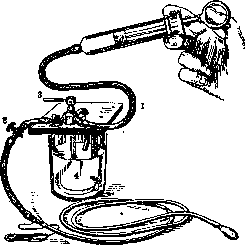
Figure 3. Apparatus for artificial feeding through a duodenal tube. Rubber connecting tubes: 1 - with syringe; 2 - with tube; 3 - lever-switch; 4 - vessel with nutrient fluid. The presence of a stomach or duodenal ulcer does not impede the insertion of the tube in the least, although the pylorospasm often encountered during this sometimes requires subcutaneous injection of Atropine or, better, Papaverine, or the preliminary introduction of 20-30 cm3 of bismuth milk into the stomach, which reduces the reflex excitability of ulcerated surfaces. After inserting the tube to the proper depth, the patient must be fed approximately every two hours, hence 6 times a day. Each portion of food consists of one glass of milk, one raw egg, and one to two tablespoons of milk sugar, if it does not cause diarrhea. In case of nutritional decline, a teaspoon of melted butter can be added to each portion. Patients usually learn to perform the entire feeding procedure without outside help after 2-3 days. The main reason for using transduodenal nutrition is stomach and duodenal ulcer. Besides ulcers, transduodenal nutrition can be applied with success in many cases of gastric dilation without organic pyloric stenosis, in some cases of invincible aversion to food (for example, in consumptives), in nervous vomiting, in intractable vomiting of pregnant women, and especially in fermentative dyspepsias, etc. Good results are also obtained in those severe dyspepsias and vomitings that are often observed in a very stubborn form after gastroenterostomies.
Related articles
Cite this page
“Duodenal Tube (Aluminium subaceticum is added to the washing).” Soviet Medical Encyclopedia. English translation of Bolshaya Meditsinskaya Entsiklopediya, 1st ed. (Moscow, 1928–1936), ed. N. A. Semashko. https://sovietmedicalencyclopedia.pages.dev/article/duodenal-tube-2/