Fyodor Kalaydovich
Historical document, translated for reference. It reflects medical knowledge of the 1920s–30s and is not medical advice.
Summary
A biographical and historical overview of Fyodor Kalaydovich (1742–1820), one of the early Russian hygienists of the early 19th century.
Encyclopedia article (1928–1936)
KALAYDOVICH, Fyodor Dmitrievich (1742–1820), one of the first Russian hygienists of the early 19th century. He served as an adjunct in hygiene under Erdmann, who held the chair of pathology, therapy, and clinical medicine at Kazan University; Kalaydovich was simultaneously a translator of Erdmann's lectures from German into Russian. Kalaydovich's stay in Kazan, where he "fled" from Moscow during Napoleon's invasion, was short-lived (from December 1812 to September 1813). By academic rank, Kalaydovich was a staff physician, serving as the doctor of the "noble boarding school" at Moscow University. He lectured on hygiene, "copying out abbreviated rules and teaching them to listeners in writing to preserve memory" based on the French manual by F. Pissis (Russian edition: "The Science of Preserving One's Health or a Guide to Hygiene", Moscow, 1806). Kalaydovich's short course of lectures was published in 1813 in Kazan under the title "On the Preservation of Health or Brief Rules of Hygiene." This brochure by Kalaydovich, like the primary source (Pissis's manual), characteristically reflected the state of hygiene at the end of the 18th century. Kalaydovich defines the subject of hygiene as follows: "Hygiene is that part of medicine which shows how to preserve health through the proper use of six non-natural things." The "six non-natural things"—a surviving term of Galen—refer to: "air, food, excreta, motion, sleep, and passions of the soul."
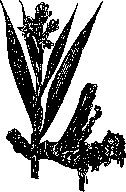
Part of the galangal rhizome and the top of the flowering stem.
cells are scattered, filled with essential oil or resin into which the essential oil turns; numerous starch grains—simple (ovoid, pear-shaped, and club-shaped forms), from 25 to 45 Θ in length. Kalaydovich powder is distinguished by a large number of starch grains, thick-walled parenchyma, sclerenchymatous fibers, scalariform vessels, brown masses of secretion (which turn black from a 2% iron chloride solution), and epidermis nests. Ash should be no more than 3-5%. The constituent principles of Kalaydovich: 1) essential oil, about 0.5-1.5%, rich in cineole (C10H18O); 2) crystalline substances of the aromatic series (flavone series) close to each other—alpinin, galangin, and kaempferide; 3) 23% starch; 4) acrid resin; 5) gum; 6) ash. In medicine, Kalaydovich is used as a stimulant of digestive organ activity; it is prescribed in powder, decoction, and tincture. Kalaydovich is a favorite folk remedy. PREGNANCY CALENDAR [obstetric, used since the time of Carus (1789–1869)], serves as a visual aid for calculating the expected date of childbirth and dates, and at present in the USSR—for granting female workers and employees leave in connection
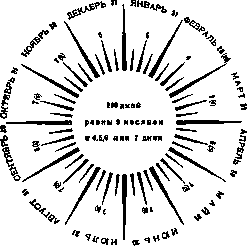
with pregnancy, childbirth, and the postnatal period. The starting point is the first day of the last menstruation. The pregnancy calendar can be provided in the form of a table (see articles 85–86). The pregnancy calendar is very widespread; there are many modifications of it (see figure). Recently, with the aim of further simplifying and facilitating the use of the pregnancy calendar, Baksht proposed his designed model of "obstetric clocks." These clocks are a dial 50 cm in diameter, on which 7 concentric circles are plotted. Each of the latter, containing the corresponding figures of days and months, designates strictly defined dates: the first circle—the first day of the last menstruation, the second—the day of the first quickening, the third and fourth—the day of releasing the female worker on an 8- and 6-week leave, the fifth—the day of delivery, the sixth and
seventh—the day of returning to work after 8 and 6 weeks of leave. By setting the clock hand to the figure corresponding to the first day of the last menses, along the direction of the hand, one obtains indications of all the necessary dates.
Related articles
Cite this page
“Fyodor Kalaydovich.” Soviet Medical Encyclopedia. English translation of Bolshaya Meditsinskaya Entsiklopediya, 1st ed. (Moscow, 1928–1936), ed. N. A. Semashko. https://sovietmedicalencyclopedia.pages.dev/article/fyodor-kalaydovich/