Genealogy
Historical document, translated for reference. It reflects medical knowledge of the 1920s–30s and is not medical advice.
Summary
An overview of genealogy as a biological and medical method for studying human heredity, constitution, and the influence of environment, detailing pedigree charts, ancestor tables, and kindred studies as used in the early 20th century.
Encyclopedia article (1928–1936)
GENEALOGY (from Greek genos—kin and logos—word, science), a systematic list and description of the characteristics of all persons having a common origin (members of one lineage). For a more convenient and rapid overview of the entire series of members of a genealogy, so-called genealogical tables, or "pedigree trees," compiled according to special rules, are usually employed. In earlier times, genealogy was of great importance for proving the "nobility" of origin and for demonstrating rights to class privileges; the only features recorded for family members were their official "exploits" and "supreme" awards. Different genealogies and other records are of interest to the modern biologist and physician. In the impossibility of experimental crossbreeding, the collection of genealogical material is the only way that allows the analysis of hereditary (including pathological) characteristics of man, the study of his constitution, and the influence of the environment on the manifestation of innate traits. The beginning of biologists' interest in genealogy was marked by the book by Lorenz, Fundamentals of Scientific Genealogy, published in Germany in 1898. Lorenz's great merit is his indication that the solution to questions of human heredity should not be expected from the establishment of similarities in masses or populations, as Galton and Pearson asserted, but from the establishment of regularities in individual generations. Lorenz's merit also lies in introducing scientific precision into the methods of collecting and designating genealogical material. Genealogy is still the only method of collecting material for further study according to the laws of genetics of various human traits (characteristics). At present, a distinction is made between: 1) pedigree tables (Stammtafel), 2) ancestor tables (Ahnentafel), and 3) tables of all persons of common origin (Sippschaftstafel). Pedigree tables, used in old times to prove class privileges, were compiled starting from a famous progenitor (the first in the lineage to receive a "noble" title) and usually contained only those family members who bore the same surname (male lines). Generations of female family members were usually not included in pedigree tables. For biological studies, such tables are insufficient. Ancestor tables are compiled starting from the person whose heredity is investigated (the proband). In its simplest form, the scheme of such a table is as follows: 16 17 18 19 20 21 22 23 24 25 26 27 28 29 30 31
15 4,
3 mother subject tested (proband) Tables usually contain: the proband, designated by the number 1; his two parents (2 and 3); paternal and maternal grandparents (4–7); the generation of great-grandparents (16–31), etc. Often, in addition to the indicated numbering, the following is also used: in each generation, numbering begins with one, and generations in order are designated by Roman numerals: generation of the proband—I, parents—II, grandparents—III, and so on. This latter designation is also applicable to complex genealogies that include all collateral relatives (Sippschaftstafel). In graphical representation, males are usually designated by a square—□ or the sign ♂, and females by a circle (○) or the sign ♀. Various studied characteristics of family members are noted either by different colors of the symbols of the carriers of these features or by conventional letters placed within these symbols. However, ancestor tables do not exhaust all persons connected by kinship: they do not contain collateral lines of relatives, yet this information is also important for the study of heredity. Tables that include collateral relatives are called Sippschaftstafel. For a more graphic representation, various forms of tables have been proposed by a number of researchers, but the most convenient form appears to be the so-called rectilinear table. As an example, a specimen of such a table adopted by the American Eugenics Record Office is given. In a complete genealogical table, it is necessary to note all miscarriages and all those who died in childhood, because only this ensures the possibility of further statistical study of heredity and the establishment of Mendelian laws of inheritance of a particular trait. For scientific
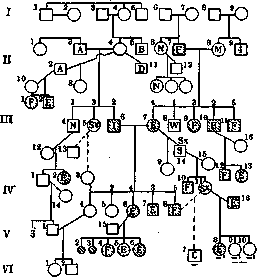
Genealogical table of the Eugenics Record Office: circle denotes females, square—males; hatched squares and circles—feesbleminded; E—epilepsy; F—imbecility/feeblemindedness; A—alcoholism; B—blindness; D—deafness; Sx—sexual abnormalities.
study of genealogy, it is necessary to have special personal cards for each member of the genealogy, which should indicate the name and surname of each member (and if possible the address), the year of birth, since this often makes it possible to discover the connection of several genealogies, thanks to which the mode of inheritance of any trait can be traced even better. Then, on these personal cards, all available information on anthropometric features, bodily characteristics, temperament, special talents, all data on past somatic and mental diseases, the entire course of life in general, profession, and the like should be indicated as fully as possible; it is also good to have a photograph. Personal examination of each person by specialists is desirable, but important results can often be obtained through questionnaires. The more genealogical data collected, the better for the study of heredity. In Germany, it was considered desirable to establish special "biological passports" for the entire population, in which, starting from birth, all characteristics of the organism and the course of its development (school performance, data upon entering service, etc.) would be recorded. Such biological passports would later make it possible to have precise genealogies of the entire population. So far, the introduction of "biological passports" has not succeeded anywhere, but at present in many countries there are genealogical bureaus where genealogical data are collected, and genealogical journals are published (for example, Familiengeschichtliche Blätter in Germany, The Treasury of Human Inheritance in England, etc.). In America, genealogical bureaus usually have so-called field workers who are sent to localities to examine members of the family of interest to the bureau. Over recent decades, a number of large genealogies have been published, traced over 7–8–9 generations and containing thousands of individual members. Such genealogies were usually collected in families with some clearly hereditary disease and illustrate the type of inheritance of this disease particularly clearly. Thus, the genealogy of Cuennet-Nietlispach with 2,000 persons illustrates the type of inheritance of hemeralopia, the genealogy of the Mampel family (collected by Lossen)—the type of inheritance of hemophilia, the genealogy of the Zero and Markus families (collected by Jörger) and the Jukes (Dugdale) and Kallikak (Goddard) families—the type of inheritance of feeblemindedness and character traits easily leading to criminality, and so on. Lundborg in Sweden, Schweichofer in Germany collected genealogical data of the entire population of a certain region and obtained interesting data not only for studying the inheritance and distribution among the population of various anomalies, but also for clarifying the significance of professions, economic and domestic ways of life for the manifestation of hereditary features, for assessing the genetic potential of a given population in general. The maintenance of genealogical "family-by-family" lists by some Zemstvo physicians was also of great importance, not only clarifying the hereditary baggage of the population, but also allowing a better understanding of all the variability of features in connection with surrounding life (at present, sanitary journals are maintained). In general, genealogical data, allowing one to monitor the change in the character of the manifestation of individual hereditary traits over a number of generations, also provide a picture of the degree of variability of the trait from external influences, and allow the study of the relationship between environment and constitution. Genealogical data are also very important in cases of eugenic marriage counseling and the like.
Related articles
Mentioned in
Cite this page
“Genealogy.” Soviet Medical Encyclopedia. English translation of Bolshaya Meditsinskaya Entsiklopediya, 1st ed. (Moscow, 1928–1936), ed. N. A. Semashko. https://sovietmedicalencyclopedia.pages.dev/article/genealogy/