Head
Historical document, translated for reference. It reflects medical knowledge of the 1920s–30s and is not medical advice.
Summary
The article describes the anatomy and development of the head in animals, focusing on vertebrates. It details the structure of the head, including sensory organs, the brain, and the visceral apparatus, with particular attention to the evolution of gill structures and their transformation into jaw structures in different animal groups.
Encyclopedia article (1928–1936)
Head of animals, represents a greater or lesser clearly defined anterior part of the body, characterized by the location on it of the most important sense organs and
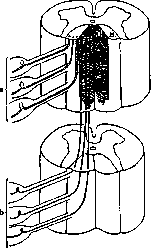
Structure of the posterior columns: G- bundle of Goll (funiculus gracilis); B- bundle of Burdach (funiculus cuneatus); o-long posterior root fibers from the upper half of the body; Ъ-long posterior root fibers from the lower half of the body. (According to Bing.)
often also the presence of grasping organs near the mouth opening. In vertebrate animals, the composition of the H. includes a very significant number of organs: organs of vision, hearing and smell, the brain, surrounded by the cranial box, the visceral apparatus with corresponding musculature and a number of glands. Data from embryonic development show that the head represents a transformed anterior part of the body, which was as correctly segmented as the trunk of lower vertebrates. This segmentation has been lost with the progressive development of sense organs and the brain and with the transformation of the anterior gill arches into jaws, requiring a strong support on the axial skeleton. Traces of segmentation of musculature and skeleton are especially clear in the posterior "chordal" area of the skull, behind the pituitary gland, where the anterior end of the notochord also extends. In the occipital region of the skull, the fusion of the nearest arches of vertebrae and even entire vertebrae is often observed. In fish, the H. is not externally isolated from the trunk, and the boundary is conventionally drawn along the posterior edge of the gill apparatus. The cranial box occupies a relatively small part of the H., yielding the main place to the visceral apparatus, which externally limits the oral and pharyngeal cavities. Initially, the entire visceral apparatus performed the function of respiratory organs, as is still evident in fossil armored fishes (Ostracodermi). However, in all modern fishes, the anterior visceral arch has lost gills and serves as the jaws. Usually it is armed with numerous small teeth. The second, hyoid arch in most cases serves to strengthen the jaws on the cranial box; however, limiting the first gill slit in front, it often carries a gill on its posterior surface. A rudimentary gill slit-sprinkler-also lies between the mandibular and hyoid arches, opening outward on the sides of the dorsal part of the H. in lower fishes (sharks, rays, sturgeons and crossopterygians). The third visceral arch, as well as those following it, serves as gill arches. Located in the partitions between successive gill slits, they carry on both their anterior and posterior surfaces complex folds of the mucous membrane abundantly supplied with venous blood-gills. In cyclostomes (lampreys), as well as in lower cartilaginous fishes (sharks, rays), the gill slits open independently outward on the sides of the H. (in rays-from below). In chimeras, as well as in all bony fishes, starting with sturgeons, the gill apparatus is covered from the outside by a skin fold (in bony fishes-with bones)-the gill cover, attached to the hyoid arch and opening behind when the cover is raised by special musculature. In terrestrial vertebrates, gill respiration is lost (except for the larvae of amphibians); the visceral apparatus is significantly reduced. Remnants of gill arches are preserved only in the hyoid apparatus and partly in the cartilages of the larynx. With the progressive development of the brain in higher vertebrates, the axial part of the skull receives predominant significance. In fish, the H. is immobile, which is largely due to the absence of the occipital articulation and the connection of the bones of the shoulder girdle with the skull. In terrestrial animals, the trunk is less agile, and in connection with this, the H. in them acquires considerable mobility: an articulation with the spine develops by means of 1-2 condyles, the shoulder girdle loses its connection with the skull and a greater or lesser flexible cervical part of the body develops. In addition to the usual sense organs, fish also have a number of lateral line channels on the H., which have a very typical location. The organ of hearing, the membranous labyrinth of which in origin also represents a complicated lateral line channel, opens in cartilaginous fishes via the endolymphatic canal outward on the dorsal side of the head. The middle ear develops only in terrestrial vertebrates at the expense of parts of the visceral apparatus (the operculum and hyoid arch, supplemented in mammals also by parts of the mandibular arch), and the outer ear, appearing in reptiles and birds, receives its movable shell only in mammals. The position and relative development of the organ of vision strongly reflect the structure of the skull (development of the interorbital septum in higher fishes, reptiles and birds). The organ of smell in cyclostomes opens forward on the dorsal part of the H. with a single unpaired nostril. In all other vertebrates, this is a typical paired organ. In cartilaginous fishes, the nostrils open in front of the mouth, on the ventral side of the snout. In bony fishes, there are two pairs of nostrils, on the dorsal side of the H., while in terrestrial vertebrates one pair of nostrils is located on the dorsal side of the anterior part of the H., and the other has moved into the oral cavity, appearing in the form of choanae.
Related articles
Cite this page
“Head.” Soviet Medical Encyclopedia. English translation of Bolshaya Meditsinskaya Entsiklopediya, 1st ed. (Moscow, 1928–1936), ed. N. A. Semashko. https://sovietmedicalencyclopedia.pages.dev/article/head/