KONCHALOVSKY
Historical document, translated for reference. It reflects medical knowledge of the 1920s–30s and is not medical advice.
Summary
Konchalovsky was a prominent Soviet physician and therapist who served as director of the faculty therapeutic clinic at Moscow State University. He made significant contributions to medical education, research on various diseases, and was involved in numerous medical organizations and publications.
Encyclopedia article (1928–1936)
KONCHALOVSKY Maksim Petrovich (born in 1875), prominent therapist, director of the faculty therapeutic clinic of 1st Moscow State University; in 1899 he graduated from the medical faculty of Moscow University. K. worked for 18 years in the faculty therapeutic clinic under the guidance of V. D. Shervinsky and L. E. Golubinin. In 1912 - assistant professor, in 1918 elected professor of the hospital therapeutic clinic of the Higher Women's Courses, now 2nd Moscow State University; from 1927 to 1929 K. served as dean of the medical faculty of 2nd Moscow State University. Since 1929 K. has been director of the faculty therapeutic clinic of 1st Moscow State University. Since 1919 K. served as deputy chairman of the Moscow Therapeutic Society, and since 1923 has been chairman of the same society. K. was a founder of congresses of Russian therapists and serves as deputy chairman of the Therapeutic Society of the USSR; he took an active part in the reform of medical education and in the organization of new medical institutions of the People's Commissariat of Health and Moscow Health Department. K. is a member of the Medical Methodological Commission of the Main Professional Education Board. Since 1925 K. has been a member of the State Art Council. K. is a member of the Scientific Medical Council of the People's Commissariat of Health of the RSFSR, chairman of the Central Scientific Resort Commission, founder and honorary member of the Scientific Resort Society, chairman of the Committee for the Study of Rheumatism, deputy director of the State Scientific Institute named after A. A. Bogdanov, consultant of the Institute for the Study of Occupational Diseases named after V. A. Obukh. In 1927 and 1928 K. was a member of the Moscow Council for elections from 2nd Moscow State University; he is a member of the International Balneological Society and representative of the USSR in the International League against Rheumatism. In 1922 K. founded the journal "Therapeutic Archive" and serves as its editor-in-chief, co-editor of the "Great Medical Encyclopedia", publication of "Library of the Practicing Physician" and others. K. has published about 60 works, of which should be noted: "Gastric Achylia" (dissertation, Moscow, 1911); "Sugar Disease, its Diagnosis and Treatment" (together with N. Zolotareva, Moscow-Leningrad, 1928); "Clinical Picture of Lung Cancer" (Moscow-Leningrad, 1930); "On Lung Suppurations and on Indications for their Surgical Treatment" (Progress Report of the VII Congress of Therapists); "Functional Diagnosis of the Liver" (VIII Congress); "Clinical Characteristics of the Hepatosplen Syndrome" (X Congress); "Treatment of Patients with Basedow's Disease" (X Congress) and others. CONJUGATION (from Latin conjugatio-connection), sexual process in infusorians; consists in the temporary, close contact of two individuals, which at this time exchange parts of their nuclei. The scheme of C. (fig. 1 and 2) is based on the existence in infusorians of a dimorphic nuclear apparatus, consisting of macro- and micronucleus. In the simplest case with 1 macro- and 1 micronucleus, for example in the slipper animalcule (Paramaecium caudatum), the scheme of C. is as follows. Two conjugating infusorians come together so that a protoplasmic bridge is formed between their cytostomes. At this time their macronuclei break down and degenerate, while the micronuclei divide twice. As a result, each conjugant has 4 daughter elements of the micronucleus, 3 of which degenerate, and the 4th divides again in each conjugant, with one half turning into a stationary micronucleus and remaining in the same individual, and the second - migratory micronucleus - passes to the partner and merges with the stationary part of its micronucleus, which corresponds to the process of fertilization. After this the conjugants separate. Thus, at the beginning of the postconjugation period each conjugant still has no macronucleus, but only 1 micronucleus. The latter divides, with one of the products of its division being reconstructed into a new macronucleus, and from the other a micronucleus is formed. Thus, during C. the destruction of old macronuclei, mutual fertilization of two individuals and reconstruction of the macronucleus occurs. In connection with this, the biological significance of C. comes down to two points: reorganization of the macronucleus and fertilization. C. usually occurs after a series of vegetative divisions, when as a result of the trophic period under the influence of toxic metabolic products accumulated in the environment, the latter pass into a state of depression, usually accompanied by hypertrophy of the macronucleus. The only way out of the state of depression is the reconstruction of the macronucleus. In connection with this, after C. the normal vegetative existence of the infusorian and its asexual reproduction are restored. This connection was first noted by Maupas (1888), who introduced the concept of rejuvenation through the fusion of nuclei ("rajeunissement par ogamie"). Since the reconstruction of the macronucleus is carried out by endomixis (see), C. may not occur at all. This is the basis of the experiments of American protozoologists (Calkins, Woodruff), who managed to maintain asexual reproduction of infusorians for over 10,000 generations without allowing C. Thus, from the point of view of vegetative periodic reconstruction of the macronucleus is more important for the infusorian than fertilization of the micronucleus. The latter has only genetic significance.
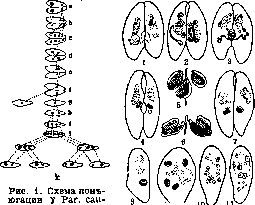
datum: a-d-conjugation
» ^>"
jugation; h-j -post
Figure 2. Conjugation in conjugating pe
Paramaec. caudatum (1- riod; y-reconstr
7); 8 - 11 - postconjugation macronucleus.
ctional period. dimorphic nuclear apparatus, consisting of macro- and micronucleus. In the simplest case with 1 macro- and 1 micronucleus, for example in the slipper animalcule (Paramaecium caudatum), the scheme of conjugation is as follows. Two conjugating infusorians come together so that a protoplasmic bridge is formed between their cytostomes. At this time their macronuclei break down and degenerate, while the micronuclei divide twice. As a result, each conjugant has 4 daughter elements of the micronucleus, 3 of which degenerate, and the 4th divides again in each conjugant, with one half turning into a stationary micronucleus and remaining in the same individual, and the second - migratory micronucleus - passes to the partner and merges with the stationary part of its micronucleus, which corresponds to the process of fertilization. After this the conjugants separate. Thus, at the beginning of the postconjugation period each conjugant still has no macronucleus, but only 1 micronucleus. The latter divides, with one of the products of its division being reconstructed into a new macronucleus, and from the other a micronucleus is formed. Thus, during conjugation the destruction of old macronuclei, mutual fertilization of two individuals and reconstruction of the macronucleus occurs. In connection with this, the biological significance of conjugation comes down to two points: reorganization of the macronucleus and fertilization. Conjugation usually occurs after a series of vegetative divisions, when as a result of the trophic period under the influence of toxic metabolic products accumulated in the environment, the latter pass into a state of depression, usually accompanied by hypertrophy of the macronucleus. The only way out of the state of depression is the reconstruction of the macronucleus. In connection with this, after conjugation the normal vegetative existence of the infusorian and its asexual reproduction are restored. This connection was first noted by Maupas (1888), who introduced the concept of rejuvenation through the fusion of nuclei ("rajeunissement par ogamie"). Since the reconstruction of the macronucleus is carried out by endomixis (see), conjugation may not occur at all. This is the basis of the experiments of American protozoologists (Calkins, Woodruff), who managed to maintain asexual reproduction of infusorians for over 10,000 generations without allowing conjugation. Thus, from the point of view of vegetative periodic reconstruction of the macronucleus is more important for the infusorian than fertilization of the micronucleus. The latter has only genetic significance.
G. Epstein. Conjugation of chromosomes - pairwise connection of homologous chromosomes, occurring during the preparation of sex cells for the last two divisions they undergo before final maturation. One of these divisions is the reduction division, in which the chromosomes do not split, as in all others, but the members of the previously conjugated pair go to the poles of the daughter cells. Conjugation thus ensures the even distribution of paired chromosomes to the daughter nuclei and allows the chromosomes of paternal and maternal origin to combine in them according to the laws of chance. In addition, during conjugation, an exchange of parts may occur between homologous chromosomes. All this makes conjugation one of the most important moments in the complex processes of maturation of sex cells. Lit.: Doflein F., Lehrbuch der Protozoenkunde, Vol. 1, p. 271, Jena, 1927 (literature).
Related articles
Mentioned in
Cite this page
“KONCHALOVSKY.” Soviet Medical Encyclopedia. English translation of Bolshaya Meditsinskaya Entsiklopediya, 1st ed. (Moscow, 1928–1936), ed. N. A. Semashko. https://sovietmedicalencyclopedia.pages.dev/article/konchalovsky/