Leukocytic Profile
Historical document, translated for reference. It reflects medical knowledge of the 1920s–30s and is not medical advice.
Summary
A 1930s graphical method for representing white blood cell counts, developed by Moshkovsky, showing both the relative ratios and absolute numbers of different leukocyte types. The article details how these profiles change in various conditions such as infections, age groups, and endocrine disorders.
Encyclopedia article (1928–1936)
LEUKOCYTIC PROFILE, a method for graphically depicting the white blood cell picture (according to Moshkovsky), which simultaneously displays both the ratio of the main groups of leukocytes to one another and the absolute content of each of them in 1 mm3 of blood. Five columns of the diagram correspond to the five main types of leukocytes. Rectangles indicate the normal limits for the absolute quantities of each type in 1 mm3. The norm for an adult is: basophils (B) 0-80; eosinophils (Eo) 100-250; neutrophils (N) 3,000-6,000; lymphocytes (Ly) 1,200-2,800; monocytes (Mo) 200-600. The absolute quantities of each leukocyte type, calculated for a given case (from the total leukocyte count and the differential white cell count or directly from the differential count in a counting chamber), are marked with points in the corresponding columns. By connecting the marked points, we obtain a broken line—the leukocytic profile. Under normal conditions, all vertices of the profile fall within the corresponding rectangles. The emergence of any point of the profile beyond the limits marked on the diagram indicates an increase or decrease in the content of these elements compared to the norm. The configuration of the profile, the slope of its individual constituent segments, determined by the relative height of its points, characterize the numerical ratio of the main types of leukocytes, i.e., the leukocyte formula, but unlike the leukocyte formula, the leukocytic profile is not limited to a simple statement of a deviation in the ratio of formed elements, but gives a clear
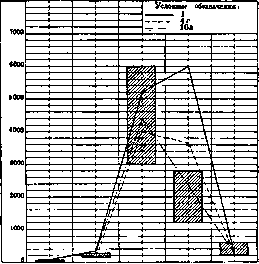
basophils
eosinophils neutrophils lymphocytes monocytes
Figure 1. Leukocytic profiles of childhood age.
representation of which particular group of leukocytes has undergone changes causing the observed deviation. In cases with a uniform decrease or increase in all forms of leukocytes, the leukocytic profile registers an anomaly, whereas the leukocyte formula detects no deviations from the norm. For a normal adult, a pointed profile is characteristic, with the highest point in the neutrophil column and a steep descent toward the lymphocytes. Lymphocytosis (percentage) is characterized by a decrease in the slope of the N-Ly segment up to a complete reversal of its direction (rise from N to Ly - inverted profiles). The ratio of monocytes to lymphocytes, which has attracted attention in recent years in certain infections, is reflected by the slope of the Ly-Mo segment. Different periods of childhood have their own specific forms of leukocytic profiles (Fig. 1). The influence of endocrine regulators of hematopoiesis on the type of leukocytic profile is manifested quite clearly both in experiments on animals and in the clinic (sharpening of the neutrophil peak after splenectomy in cases of hypersplenism). Certain infectious diseases also produce profiles characteristic of different periods of the disease. Thus, for example, chronic malaria is characterized by a profile with a truncated neutrophil "nose." Comparison on one form of two or three profiles from different stages of the same disease yields in a number of cases characteristic patterns of the mutual arrangement of individual segments of successive profiles (dynamics of profiles) (Fig. 2).
EOSINOPHILS
NEUTROPHILS
LYMPHOCYTES, MONOCYTES Figure 2. Leukocytic profiles of a patient with pappataci fever; crossover of the N-Ly lines.
Related articles
Cite this page
“Leukocytic Profile.” Soviet Medical Encyclopedia. English translation of Bolshaya Meditsinskaya Entsiklopediya, 1st ed. (Moscow, 1928–1936), ed. N. A. Semashko. https://sovietmedicalencyclopedia.pages.dev/article/leukocytic-profile/