Mayo
Historical document, translated for reference. It reflects medical knowledge of the 1920s–30s and is not medical advice.
Summary
The article profiles the Mayo family, particularly William W. Mayo and his sons William J. and Charles H. Mayo, who founded the Mayo Clinic in Rochester, Minnesota. It details their contributions to medicine, surgery, and the development of what became one of the world's largest medical institutions.
Encyclopedia article (1928–1936)
Mayo. 1. William Worrel Mayo (1819-1911), born in England near Manchester. He received his education as a chemist at Owens College (now the University of Manchester). He was one of the favorite students of the famous John Dalton. In 1845 he moved to America, where he worked as a chemist in New York; then he completed medical school in Lafayette and furthered his medical studies in St. Louis, where he received his medical degree from the University of Missouri in 1854. M. began his independent medical practice in the city of La Porte (Indiana). In early 1855 he moved to the state of Minnesota and began practicing in the capital St. Paul, and then in the city of Le Sueur, where he was overtaken by the Civil War. In the spring of 1863 the Mayo family finally settled in Rochester (Minnesota). Working here as the head physician of Olmsted County, M. quickly gained widespread popularity and became one of the pioneers of abdominal surgery in America, performing successful removal of ovarian tumors as early as 1871; in the following 13 years he performed 36 such operations. M. was one of the first physicians in the West to introduce the microscope into medical practice. M. was one of the founders (1861) of the Minnesota Medical Society and its president; M. wrote a vast number of works on various topics in medicine and surgery. He was also a prominent public figure, actively participating in municipal as well as state affairs. Politically, M. was a liberal democrat. His wide curiosity led him to travel extensively, making his second circumnavigation of the globe alone at the age of 87. He left two sons: William and Charles—both outstanding surgeons, leaders of the grandly developing clinics that grew from the small charitable hospital founded by their father. 2. William James Mayo (born in 1861). He received his medical degree in June 1883. Together with his father, he studied American hospitals on special trips, developing a plan for the construction of St. Mary's Hospital, which was destined to become the largest surgical center in the world (see below); formally he headed this institution only in 1911 after his father's death, but in reality both brothers had been conducting all the surgical work themselves from the very beginning. The unprecedented expansion of a small local hospital into a grand hospital trust was due to the exceptional surgical talent of both brothers and the extraordinary productivity of their scientific works in various fields of surgery. A continuous stream of scientific works coming from the clinics they directed were annually collected in the 'Collected papers of Mayo clinics,' forming enormous volumes of valuable works; there are already about 20 volumes; by 1925 William M. himself had published 221 scientific works. 3. Charles Horace Mayo (born in 1865). Beginning to work with his father and older brother in the St. Mary's Hospital they founded, he demonstrated exceptional ability in surgery, progressing sequentially from eye operations to surgery of the ear, face, orthopedics, and finally to abdominal surgery. He published 162 scientific works (by 1925), not counting works published together with his brother William. In 1915 he, along with his brother, donated 15 million dollars for the establishment of the Mayo Foundation and in 1919—the Mayo Properties Association for the perpetual public use of medical assistance in the clinics in Rochester. Both brothers are honorary and active members of most learned societies in America as well as a number of major societies in Europe. Mayo Clinics. The surgical trust in Rochester combines a number of hospitals, laboratories, research institutes, and hotels for incoming patients and their relatives. The Associations own all the land and buildings of the clinics, museums, libraries, auditoriums, equipment, archives, and monetary funds. All future buildings and acquisitions are also to become the property of the Association. At the time of the Association's formation, the value of Mayo's hospital institutions exceeded 5 million dollars; the holdings and capital of auxiliary enterprises were worth another 51/2 million dollars; finally, the portions allocated to a special fund for the development of educational and scientific works (The Mayo Foundation for Medical Education and Research) (see above) at the University of Minnesota were also valued at over 2 million dollars. In 1925 there were 118 members in the Association, consisting exclusively of physicians and scientists. Responsible for management and operations are 7 members of the board of directors (the two brothers M., physicians E. S. Judd, H. S. Plummer, D. C. Balfour, orthopedist M. S. Henderson, urologist W. F. Braasch). Direct leadership and management are in the hands of an executive committee of 5 persons. Meetings of the board of directors, the executive committee, the chairman of the faculty, and two permanent members
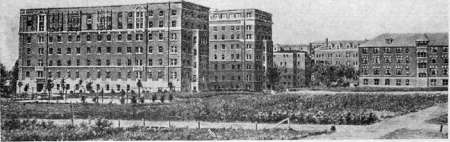
Figure 1. Surgical Hospital of St. Mary (Mayo Clinic). View from the South.
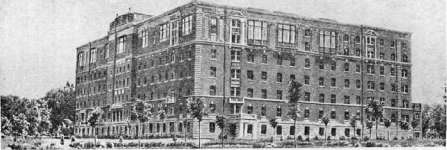
Figure 2. Surgical Hospital of St. Mary (Mayo Clinic). View from the West.
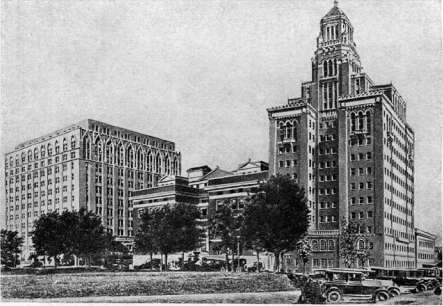
Figure 3. New Mayo Surgical Clinic.
form a 'council'. There are also 18 various commissions in charge of special departments (scientific research, publishing, library, university, surgical, club, etc.). The entire existing organization of clinics grew out of the small St. Mary's Hospital, built by Dr. W. W. Mayo. The elder M. was already 70 years old, and if he actively participated in all the affairs of the hospital, his sons carried out all the medical and especially the surgical work. The successes of the hospital were immediately enormous, and as early as 1893 the first addition was required. Interestingly, during these first years the hospital had to withstand a rather serious onslaught from those organizations that saw in St. Mary's Hospital a dangerous competitor. These turned out to be the private practitioners of the district, homeopathic physicians, and especially representatives of Protestant religious groups, who saw in the success of the Catholic hospital a undermining of the authority of Protestant organizations. From 1889 to 1905, the brothers operated only themselves with assistants; the number of operations increased from 495 in 1893 to 3,836 by 1905. In this year, E. S. Judd, an excellent surgeon, joined St. Mary's and began independent work in the third operating room; from 1911 he held the position of one of the chief surgeons of the clinics. Following him, in 1912, Balfour, Henderson (D. C. Balfour, M. S. Henderson) and a number of other physicians took on these roles. Additions and extensions at St. Mary's alternated almost annually with the construction and opening of new buildings. These include Chute Sanatorium, The Damon, Colonial Hospital, The Zumbro, Worrel Hospital, The Kahler, Alfred Convalescent Hospital, Stanley Home, Samaritan Convalescent Hospital, and finally, opened in 1927, the luxurious 18-story outpatient clinic (see separate table, fig. 1-3). Correspondingly, the total number of physicians also grew: until 1893, the Mayos worked as three, in 1896 there were 5 physicians, in 1898 - 8, in 1900 - 12, in 1904 - 15, in 1906 - 20, in 1910 - 47, in 1913 - 84, in 1914 - 104, in 1915 - 123, in 1916 - 142, in 1917 - 195, in 1918 - 207, in 1919 - 281, in 1920 - 296, in 1921 - 301. In 1925, the number of beds reached 1,507 with 27 operating rooms in use. The number of operations progressively increased year by year: 1906 - 4,770, 1907 - 5,523, 1908 - 6,454, 1909 - 7,204, 1913 - 10,873, 1915 - 14,951, 1916 - 17,085, 1918 - 18,744, 1919 - 23,622, 1925 - 25,730, 1928 - 27,318. Among these 27,318 operations performed in 1928, there were 496 operations on the brain and spinal cord, 2,134 operations on the thyroid gland, 646 operations on the thoracic gland, 802 operations on the stomach and 1,089 on the duodenum, 431 operations on the large intestine, not counting 1,211 appendectomies and 1,191 operations on the rectum, 1,312 operations on the bile ducts, 450 operations on the kidneys and ureter, 623 operations on the bladder and prostate gland. The overall mortality rate was 1.3%. Mortality for 8,841 operations on abdominal organs was 3.0%; for intraperitoneal operations, mortality was 2.9%. It should be noted the strictly carried out specialization in the distribution of surgical material. Thus, neurosurgery, plastic surgery, orthopedic surgery, jaw surgery, proctology, etc., are completely separate. Alongside surgery, other specialties are also exceptionally well represented. The 1928 staff includes, in addition to 75 general surgeons, 11 laryngologists, 7 plastic surgeons, 8 ophthalmologists, 10 dentists, 73 internists, 86 clinical assistants, 16 neurologists, 18 urologists, 13 dermatologists, 14 pediatricians, 6 obstetricians, 10 radiologists. The pathology department, headed by Wilson (L. B. Wilson), is exceptionally well equipped: 3 senior prosectors with 33 assistants. There are 26 physicians in experimental surgery, 6 experimental bacteriologists, 8 biochemists, and 4 on basal metabolism, 27 anesthetists, 5 artists, and a photographic studio. The number of separate laboratories before the opening of the new clinic reached 140 (37 in the old outpatient clinic, 28 in the institute of experimental pathology, 37 at St. Mary's, etc.); by type of work, they are listed in 22 separate categories. Since 1907, when the daily number of patients seen in the outpatient clinic reached 5,000, Dr. Plummer (Henry S. Plummer), one of the oldest and most talented associates of M., developed and introduced a special system for recording and accounting for all data concerning both inpatients and outpatients. 'Detailed, accurate, and intelligent disease histories are the most valuable spiritual asset that clinics possess,' wrote Plummer, 'a system is needed that allows finding everything concerning a patient at any time in case of readmission and for regular written inquiries, requests, etc.' The so-called cross-reference system (Russell's) was introduced, where the current outpatient clinic number follows all written data (analyses, X-rays, operation protocols, etc.); registration is conducted both alphabetically and by type of disease. Since as early as 1926, up to 1,000 patient histories were received daily in the archives, special large premises were needed to store such a volume of material. For this purpose, fireproof safes were built, which are open to physicians daily from 7:30 a.m. to 9:30 p.m., including Sunday - a phenomenon quite exceptional in America. The staff here includes: 8 registrars, 28 couriers, 2 controllers checking the completeness of the collected data, 9 special surgical registrars, 3 on the general cross-reference catalog, and 10 statisticians. Of course, this does not include the entire army of clerks and secretaries in the outpatient clinic offices. The clinic library, consisting in 1914 of only 4,000 medical books, reached 17,547 volumes in 1925. In 1926, the clinics received up to 350 titles of scientific medical journals in all languages, not counting the huge number of books. The works of the M. clinics ('Collected papers of Mayo clinics', Philadelphia) have been published annually since 1909; since 1921, a daily bulletin containing short articles and reports has also been published. A list of works published by M. institutions was issued in 1926 ('Index of the Collected papers of the Mayo clinic a. the Mayo foundation, 1884-1925', Philadelphia-London, 1926).
Related articles
Mentioned in
Cite this page
“Mayo.” Soviet Medical Encyclopedia. English translation of Bolshaya Meditsinskaya Entsiklopediya, 1st ed. (Moscow, 1928–1936), ed. N. A. Semashko. https://sovietmedicalencyclopedia.pages.dev/article/mayo/