Neurolysis
Historical document, translated for reference. It reflects medical knowledge of the 1920s–30s and is not medical advice.
Summary
Neurolysis is a surgical procedure to free a nerve from compressive scar tissue, categorized as external (exoneurolysis) or internal (endoneurolysis). The technique involves careful isolation of the nerve, with internal neurolysis specifically addressing nerve fascicles within the nerve trunk.
Encyclopedia article (1928–1936)
NEUROLYSIS, neurolysis (from Greek neuron- nerve and lysis- release), liberation of a nerve from compressive scar tissue. It was introduced into surgical practice almost simultaneously with nerve resection and nerve suture. At present, N. represents one of the important surgical procedures on the peripheral nervous system. A distinction is made between external N. (exoneurolysis) and internal (endoneurolysis). E x t e r n a l N. is the liberation of a nerve from scars enveloping it from the outside. The operative technique in cases where adhesions involve only the epineurium is very simple. Scar tissue is easily removed with a scalpel along with the outer sheath of the nerve (avoiding dissection of the nerve by blunt means - probe, gauze ball, etc.). In the presence of extensive scar masses firmly adhered to the nerve trunk, its liberation presents considerable difficulties. In these cases, special care must be taken when isolating muscular (motor) branches to avoid their damage. The nerve trunk, after isolation is complete, must be thoroughly examined by palpation to determine intra-stem injuries (ruptures, neuromas, scars). In the absence of endoneural changes, the operation of external N. ends here. Sometimes N. is complicated by the presence of a bony callus compressing the nerve. In these cases, to liberate the nerve trunk, it is necessary to resort to the help of bone instruments. The measures to prevent the renewed development of scars around the nerve after N. are the same as after nerve suture (see). Internal N. is the liberation of individual nerve fascicles from scar tissue that has developed within the nerve trunk. The operative technique was developed mainly by Stoffel. The separation of fascicles begins in the healthy area, then each fascicle is sequentially isolated from the scar tissue. The operation is applicable only in cases where intra-stem scars occupy a limited extent. In the presence of extensive scar masses, endoneurolysis proves technically unfeasible. In these cases, the affected segment of the nerve is resected and its ends are sutured (fig. 1 and 2). As a modification of endoneurolysis, the nerve combing (hersage) used by French authors can be considered - the longitudinal splitting of the nerve into fascicles with the help of fine needles or a series of silk threads. Similar significance is attached to the longitudinal ruptures of the nerve in the presence of transverse scar bridges used in some cases. - The results of N. are usually quite good. After 2-3 days, the symptoms of irritation disappear, and after 2-3 weeks, the function of the nerve is restored.
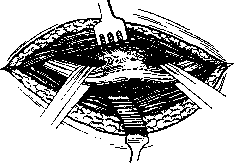
Figure 1. Nerve liberation. The dotted line indicates the site of resection.
by palpation for determining intra-stem injuries (ruptures, neuromas, scars). In the absence of endoneural changes, the operation of external N. ends here. Sometimes N. is complicated by the presence of a bony callus compressing the nerve. In these cases, to liberate the nerve trunk, it is necessary to resort to the help of
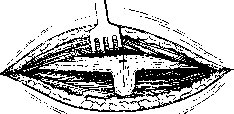
Figure 2. Suturing of the nerve after partial resection.
bone instruments. The measures to prevent the renewed development of scars around the nerve after N. are the same as after nerve suture (see). Internal N. is the liberation of individual nerve fascicles from scar tissue that has developed within the nerve trunk. The operative technique was developed mainly by Stoffel. The separation of fascicles begins in the healthy area, then each fascicle is sequentially isolated from the scar tissue. The operation is applicable only in cases where intra-stem scars occupy a limited extent. In the presence of extensive scar masses, endoneurolysis proves technically unfeasible. In these cases, the affected segment of the nerve is resected and its ends are sutured (fig. 1 and 2). As a modification of endoneurolysis, the nerve combing (hersage) used by French authors can be considered - the longitudinal splitting of the nerve into fascicles with the help of fine needles or a series of silk threads. Similar significance is attached to the longitudinal ruptures of the nerve in the presence of transverse scar bridges used in some cases. - The results of N. are usually quite good. After 2-3 days, the symptoms of irritation disappear, and after 2-3 weeks, the function of the nerve is restored.
Related articles
Mentioned in
Cite this page
“Neurolysis.” Soviet Medical Encyclopedia. English translation of Bolshaya Meditsinskaya Entsiklopediya, 1st ed. (Moscow, 1928–1936), ed. N. A. Semashko. https://sovietmedicalencyclopedia.pages.dev/article/neurolysis/