Perigastritis
Historical document, translated for reference. It reflects medical knowledge of the 1920s–30s and is not medical advice.
Summary
This article from the 1928–1936 Soviet medical encyclopedia defines perigastritis as an inflammatory process of the stomach's serous coat, always secondary to other diseases. It details the causes, such as gastric ulcers and toxic gastritis, and describes the resulting adhesions and deformities.
Encyclopedia article (1928–1936)
PERIGASTRITIS (from the Greek words peri- around and gaster- stomach), an inflammatory process of the serous coat of the stomach, always developing secondarily as a complication of diseases of the stomach itself or of other neighboring organs. The most frequent cause of P. is gastric ulcer and toxic gastritis (burns, intoxications), then ulcer of the duodenum and inflammatory processes in the biliary passages, first giving rise to periduodenitis and then spreading to the antral part of the stomach, and finally often colitis and pancreatitis; the latter, according to Zander, often lead to the development of posterior adhesive P. Next come acute peritonitis of any origin (traumatic, perforating) and chronic peritonitis (tuberculous), which may give extensive adhesions in the region of the stomach. In some cases, chronic trauma of the epigastric region as a result of professional occupations (e.g., persistent pressure on the epigastrium with a cobbler's last or other working tools) leads to the formation of adhesions of the stomach with the anterior abdominal wall. After blows to the epigastric region (e.g., with a carriage shaft), subsequent perigastritic adhesions were observed as a result of damage to the stomach or intraperitoneal hemorrhages. Quite often P. develops after various operations in the upper part of the abdominal cavity and especially on the biliary passages and the stomach itself. The available observations allow one to think that P. develops especially easily in subjects with a predisposition to adhesive processes (constitutional predisposition). P. is rarely encountered in young age; its frequency increases to the 40th year. Pathological anatomy. In the acute stages of P., marked hyperemia of the serous coat of the stomach is observed. Subsequently, the deposition of fibrinous exudate, which glues the stomach to neighboring organs or to the abdominal wall, joins; as a result of the organization of these deposits, stable connective tissue adhesions are formed. Fibrinous deposits in acute stages can be so massive that they become palpable from the outside; among them there may be necrosis resembling caseous, or even isolated purulent accumulations. In the chronic stage, adhesions have the appearance of either bands or bridges or wide flat adhesions. According to the extent of the lesion, the most diverse degrees are encountered—from limited bands to diffuse adhesions occupying the entire anterior or posterior wall of the stomach, or even enveloping the stomach from all sides. As a result of adhesions, more or less pronounced organic changes may occur in the walls of the stomach itself in the form of local thickening, change of shape, displacement or fixation of the stomach, and narrowing of its lumen. Bridges and bands in the region of the pylorus (peripyloritis) lead to the formation of a flexure with relative narrowing of the exit. Diffuse adhesions around the stomach, fixing it like on a frame, sharply disturb peristalsis and lead to stagnation of food. In the formation of cascade and bilocular stomach, adhesions also take a significant, and sometimes even exclusive, part. In some cases, on the basis of P., a peculiar deformation develops, called "riding stomach" g when the latter, thrown over a dense weight of adhesions, resembles a sack placed on the back of a pack animal. With a sharply expressed P., a number of clinical symptoms are observed: distension of the epigastric region after eating, sometimes severe pain, but more often an indefinite sensation of pressure, heaviness, or simply an unpleasant sensation in the upper part of the abdomen, precisely not determined by the patient. In posterior P., pains radiate to the back and to the corresponding segments. All these sensations are caused by the peristalsis of the stomach and therefore usually occur after eating. In very many cases, however, despite extensive P., subjective sensations are insignificant or completely absent. Suggestibility, autosuggestion, and the general state of the patient's psyche play a large role in the degree of expression of pain symptoms; this especially concerns postoperative P. According to Strazhesko, expressed forms of P. give characteristic signs upon percussion and palpation: upon percussion one can note a more horizontal position of the tympanitic zone of the stomach with significant expansion of it to the right, sometimes to the axillary line. At the same time, the lower boundary of the dull sound of the liver gives a semilunar concave line. Upon palpation, the lower edge of the liver is not felt in its usual place: it is determined only by the axillary line in the patient's position on the left side. Motor function of the stomach is significantly disturbed in extensive adhesions; in other cases the disturbances are insignificant or even absent. Radioscopically, P. sometimes gives clearly expressed signs, on the basis of which one can judge to a certain degree about the nature of local changes. Individual bands of adhesions disfigure the stomach (Fig. 1), forming pockets in its walls, notches of contours, and clearly fix individual points; at the site of fixation, often a.
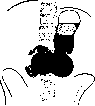

Fig. 1.
Figure 2. The aforementioned "riding stomach" can also be established by radioscopy. With flat adhesions, the stomach is displaced, or its elongation to the right is striking. Changes in the contours of the stomach, noted on the screen, increase with peristalsis. In some cases, changes in contours are so coarse and sharp that distinctive recognition with a neoplasm becomes impossible; such changes give occasion to speak of perigastritis deformans (Fig. 2). Treatment is directed first against the basic disease. If one is dealing with a process that has already ended, i.e., with adhesive perigastritis of not very recent origin, thermal procedures in various forms—compresses, hot-water bottles, mud cakes, diathermy—should be applied. Surgical treatment is indicated in those cases where there is an obviously expressed deformation of the stomach (bilocular, cascade stomach), as well as where adhesions narrow the exit. In these last cases, success can be counted on if individual bands and constrictions compressing the stomach are found and separated. In the presence of flat adhesions, their separation sometimes also gives success, but usually adhesions develop again and often in an even more expressed degree, and the effect of the operation is too impermanent. In separating adhesions, in any case, one should strive to peritonize the exposed areas by suturing and plastic operations on the peritoneum or by inserting omental pads. Anastomosis of the digestive tract may take place with an intractable narrowing of the exit or with stomach deformation. But with simple diffuse P., fixing the entire stomach, with signs of motor insufficiency, gastroenterostomy gives poor results and can even worsen the patient's condition. Moreover, due to adhesions, access to the posterior wall of the stomach for anastomosis is often impossible. One must always bear in mind that individual predisposition to the development of adhesions in the abdominal cavity can be expressed extremely sharply and therefore in indications for operations one should be very cautious and decide on it only where other measures do not lead to the goal.
Related articles
Mentioned in
Cite this page
“Perigastritis.” Soviet Medical Encyclopedia. English translation of Bolshaya Meditsinskaya Entsiklopediya, 1st ed. (Moscow, 1928–1936), ed. N. A. Semashko. https://sovietmedicalencyclopedia.pages.dev/article/perigastritis/