Biogenetic Law
Historical document, translated for reference. It reflects medical knowledge of the 1920s–30s and is not medical advice.
Summary
The biogenetic law, formulated by Ernst Haeckel, establishes the relationship between individual organism development (ontogeny) and the evolutionary development of a species (phylogeny). It became a fundamental method for studying evolution alongside comparative anatomy and paleontology.
Encyclopedia article (1928–1936)
Biogenetic Law, formulated by Ernst Haeckel, establishes the regular relationship between the individual development of an organism (ontogeny) and the development of this form during the evolutionary process (phylogeny). The idea that embryos of higher animals pass through stages corresponding to the adult organization of lower forms arose long before Haeckel, as early as the beginning of the 19th century. Meckel (1811, 1821) was among the first to begin speaking of the correspondence of developmental stages in humans to adult forms of lowly organized animals. Karl von Baer ("History of Animal Development", scholium 5, 1828), unlike Meckel, asserted that "the embryo of a higher form is never similar to another animal form, but only to its embryo." Furthermore, K. Baer established a certain sequence in the appearance of characteristics of the developing embryo: characteristics common to large systematic groups of animals appear earlier than characteristics specific to smaller groups (the so-called Baer's law). Later Fritz Müller (1864), based on the study of the developmental history of crustaceans, built his generalization between the individual development of an animal and the history of its species already on the basis of evolutionary theory, according to Darwin. The larval forms of certain crustaceans, according to the research of Fr. Müller, are very similar to the forms of their extinct ancestors; they as if briefly repeat during their embryonic development the evolutionary process passed by their ancestors through countless generations living in previous geological epochs. Similar views were also held by C. Darwin. In the latest edition of "Origin of Species" he notes (chapter 15): "It is highly probable that the embryonic or larval stages of many animals more or less clearly indicate to us the structure of the progenitors of the entire group in their adult state." Thus, gradually a generalization was established, maintaining the preservation in the embryonic state of characteristics of ancestors in their adult or embryonic state, which was finally formulated by E. Haeckel in his "General Morphology of Organisms" in 1866 and received the name of the basic biogenetic law. Haeckel's formulation is as follows: ontogeny is a repetition of phylogeny; or more in detail: the series of forms through which the individual organism passes in its development, starting from the egg cell and ending in a fully developed state, is a brief, condensed repetition of the long series of forms passed by the animal ancestors of the same organism or the ancestral forms of its species, from the earliest times so-called organic creation to the present time. This law of phylogenetic and ontogenetic parallelism played a major role in the study of animal evolution. Haeckel himself, using the embryological method, attempted to reconstruct the general genealogical tree of the entire organic world, plant and animal, from the appearance of life on Earth in the form of the simplest, single-celled organism (monera) to the present day. And the human organism, according to Haeckel, at the beginning of its development, as a fertilized egg cell, resembles the simplest organism; later it resembles a coelenterate (gastrula); even later it resembles a worm-like animal. Then it develops gill slits and arches (as in a fish, see Figure 1), the last remnant of which is the hyoid bone. Haeckel believed (though not to the extent usually attributed to him) that at certain stages of development in the human embryo (as well as in the embryo of any other animal) one can find so many characteristics of ancestors that the given embryo, by the sum of its characteristics, can be assigned to a certain systematic group to which its ancestors belonged at the corresponding phylogenetic stage. Thus, the history of individual development becomes one of the basic methods in the study of evolution, equal in importance to comparative anatomy and paleontology. All three methods together, complementing each other, become one common method for studying evolutionary development, which is why Haeckel is usually called the founder of the phylogenetic direction. However, even Haeckel himself took into account that not all embryonic processes are of equal importance for phylogeny. Haeckel divides embryonic processes into two groups: 1) palingenetic processes—embryonic repetitions (recapitulations)—represent phenomena in the individual history of development, inherited by the animal from its more or less distant ancestors and passed from generation to generation; 2) cenogenetic processes represent changes in the original structure caused by the struggle for existence as adaptations in embryonic life. In the history of development
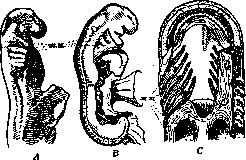
Figure 1. Gill slits (g.s.) in the embryos of a skate (A) and a human (B) at corresponding stages. In humans they do not persist in the adult state, in fish they remain (C—pharyngeal cavity of a shark).
one can find many examples of both palingenesis and cenogenesis. Examples of phenomena of the first order can be the following formations in the developmental history of vertebrates and humans: 1) development in higher vertebrates in the place of the future spine of the notochord, which persists in lower vertebrates and in the adult state; 2) stages of heart development in higher vertebrates, first having the appearance of a simple curved tube, and then transforming into a two-chambered, three-chambered, and four-chambered heart, which corresponds to the transformation of the heart in the series of vertebrate animals; 3) development in the embryonic state of humans and other higher vertebrates of the primary kidney, which functions in the adult state only in lower vertebrates and is replaced in higher vertebrates by the permanent kidney (metanephros); 4) formation of gill slits and arches in the embryos of higher vertebrates, in which gill respiration no longer exists. As is known, fish breathe with gills consisting of gill arches with gill filaments attached to them (see Figure 1); the gills are located in the pharyngeal region of the intestine between the gill slits and are washed by water entering through the mouth and through the gill slits. In Fig. \A the embryo of a fish—sea skate—is presented
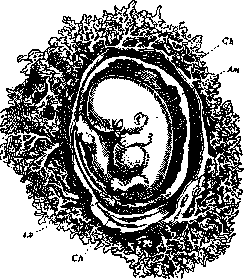
Figure 2. Six-week-old human embryo with all embryonic membranes, which are opened from the outside: Ch-outer embryonic membrane with well-developed villi-chorion; Am-inner embryonic membrane-amnion; s. i>-yolk sac, communicating through the umbilical cord with the intestine of the embryo. (Trygon pastinacum) at an early stage of development, where the formation of three gill slits and arches between them is visible. In Fig. 1B, a human embryo of approximately the corresponding stage is presented. In general form, both embryos, despite the enormous difference between adult animals, resemble each other. The pharyngeal region of the human embryo (as well as the pharyngeal region of the fish) is penetrated by three slits. These slits in the human embryo very quickly overgrow and never play the role of respiratory organs; in fish they are preserved in the adult state as respiratory organs (see Figure 1C). Thus, in the developmental history of humans (and also of all other terrestrial vertebrates), the structure of an extremely distant ancestor is preserved, not only of humans, but of all terrestrial vertebrates together.-As an example of cenogenetic processes, Haeckel points to the appearance in the developmental history of various organs that play a role in embryonic life and are not preserved in the adult state. Such organs are, for example, the following embryonic organs: 1) yolk sac, developing in many vertebrate embryos and serving as an organ for storing reserve nutrients used for nourishing the embryo; 2) embryonic membranes-amnion, allantois, chorion, developing in higher terrestrial vertebrates and humans; 3) various larval organs in those animals whose larvae lead a free lifestyle (one of the examples mentioned is depicted in Fig. 2). The human embryo (as well as all mammals, birds, and reptiles) is surrounded by a whole series of complex organs that are part of its organism (such as amnion, chorion, and yolk sac), but play a role only during embryonic life. In addition to the appearance of special embryonic organs, cenogenetic processes include embryonic developmental disorders, which Haeckel reduces to shifts in embryonic development processes arising from the adaptation of the embryo to new conditions of existence. These shifts Haeckel divides into two groups: shifts in the timing of development-heterochronies-and shifts in the place of organ formation-heterotopias. Particularly significant disorders are given by heterochronies. Heterochronies, in turn, break down into ontogenetic accelerations and ontogenetic retardations. If an organ, in its ontogenetic development, gradually, in a series of successive generations, begins to be laid down at earlier stages of development, then this concerns ontogenetic acceleration. Thus, e.g., in higher vertebrates, the brain, as a progressive organ, develops faster than other organs and at the stage when gill slits still exist, it is much more complex than the brain of fish breathing with gills. Similarly, the heart develops and differentiates into a complex heart when other organs still retain a primitive structure. If an organ is laid down embryonically later than in ancestors (as, e.g., the intestinal canal, body cavity, sexual organs of higher vertebrates), then there is ontogenetic retardation. Thus, the Biogenetic Law established two basic teachings: the teaching of recapitulations and the teaching of cenogenesis. The teaching of recapitulations became a method of phylogenetic research. Most morphologists, starting from the second half of the 19th century, used this method to establish the phylogenies of various animal organs. Particularly much was done in the study of vertebrate animals. The Biogenetic Law also played no less a role in the teaching of the origin of man. Many rudimentary formations in the human body, such as the hairy covering of the embryo at 5-7 months (lanugo), phenomena of polymastia, rudimentary formations of the urogenital system (pedunculated and sessile hydatids, male uterus, etc.), received their precise interpretation when applying the biogenetic law to human development. The analysis of cenogenetic phenomena at the end of the 19th and beginning of the 20th centuries led to extensive criticism of the basic Biogenetic Law as a whole. This criticism developed in two directions: from the point of view of cenogenesis and from the point of view of heredity. Let us note only the main works devoted to the criticism of the Biogenetic Law: to the first group belong Oppel, Kiebel, Menert, etc.; to the second group-O. Hertwig, Emery, Morgan, etc. This criticism had relatively little effect on the research of morphologists. They continued to use the Biogenetic Law to establish phylogenies; gradually a large number of facts accumulated, consistent with the data of comparative anatomy and paleontology, confirming the parallelism between ontogeny and phylogeny. Most modern evolutionists (Plate, Abel, Severtsev, Goodrich) use the Biogenetic Law as a means of evolutionary research and for theoretical conclusions (Neef). To a greater extent, the criticism of the Biogenetic Law affected the now widespread direction of experimental morphology in Western Europe (Driesch, Rou, Spemann, Dürken, etc.). Without fully denying the significance of the Biogenetic Law (Dürken, 1924), experimental morphologists, with rare exceptions (Schmalhausen, 1926-27), do not use it at all in their research, having refused to use experiment to verify the laws of phylogeny. The modern substantiation of the Biogenetic Law and its application to the study of evolution is given in his works by A. N. Severtsev (1912, 1922, 1927). According to Severtsev's views, embryonic development itself is one of the factors of evolutionary development. Two types of evolution can be outlined, occurring in embryonic development: evolution by superposition (anabolia) and evolution by changing the initial stages (archallaxis). The method of superposition consists in the fact that in the course of development, at late stages, a change in the structure of an organ occurs, leading to a change in the structure of the organ also in the adult state. To the last embryonic stages of ancestors is added a series of new stages changing the ancestor's organ and transforming it into the descendant's new organ, while embryonic development as a whole is lengthened. This type of evolution is the main factor in the evolution of organs and represents the cause of true recapitulation. In the developmental history of humans, many characteristic features of human structure develop very late and can serve as examples of evolution by superposition. The lengthening of human legs, the fusion of pelvic bones, the fusion of sacral vertebrae are examples of changes that occurred very late in connection with adaptation to walking on two legs in a vertical position. Another example can be the gradual reduction of the tail in humans, which is developed quite strongly in the embryo. The method of changing initial stages consists in changing the rudiment of an organ at some early stage of development and in its transition in the same modified form to the adult state. These changes do not cause recapitulation, because from the very beginning the organ is laid down already modified. An example of such phenomena can be the change in the position of the pelvic fins in some fish. Typically they lie near the anal opening, but in some fish they are laid down from the very beginning of development far forward, near the pectoral fins (and even in front of them). The method of evolution of organs by superposition gives an interesting relationship with Baer's law (see above). The method of superposition explains Baer's position about the appearance in ontogeny first of the features of large systematic groups and at late stages-of small systematic groups. The method of changing initial stages does not obey Baer's law, because then new features are laid down modified from the very beginning.
Related articles
Mentioned in
Cite this page
“Biogenetic Law.” Soviet Medical Encyclopedia. English translation of Bolshaya Meditsinskaya Entsiklopediya, 1st ed. (Moscow, 1928–1936), ed. N. A. Semashko. https://sovietmedicalencyclopedia.pages.dev/article/biogenetic-law/