Evolutionary Theory
Historical document, translated for reference. It reflects medical knowledge of the 1920s–30s and is not medical advice.
Summary
Evolutionary Theory is the doctrine of the successive, historically developing forms of life (animals and plants). According to this theory, all currently existing living forms originated through transformation of previously existing forms.
Encyclopedia article (1928–1936)
EVOLUTIONARY THEORY, the doctrine of successive, historically developing forms of life (animals and plants) considered over time. According to E.T., all currently existing living forms originated through transformation (change, metamorphosis) of previously existing forms. The basic unit concerning which evolution is primarily discussed is the species (see). E.T. asserts that species change and give rise to subsequent species, which in turn evolve into new species. Of course, evolutionary development also occurs in other, larger systematic units, i.e., genera, families, orders, classes, and types. A. Main stages in the development of E.T. The origin of the idea of organismal development dates back to ancient times. In the works of Empedocles, Democritus, Anaxagoras, Aristotle, Lucretius and other philosophers, ideas about the development and transformation of organisms are quite clearly expressed, and at the same time attempts are made to determine the directions and driving forces of the evolutionary process. In this connection, two world-view concepts emerge—mechanistic and idealistic. As the foremost representative of the first, Democritus must be named. He believed that plants and animals, like other (inanimate) bodies of nature, are the result of the combination and collision of moving atoms. The combinations of atoms forming plants, animals, and bodies of inanimate nature differ, according to Democritus, only in purely quantitative relationships, but do not constitute a special quality. On the contrary, Empedocles, Anaxagoras, Aristotle and others based their views on idealistic conceptions of a special 'life force' (Aristotle's entelechy) governing the transformation and development of living forms. Greek philosophy could not provide any complete evolutionary doctrine, both due to the state of factual knowledge at that time and due to the socio-economic and productive relations of the ancient period. Nevertheless, as Engels says, for the Greek philosophers 'the world was essentially something that had arisen from chaos, something that had developed, something that had become.' Beginning with the Middle Ages with their feudal-aristocratic, religious world-view, for approximately the first 14 centuries from the beginning of our era, the evolutionary idea could not find any basis for its development. In the 15th century, when new capitalist relations began to emerge, accumulation of knowledge about the diverse animal and plant world of the earth increased. In the first half of the 16th century, a number of researchers (Bock, Brunfels, Fuchs, Belon, Salviani and others) turned to detailed description of various animal and plant forms and laid the initial foundations for the concept of species. In the second half of this century, major compilations about animals appeared (C. Gesner, Historia animalium, 1551-1558, Aldrovandi, Ornithologia, 1599, and other works) and at the same time knowledge of animal and human anatomy rapidly developed (Fabricius ab Aquapendente, Spigelius, Marco Aurelio Severino and others—in the 16th century; Harvey, Stelluti, Redi, Thomas Willis, Blasius, Malpighi, Swammerdam, Leeuwenhoek and others—in the 17th century). The accumulation of rich factual material made it possible to discover the fact of the enormous diversity of living forms. The study of this diversity becomes possible only under conditions of applying the comparative method, which allows the study of animal and plant forms based on the characteristics of similarity and difference between them. Hence the development of systematics and comparative anatomy—sciences that played a major role in the formation of the evolutionary idea. The leading representative of 18th-century systematics, Carl Linnaeus, recognizing the theory of the constancy of species (the theory of creation) prevalent in his time, at the same time was forced to recognize the existence of varieties (varietas) arising under the influence of random external causes, and, as Engels says, 'made already a major concession when he pointed out that through crossing, new species could arise.' In the 'Amoenites Academicae' published by Linnaeus, there were suggestions that species of one genus originally represented one species and originated through change of this latter (Greberg, Fundamentum fructificationis, Amoenitatos Acad., VI, 1762). In the second half of the 18th century, the idea of development was in the air. A number of philosophers and naturalists expressed various evolutionist theories contradicting the officially accepted dogma of the constancy of species. Such are the evolutionist views of de Maillet (pseudonym Telliamed), Robinet, Bonnet (Bobinet, Bonnet) and other authors. Robinet (1766, 1768) tried to rely on Leibniz's law of continuity and accordingly derived all living things from the same source, from the same matter. 'There must have been a time,' says Robinet, 'when there was not a single creature arranged as those we see...' The first forms were primitive, from them through successive development arose the ascending series of modern forms. The path goes from minerals to plants, from them to animals, from animals to man. Leibniz's philosophy also influenced the views of Bonnet (1720-1733), who tried to develop the idea of a pre-established order by the Creator in nature and depicted the relationships between natural bodies in the form of a ladder. On its lower steps are atoms and minerals, then, in ascending order, corresponding plants, animals, man, cherubim, God. At the same time, Bonnet tried to connect forms of adjacent steps with succession and bonds of kinship. Strictly speaking, the views of the mentioned authors, besides their personal aspirations, have only an external similarity with evolutionary ones. In essence, these evolutionist views are close to the idea of a pre-established hierarchical order in nature by the Creator—an idea underlying the views of Linnaeus. The development, depicted as a ladder of beings arranged in order of increasing height of their organization, is conceived not as the emergence of something new, but only as the unfolding of the existing natural order. From this point of view, J. Buffon stands much closer to E.T. He developed the idea of the spontaneous generation of organisms from the smallest organic particles (molecules) and expressed himself in favor of the variability of living forms, considering the main factor causing these changes to be the influence of external conditions, attaching particular importance to the influence of temperature, food, and domestication. However, Buffon can be considered an evolutionist only with rather significant reservations. Even Quatrefages (1892) pointed out that Buffon spoke of the variability of species within genera or families and never spoke, for example, of the change of classes. Therefore, Buffon must be considered a supporter of the theory of limited variability of species. At the end of the 18th and beginning of the 19th centuries, natural philosophy developed. Reflecting the state of its epoch, natural philosophers carried forward the idea of the unity of nature and defended the theory of the development of the animal and plant world of the earth. Thus, Oken (1779-1851), proceeding from the natural-philosophical idea, put forward the thought that all organisms are related and arise from primary slime through spontaneous generation at the bottom of the oceans. Similar ideas were expressed by Carus (1789-1869), the Treviranus brothers (L. Treviranus, 1779-1864, and G. Treviranus, 1776-1834), Tiedemann (1781-1856), Goethe and others. Mention should be made of the grandfather of C. Darwin, Erasmus Darwin. In his four-volume 'Zoonomia' (1794-1796) he expressed ideas about the development of organisms, considering the driving forces of development not to be external factors, but internal causes inherent in the organism itself. The statements of E. Darwin remained completely unfounded, which however is true for most of the above-mentioned authors associated with natural-philosophical ideas. A much more complete E.T. was given by Étienne Geoffroy Saint-Hilaire and Jean-Baptiste Lamarck. The latter is usually considered the first evolutionist, as he first (1809) posed the evolutionary problem in its entirety and at the same time quite clearly considered the evolutionary process as a historical process occurring on a geological time scale, and at the same time as a continuous process, accompanied by the unlimited variability of species. However, Lamarck's doctrine did not succeed with his contemporaries. It was poorly substantiated, not armed with factual material, and too sharply contradicted the dogma of the immutability of species prevalent in official science. Finally, Lamarck's E.T. was in no way yet connected with practice, with the productive relations of the epoch, and naturally remained without ground for its development. Only after Lamarck's death in 1830 did the famous dispute between É. J. Saint-Hilaire and G. Cuvier occur. The dispute was not about evolution, but about a single plan of structure. Saint-Hilaire, defending the theses of his students (Lorenzo and Méhain) about the similarity of the plan of structure of cephalopod mollusks with the plan of structure of vertebrates, tried to uphold his idea that the differences between animals of different types are only modifications of the same single plan of structure. On the contrary, Cuvier, quite justifiably from the point of view of the data available to him, pointed out that each type of the animal kingdom has a special plan of structure.
The dispute ended with the victory of Cuvier, who, of course, found it much easier to show that the structural plans of mollusks and vertebrates are fundamentally different than to prove the opposite to Saint-Hilaire. This dispute dealt a heavy blow to Evolutionary Theory, since the 'single plan' of Saint-Hilaire reflected his evolutionary views on the blood relationship between animals of different systematic groups. The 1830s were an era when the theory of creation dominated official science. But at the same time, the late 18th century and the entire first half of the 19th century turned out to be an era when facts were accumulating and conditions were being forged for the triumph of Charles Darwin's Evolutionary Theory. The greatest services to Evolutionary Theory were rendered by its most prominent opponents, and above all by Cuvier, who made a number of fruitful generalizations that played a major role in strengthening the factual basis of Evolutionary Theory. In the field of comparative anatomy, Cuvier established a very important law of correlation of parts of the organism (loi de connexion des organes), according to which all parts of an animal's body are systematically connected and mutually condition the appearance of one another, and the change of any organ, according to Cuvier, causes corresponding changes in other organs (the principle of correlation). These positions of Cuvier bring science closer to the concept of the organism as a single whole and force researchers to evaluate the systematic position of a given animal form not on the basis of individual, arbitrarily selected characteristics, but on the basis of their regular combination. Cuvier's views and his attention to anatomical research could not but affect the state of systematics, which Cuvier enriched by the discovery of the existence of types (embranchements) of the animal kingdom. In Cuvier's teaching on branches (types), the enormous significance of his comparative-anatomical research in revealing natural, and in fact, as Evolutionary Theory later showed, related groups of forms, is evident. A type combines systematic groups of diverse animal forms that possess a single structural plan. This principle of unity in diversity later served an important function in the system of evidence for Evolutionary Theory. No less important is Cuvier's role in paleontology. Cuvier discovers the fact of the regular change of animal forms over time and establishes that, the closer to the present, the greater the similarity between fossil and modern forms. One can only marvel at the persistence with which Cuvier, who obtained a number of proofs in favor of Evolutionary Theory, denied the latter, and for this reason one must not forget that Cuvier was ideologically a representative of feudal worldviews, which undoubtedly influenced his scientific views. While highly evaluating the significance of Cuvier's works, one cannot, of course, forget the works of E. J. Saint-Hilaire, who rendered great services to comparative anatomy and comparative embryology. Another scientist who rendered valuable services to Evolutionary Theory was the famous Karl Ernst Baer (Carl Ernst v. Baer, 1792-1876), who worked in the field of comparative embryology and to a large extent created it. Baer by no means intended to fight for the evolutionary idea. However, in studying the embryos of vertebrate animals, Baer gives a number of generalizations that sound like clear arguments in favor of Evolutionary Theory. These generalizations are formulated by Baer as follows: 1) '... the general characteristics of each larger animal group are formed in the embryo before the specific ones; 2) from the more general in the area of form relationships, the less general is formed, and so on, until finally the most specific arises; 3) the embryo of each animal form by no means repeats other animal forms in its development, but, on the contrary, rather isolates itself from them; 4) in its essence, the embryo of a higher animal form is never similar to another animal form, but only to its embryo.' At the same time, Baer directly saw the enormous, striking similarity of vertebrate embryos that suggests a relationship between forms, and his generalizations clearly speak of the evolutionary process and that new characteristics always appear in the embryonic state. Comparative-embryological research leads Baer to the theory of types and in particular to the same four basic structural types that Cuvier spoke of. The works of Cuvier, E. J. Saint-Hilaire, and K. Baer open a new era in science. The first half of the 19th century is characterized by the most energetic accumulation of facts in the field of systematics: Latreille (1762-1833), Blainville (1777-1851), Valenciennes (1828-1849), Siebold (1804-1855), Leuckart (1822-1898), Bronn (1800-1862), Rudolphi (1771-1832); in the field of comparative anatomy: Burdach (1776-1847), Blumenbach (1752-1840), Bojanus (1776-1827), Meckel (1781-1833), Waldheim (O. P. v. Waldheim, 1771-1853), Johannes Müller (J. Müller, 1801-1858), R. Owen (1804-1892) and others; in the field of embryology: Pander (1794-1865), Martin Rathke (M. Ratke, 1793-1860) and others; paleontology: d'Orbigny (1802-1857), Brongniart (1770-1847), Brocchi (1772-1826), Sowerby (1757-1822), d'Archiac and others; zoogeography: St. Vincent (1780-1846), R. Lesson (1794-1849) and others, and in the field of other disciplines. In the first half of the 19th century, cytology with histology and protistology achieved major successes. Thus, by the middle of the 19th century (1859 - the appearance of Darwin's 'Origin of Species'), guiding concepts had already been formed in the above-mentioned sciences, a huge amount of factual material had been accumulated, and the main milestones of modern systematics had been established. As is known, these successes were connected with the development of capitalism, which during this period was in a phase of growth, especially in England with its highly developed factory industry and large-scale agriculture. In England and to a lesser degree in the countries of Western Europe, the view was widely spread that domestic animals and cultivated plants are variable and that man has the power to create new breeds by selecting changed producers and rejecting individuals unsuitable for the pursued goals. The expression that nature can be molded according to a conceived intention was common. Herbert (1822, 1837), J. Matthew (1831), Naudin (1852) and others, as Darwin says, even before him recognized the 'principle of the struggle for existence' and natural selection, comparing the fate of domestic breeds with the transformation of natural species; at the same time as Darwin, Alfred Wallace (A. Wallace) formulated an extremely similar evolutionary theory, while in geology the views on the evolution of the earth's surface, expounded by Lyell in his 'Principles of Geology' (1830 and 1872 11th ed.), were already spreading. At the same time in England, the doctrine of free competition of struggling forces (A. Smith) and the reactionary theory of population by Malthus gained wide circulation. Engels sharply emphasized the ideological basis that determined the genesis of Darwinism: 'The whole teaching of Darwin about the struggle for existence is simply a transfer into the sphere of living nature of Hobbes' teaching about bellum omnium contra omnes (war of all against all) and the bourgeois-economic teaching about competition along with Malthus' theory of population.' B. Brief overview of the arguments (evidence) in favor of Evolutionary Theory. Darwin for the first time in the history of science collected and brought into a systematic system the so-called evidence in favor of Evolutionary Theory. By the latter should be understood all those facts whose materialistic (scientific) explanation is given by Evolutionary Theory. I. The basic premises speaking in favor of Evolutionary Theory are given by systematics. Its development was accompanied by the gradual development of such concepts and the discovery of such phenomena that can be understood only from the point of view of Evolutionary Theory and therefore are arguments in its favor. Such arguments from the field of systematics will be the following: 1. Systematists, independently of Evolutionary Theory, discovered the existence in nature of natural groups of forms. A natural group of forms is a real phenomenon of nature. The existence of such groups was already sensed by Linnaeus, but he openly said that he could not causally explain the existence of 'natural orders.' Evolutionary Theory gives a completely scientific explanation for the existence of natural groups of forms; obviously, a natural group is formed by related forms, i.e., those descending from a common ancestor (e.g., mammals form a natural group because they unite related forms, i.e., those that descended from a common ancestor). 2. Independently of Evolutionary Theory, systematists come to the necessity of depicting the relationships between systematic groups of forms in the form of a genealogical tree. Attempts by some authors (Robinet, Bonnet and others) to depict these relationships in the form of a ladder (see above) encountered the impossibility, already revealed at the beginning of the 19th century, of attributing absolute meaning to the concepts 'higher' groups and 'lower' groups. On the contrary, these concepts are relative. Any group of forms may turn out to be in some respects higher than another neighboring group, and in other respects lower, e.g., neighboring orders of a given class or neighboring families of a given order, etc.
Therefore, it is completely impossible to depict their mutual position as adjacent steps of a ladder, where one step would inevitably be higher than another, and it is much more correct to depict the mutual position of groups in the form of branches of a common 'tree'. Such relations, arising from the coexistence of groups of forms whose organization is simultaneously 'higher' and 'lower' than that of neighboring groups, can only be explained on the basis of evolutionary theory, namely, on the assumption that these groups descended from a common ancestor and then diverged in different directions. In this connection, only from the point of view of evolutionary theory does the real existence in nature of not only species but also genera (Genus), families (Familia), orders (Ordo), classes (Classis), and types (embranchement, Typus) become understandable. Obviously, these systematic groups express degrees and at the same time phases of divergence of originally similar forms. 3. Finally, systematics, having accumulated a huge amount of material, prepared the statement of the fact of species variability. This is the basic prerequisite of evolutionary theory, since without species variability there can be no evolutionary process. It is not therefore accidental that the struggle for and against evolutionary theory has always been a struggle for or against theories of the constancy and variability of species. II. The development of morphology ensured the accumulation of very important evidence in favor of evolutionary theory. Comparative anatomy provides a series of most valuable facts, explainable only from the point of view of evolutionary theory. 1. Within any type of the animal kingdom, a phenomenon of amazing similarity is observed between the forms included in it, so-called unity of structural plan. For example, the skeletons of all terrestrial vertebrate animals (from amphibians to mammals and humans) are extremely similar in the general plan of structure. This 'unity of structural plan' acquires enormous value as an argument in favor of evolutionary theory because forms possessing a similar structural plan (for example, the human and the dog are similar in the structure of the sclera) at the same time possess homologous organs, i.e., organs that may be of different functions but develop from similar rudiments and at the same time are similar in structure and position (for example, the flipper of a dolphin, the foreleg of a dog, and the human hand, despite the difference in functions, are similar and are homologs). Furthermore, homologous organs (for example, the above-mentioned limbs of the dolphin, dog, and human) consist of similarly arranged and homologous elements [thus, the human humerus is homologous to the humerus of the dolphin, dog, etc.; the human radius is homologous to the radius of the dolphin, dog, etc.]. Consequently, one can observe not only general similarity but also similarity in details of organization. Such deeply penetrating similarity is obviously regular, appears independently of the mode of life of the forms being compared, and can be explained only by the fact that it is an expression of their blood relationship. In a number of cases, similarity between organs may be purely external, not due to similar origin, but in connection with identical or similar functions (the tail fin of a dolphin and a fish). These are so-called analogous organs. Thus, similarity can be of different kinds. Only evolutionary theory can explain the fact that in given forms, despite deep differences in mode of life, homologous similarity is still preserved, down to the details of structure of individual organs. Obviously, it is most natural to explain the phenomenon of preservation of similarity in forms different in mode of life by their blood relationship. 2. Morphological analysis of homologous structures acquires special value when organs become rudimentary, i.e., turn into vestigial structures. In a number of cases, it is possible to establish to which organ in normally constructed forms the given rudiment corresponds (is homologous). Knowing the normal condition of the given organ and determining that the given rudiment is homologous to this organ, we obtain the possibility of giving a natural explanation from the point of view of evolutionary theory of the nature of rudimentary organs. Obviously, this is an organ that has changed, i.e., evolved. Consequently, its possessor has also evolved. It is understandable that the phenomenon of rudimentation is a valuable argument in favor of evolutionary theory. 3. Despite the fact that unity of plan usually does not go beyond the limits of modern types of the animal kingdom, still among both modern and especially extinct organisms (see below), so-called composite forms are observed, standing as it were on the border between neighboring groups, the characteristics of which such composite forms combine. For example, onychophorans (Peripatus capensis and other forms) combine some characteristics of tracheate arthropods and annelid worms (Annelides). Among extinct representatives of various groups of amphibians and reptiles there is a number of very typical composite forms (see below). The existence of composite forms is valuable evidence in favor of evolutionary theory, since the presence of these forms indicates genetic connections between neighboring groups. 4. Comparative embryology gives important evidence in favor of evolutionary theory. It discovers phenomena often of completely amazing similarity between embryonic or larval forms of various groups. This similarity (for example, similarity between vertebrate embryos, between trochophore larvae of some groups of worms, between larvae of some groups of crustaceans, etc.) can have only one explanation: it is the result of relationship. Embryology gives amazing evidence of this last, and consequently of evolutionary theory. The study of these phenomena first allowed F. Müller (F. Muller, 1864) and then E. Haeckel (E. Haeckel, 1894) to formulate the widely known biogenetic law, which played, and even now (see below) continues (even if in modified form) to play a significant role in the study of the evolutionary process. III. Paleontology gives no less, and in many respects even more important, evidence in favor of evolutionary theory. First, paleontological documents clearly depict the change of forms over time. Second, they testify that the closer to the present, the more clearly does the similarity of corresponding extinct forms with modern ones increase. Third, paleontological documents, and this is especially important, in a number of cases directly show that the aforementioned change of forms has the character of a successive change. The faunas of individual strata are not isolated from each other, and in a number of cases are clearly genetically connected. These facts became known even before C. Darwin (before 1859) and constitute the basis of, although still controversial, yet the next problem, despite the fact that in paleontology of the first half of the 19th century the theory of creation still predominated. J. Cuvier and his student A. d'Orbigny in 1849 put forward the theory of catastrophes. In the history of the animal world, he distinguished 27 epochs, divided by 27 catastrophes. Each epoch, according to d'Orbigny's teaching, corresponded to its own animal world - the product of creative acts. When a catastrophe occurred, the animals of this epoch perished, and in the next epoch a new series of creative acts created a new series of forms, and animals of neighboring epochs, in d'Orbigny's opinion, were not genetically connected. This theory was not supported by all paleontologists. In 1833, Lyell's 'Principles of Geology' appear (see above), and in 1854 Bronn, in complete contradiction to the theory of catastrophes, comes to the conclusion that the animals of successive strata are characterized by a series of species that connect neighboring epochs. At the same time, some paleontologists-opponents of the evolutionary idea-introduced into science the concept of composite types (Agassiz, 1807-1873) and were forced to state that between groups of extinct forms it is not always possible to establish sharp boundaries (Barrande, 1854). In the second half of the 19th century, paleontology accumulated a large amount of material allowing the reconstruction of phylogenetic series of forms. The latter, for example, the phylogenetic series of ancestors of the horse (Equus), ancestors of modern elephants, modern sirenians, etc., visually show the successive change of forms over time and brilliantly confirm evolutionary theory. The scientific foundations for the reconstruction of these phylogenetic forms (ancestral series, Annenreihe) were laid by Melchior Neumayr (M. Neumayr, 1889). The great importance of arguments in favor of evolutionary theory is acquired by some extinct species and groups having the character of composite forms. Particularly interesting are some theriodonts (Theriodontia)-peculiar forms, widespread in the Triassic and combining characteristics of reptiles and mammals. Such composite forms undoubtedly shed light on the phylogenetic relations between neighboring groups and brilliantly confirm evolutionary theory. IV. Biogeography, the science of the laws of distribution and spread of organisms, likewise gives important evidence in favor of evolutionary theory. Thus, data from biogeography show that each of the six zoogeographic regions (Palaearctic, Nearctic, Indo-Malayan, Neotropical, Ethiopian, Australian) possesses a specific fauna, and the fauna of the regions differs from each other the more, the longer these regions have been isolated from each other, and, conversely, they are the more similar, the younger the zoogeographic regions being compared, i.e., the later they separated from each other.
Thus, the faunas of the youngest zoogeographical regions—Palaearctic and Nearctic—are most similar, and this is connected with the relatively recent separation of these regions. These facts clearly indicate the process of evolution: the initial similarity of forms from different regions is lost over time, in other words, forms evolve. In this respect, certain island forms are particularly characteristic when the islands are sufficiently remote from the mainland and the influence of isolation is felt. The living conditions of such island forms may be different from those of related mainland forms, and isolation may also affect the genetic composition of the island population, and consequently island forms must lose their initial similarity with mainland forms. This is what actually happens. For example, on the Galapagos Islands, which are 700 km distant from the coasts of South America, birds that cross the ocean are very similar to South American ones. On the contrary, other bird species (6 species), which live only on the Galapagos, belong to American genera but to Galapagos subspecies and species, and 25 species belong to special Galapagos genera, which are however genetically connected with South American ones. These phenomena clearly indicate that Galapagos birds have a mainland (South American) origin, however, having found themselves in conditions of island isolation, they have lost similarity with South American forms and consequently have evolved. B. Basic methods of studying the evolutionary process. Even Darwin, in substantiating his doctrine, outlined the paths along which Evolutionary Theory should develop. The post-Darwinian period is characterized by the energetic development of methods for studying the evolutionary process. Comparative anatomy, comparative embryology, and paleontology have primary importance in this research. I. Comparative-anatomical methods of studying the evolutionary process. It was indicated above that the basic concept of comparative anatomy is the concept of homologous organs. The guiding significance in comparative-anatomical research is the study of those phylogenetic changes that occur in organs in comparison with their typical homologs. The study of the paths and directions of these changes was carried out mainly by Acad. A. N. Severtsov (1923, 1933, 1934) and his school. According to the data of this school of comparative anatomists, it is possible to establish a whole series of types of phylogenetic changes in organs, and at the basis of these changes lies the inherent form of animal organs' multifunctionality (the ability for a number of functions). This phenomenon has enormous significance, as it is the starting point of organ evolution. At the same time, according to Acad. A. N. Severtsov, two basic types of possible changes can be distinguished. The first type: the function of the corresponding organs in descendants has not changed qualitatively, but has undergone the so-called intensification (strengthening). The latter can proceed in different forms, which we will not touch upon here. The second type: the function of organs in descendants has changed qualitatively. In this case, again, a series of corresponding forms of phylogenetic changes is possible. For example, the functions of an organ expand, while the previous function is also preserved; or the previous function in the process of evolution is replaced by a new one (the principle of function replacement, Dohrn, 1875), and in these cases various phases of this phenomenon are observed. For example, the functions of an organ are equivalent: or one of the functions is strengthened and becomes the main one, while the others become secondary; or some secondary function becomes the main one, while the previous main one is lost. For example, the limbs of mammals are mainly adapted for movement on land, but in many forms this main function is accompanied by secondary ones, for example, these forms swim. Later, the function of swimming may become the main one (for example, in seals), while walking on land becomes secondary. Finally, in cetaceans, the latter function is completely lost, and the function of swimming develops. A change of functions has occurred. Studying the organs of vertebrates, A. N. Severtsov established that two basic paths can be outlined along which the evolutionary process proceeds. The first of these is the path of aromorphoses, which are understood as such progressive morphophysiological changes in organs that lead to an increase in the vital activity of organs and organisms. Aromorphoses create the prerequisites for subsequent progressive evolution of forms. For example, the structure of the fins of extinct crossopterygian fish turned out to be very similar (homologous) to the structure of the limbs of terrestrial forms. Along with other characteristics, this structure of the fins of crossopterygian fish played the role of an aromorphosis, which made possible the transition to land, and consequently made possible the evolution of aquatic vertebrates in the direction of terrestrial vertebrates. An aromorphosis is a prerequisite for the appearance of new, more highly organized groups of forms. Therefore, signs of aromorphosis are found in all groups that play the role of ancestors in relation to their descendants (in stegocephalians as ancestors of reptiles, in theriodonts as ancestors of mammals, etc.).—The other path of evolution is the so-called idioadaptation, the path of narrow specialization to certain living conditions. In this case, the organization of the form does not increase, but only modifies. An example of such an idioadaptation can be the organization of bats, narrowly adapted for flight, of cetaceans, narrowly adapted for an aquatic way of life, or the organization of many parasitic forms, narrowly adapted for a parasitic way of life and having undergone regressive changes (the path of degeneration). It should be borne in mind that aromorphosis and idioadaptation do not exclude each other—in the history of any group both paths of evolution took place, and, on the other hand, the concepts of aromorphosis and idioadaptation are relative, since they can be evaluated as such only under certain environmental conditions. With the change of the latter, they can pass into each other. The significance of rudiments in the study of the directions of the evolutionary process has already been indicated. II. Comparative-embryological methods of studying the evolutionary process were outlined by F. Müller (see above) and E. Haeckel. In this sense, Haeckel attached leading significance to the biogenetic law formulated by him (1894). Biology of the late 19th and early 20th centuries was entirely guided by the generalizations of Haeckel. If embryonic phases recapitulate (reproduce) the state of ancestors, then from this follows an interesting and seemingly correct path to the study of the paths and directions of the evolutionary process. However, even K. Baer pointed out that embryos by no means repeat in the development of other forms, but rather separate from them (see above). This position of Baer is undoubtedly one-sided, but no less one-sided is the position opposite to Baer of Haeckel's biogenetic law. As a result of the work of Acad. A. N. Severtsov and other researchers, the following regularities became clear. In the process of embryonic development, the following are possible and observed: a) recapitulation (reproduction) of the state of ancestors [for example, the appearance of gill folds in terrestrial vertebrates, of a long tail in the human embryo, etc., and other palingenetic (see Biogenetic law) signs]; b) cenogeneses, i.e., signs of adaptations to the embryonic state, existing only in embryos (or larvae) and disappearing without a trace in adult forms (for example, the embryonic 'beak' in crocodile embryos, serving for breaking through the eggshell, embryonic membranes of mammalian embryos
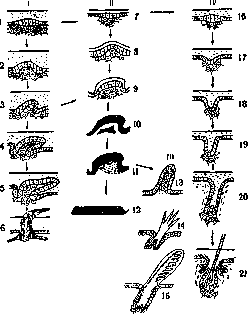
"Scheme of development of bony (I) and horny (II) scales, feathers (III) and hair (IV) of vertebrates: 1-6-development of placoid scales of a shark (Heptanchus cinereus); 7-12-development of scales of a lizard (Lacerta muralis). The course of their development is changed at the middle stages (deviation). 13-15-development of a feather. First, the development of a feather repeats the paths of development of reptile scales (7-11), but at the final stages a change (anaboly) occurs, and the development of a feather proceeds along a new path (13-15). 16-21-development of a hair. From the earliest stages, the direction of hair development deviates from the directions of development of other skin formations; there is no repetition, archallaxis is observed. (After Matveev, with changes.)
etc.); c) heterochrony, i.e., the phenomenon of shifting the development of embryonic organs in time; d) heterotopias—similar shifts of organs in terms of their position (primordia, places of formation); e) phil-embryogeneses—embryonic new formations—changes that occur in embryos and reach full development in adults; therefore phil-embryogeneses change the structure not only of embryos but also of adult forms. In general, it was found that new traits arise in animal forms not in the adult state, but through embryonic changes, i.e., through phil-embryogeneses, therefore in embryos, and these new formations (phil-embryogeneses) can arise in embryos at different stages of development, namely—at the beginning, at middle, or at the final stages of embryonic development. Changes that arose at the beginning of embryonic development are called archallaxes; changes that arose at middle stages of development received the name of deviations; changes at the final stages of development are called anabolies. The figure gives an idea of these forms of embryonic changes and shows that, for example, the scale of reptiles, the feather of a bird, and the hair of a mammal are homologous formations, phylogenetically related to the placoid scales of fish. The scale of reptiles at early stages reproduces (recapitulates) the traits of the embryonic development of the placoid scales of fish, but at middle stages it acquires new traits of development; therefore the scale of reptiles was formed by the method of deviation. The feather of birds first recapitulates in its embryogenesis the stages of development of the scales of reptiles, but at the final stages the development of the feather acquires new traits, and therefore the feather of birds developed from the scales of reptile-like ancestors by the method of anaboly. Finally, the embryogenesis of the hair of a mammal has almost completely lost the traits of recapitulation and from the very earliest stages of development takes a new path, therefore it was formed from the scale of a reptile-like ancestor by the method of archallaxis. Along with the phenomena of the emergence of new traits in the embryogenesis of animal forms, cases can be observed of the loss of palingenetic (recapitulating ancestors) traits. Depending on when this occurs, respectively, negative archallaxis, negative deviation, and negative anaboly are distinguished. Without going into details of these phenomena, it is necessary to emphasize their methodological significance. Phil-embryogeneses clearly indicate that ontogenesis not only reflects (recapitulates) phylogenesis, not only is determined by it, but at the same time in ontogenesis new paths of phylogenetic development are laid down. These facts confirm the necessity of considering ontogenesis and phylogenesis in their interrelationship. At the same time, the phenomenon of phil-embryogeneses shows that through their study we obtain a new method for investigating the evolutionary process. III. Paleontological methods of investigating the evolutionary process. From the point of view of evolutionary theory, the central problem of paleontology is the investigation of phylogenetic relationships between different groups, and consequently their origin. 1. The significance of unspecialized forms. Developing the concepts established by V. Kovalevsky (W. Kowalewsky, 1874) of inadaptive (unadapted) and adaptive (adapted) organization, the American paleontologist Cope (Cope, 1896) established an important law, according to which more specialized forms originate from unspecialized roots. This general law has great significance in the investigation of initial groups of forms. Obviously, specialized forms cannot be considered ancestors of subsequent groups of forms, since narrow specialization hinders evolution in the direction of a higher organization. 2. Collective forms (see above) partly correspond to Cope's concept of unspecialized forms, and precisely they are mostly taken as initial in relation to subsequent groups. Such are, for example, some extinct lobe-finned fishes, considered as ancestors of stegocephalians, some stegocephalians that evolved in the direction of reptiles, some theriodonts (Reptilia, Theriodontia), from which apparently mammals originate, the true creodonts (Eucreodi), from which the modern families of carnivorous mammals (Carnivora-Fissipedia) are derived, etc. All these forms (lobe-finned fishes, stegocephalians, etc.) had traits of collective, unspecialized forms, combining traits of adjacent groups or at any case possessing traits of similarity with forms in relation to which they turned out to be ancestors, finally traits of aromorphoses that determined their ability to evolve in new directions. 3. Investigating the roots of groups (Stumme des Tierreiches, term of M. Neumayer), paleontology also studies the so-called phylogenetic series of forms. At the end of the 19th century, such were called series of forms that 1) successively replace each other in time and 2) within which one can trace the successive phases of functional changes of one organ or one group of organs. On these bases Gaudry (1878) constructed several such phylogenetic series, which turned out to be erroneous. Abel (1911) resorted to more precise methods of investigating phylogenetic series. He proposed to distinguish: phylogenetic series (Ahnenreihen), stepwise series (Stufenreihen), adaptive series (Anpassungsreihen). The latter can be composed of successive (in time) forms, even if they are not related by kinship and not connected by relationships of ancestors and descendants, but showing successive phases of specialization of one organ. Such adaptive series can also be composed of modern forms to show a possible picture of the development of some adaptation. Stepwise series are somewhat more complex. They also consist of forms that successively replace each other in time, and some of these forms may even be in relationships of ancestors and descendants. However, they do not form a continuous historical series, but only show the phenomenon of increasing specialization of one or several organs, while other organs of the members of our series do not give a picture of successive changes at all. Therefore, tracing our series along one particular organ, we as if get a continuous succession of forms; but as soon as we try to check our series along other organs, this series immediately disappears or must be rebuilt. Consequently it was not a real (objectively existing) phylogenetic series. Only such a series of forms is called a phylogenetic series, within which we can trace successive changes in a series of leading traits. The accumulation of factual material and the refinement of research methods contributed to the development of our concepts about the origin of some forms, for example, about the origin of the modern horse (Equus), modern elephants (mammoth, African and Indian elephants), camels, etc. 4. The phenomena of correlation have enormous significance in the investigation of extinct forms. Even Cuvier established that organs are in a regular correlative connection and determine each other. With the usual incompleteness of paleontological documents, it is easy to see that the possibility of inferring from some organs the existence of other organs has enormous significance in the investigation of forms and their relationships (including phylogenetic) to other forms. IV. The triple method of investigating the evolutionary process. Haeckel (1894) pointed out that morphological, embryological (ontogenetic) and paleontological investigations of the evolutionary process acquire all their significance only in the case 'if they are evaluated and used in their mutual connection'. The mutual control of data from comparative anatomy, embryology and paleontology constitutes the essence of the triple method of investigating the evolutionary process. As a corresponding example, let us briefly consider the problem of the origin of the one-toed horse (it doesn't matter in this case which one: Equus or some extinct one-toed American one—Hippidium, Onohippidium, etc.) from a many-toed ancestor. First of all, comparative anatomy leads us to this conclusion, which quite precisely establishes that the single toe of the horse is the homolog of the third toe, and the sesamoid bones are rudiments of elements corresponding to the disappeared second and fourth toes. In other words, the horse's leg is a modified homolog of the many-toed limb. The same conclusions are also led to by some data from embryology; they find their brilliant confirmation also in the paleontological material. In other words, a coincidence of the conclusions of paleontology, comparative anatomy and embryology is clearly revealed. G. Directions and driving forces of the evolutionary process. Comparing the facts of sciences (geology, paleontology, systematics, morphology and biogeography) that substantiate evolutionary theory, Darwin at the same time used these facts also as evidence in favor of the doctrine of natural selection. If, according to Darwin, natural selection is in any case the leading factor, the basic driving force of the evolutionary process, then this same factor also determines the main directions of the evolutionary process.
Turning to these latter, Darwin defends the thesis of divergent directions of the evolutionary process. Darwin pays great attention to this question; the concept of divergent directions of the evolutionary process constitutes an integral part and follows from the doctrine of natural selection. However, even during Darwin's lifetime, that is, in the second half of the 19th century, and likewise throughout the 20th century, a large number of evolutionary theories were proposed, directed against the materialistic worldview of Darwin, against the theory of natural selection as the main driving factor of the evolutionary process, against the materialistic Darwinian analysis of the phenomena of purposefulness, and in accordance with this, against the thesis of the divergent direction of the evolution of animal and plant forms. All these theories, directed against Darwinism, to one degree or another reflected the views of those reactionary representatives of bourgeois natural science of the 19th and 20th centuries, who saw in Darwinism the beginnings of socialism (Virchow) and sensed in it, from the standpoint of their class, a doctrine dangerous to the foundations of bourgeois society. In the 19th century, they were opposed by bourgeois Darwinists (especially E. Haeckel, Oscar Schmidt, and others), who still opposed religion, teleology, and vitalism (see), in accordance with the thesis that Darwinism is an aristocratic evolutionary theory (E. Haeckel) and that the principles of the struggle for existence and natural selection are not only not dangerous, but, on the contrary, justify the existing (capitalist) socio-economic system. As capitalism passed into its final-imperialist-phase, this trend of bourgeois natural science weakened, and with the intensification of the processes of decay of capitalist society, it sank into a multitude of anti-Darwinist theories. Lamarckian evolutionary theories. Under the collective term "Lamarckism" is understood a fairly large number of evolutionary theories. None of them, of course, carries out Lamarck's evolutionary theory entirely, but all of them seek to develop some one of its aspects. a) Psycho-Lamarckism. The founder of this direction is considered to be the paleontologist Cope. He put forward the idea (1871) that the leading role in the change of the organization of animals is played by the conscious or unconscious will of the animal and its habits. This "will" is an expression of a special force inherent in organisms and directing the directions of the evolutionary process. In Cope, this force is called the "force of growth," or "batmism." Later, similar views were developed by Pauly (1905), France (1907), Reinke (1908), K. Schneider (1908), and others. All these authors recognized the existence of a special non-material factor, a special psychic energy, affecting the physical state of the animal. In accordance with these views, psycho-Lamarckists consider evolution as a process strictly directed, internally predetermined by the aforementioned non-material force (Cope's "batmism," Reinke's "dominants," etc.). The unscientific and reactionary nature of psycho-Lamarckism is too obvious to be worth dwelling on. It is clear that all psycho-Lamarckists are anti-Darwinists. b) The mechanophysiological evolutionary theory of K. Nägeli (1884). Under this name (mechanisch-physiologisch Theorie der Abstammungslehre) Nägeli published a work in which he tried to substantiate the position that the progressive (accompanied by an increase in organization) evolutionary process is conditioned by a special "principle of improvement," which, according to Nägeli, is the driving force of evolution. The mechanics of the corresponding processes is as follows. Nägeli assumes that the plasma of sex cells consists of two heterogeneous parts; part of the plasma, called by Nägeli idioplasm, is the bearer of hereditary properties, the rest remains only a nutrient medium for the idioplasm. Nägeli depicts the latter as a network of invisible particles-micelles. The micelles of all parts of the organism are in close connection, and therefore any changes that occur in the body cells are transmitted to the idioplasm of the sex cells and thus become hereditary. All morphological features of organisms, according to Nägeli, are the result of tendencies inherent in the idioplasm to progressive changes, i.e., to improvement. Ultimately, the cause of the progressive evolutionary process, according to Nägeli, is the aforementioned "principle of improvement," which influences the transformation of the morphological features of the organism. As for natural selection, or as Nägeli says, the "principle of usefulness," the latter affects the physiological features, the adaptive functions, but not the morphological features. The recognition of the existence of an internal impulse as the driving force of the evolutionary process allows us to place Nägeli's doctrine alongside Lamarck's doctrine of the striving of organisms to perfection. Nägeli's theory is mechanistic and at the same time, which is quite natural, has idealistic and reactionary content. c) Mechano-Lamarckian evolutionary theories. Under this name are understood various theories of an evolutionary nature that deny the principle of improvement and explain the evolutionary process as a result of the reactions of organisms to physicochemical influences of the environment. Long-term influences of environmental factors ultimately act compulsorily on the organism, the organism changes, and these changes become hereditary. The thesis of the inheritance of "acquired characteristics" is in this connection the cornerstone of mechano-Lamarckism. The unscientific nature, idealism, the hidden recognition of immanent purposefulness, and the reactionary nature of mechano-Lamarckism are easily revealed in all those cases when supporters of this doctrine turn to the problem of the influence of environmental factors on the organism and to the problem of adaptability. The evolution of living forms is conceived by mechano-Lamarckists only as a result of the influences of physicochemical environmental factors, and the changes that occur in organisms, according to mechano-Lamarckist views, are adequate to the influences of the environment. In other words, the organism changes in the direction in which the environment acts on it, i.e., in accordance with its conditions. It is clear from this that the concept of the organism as a dialectically developing unity is alien to mechano-Lamarckism, which overlooks the fact that environmental factors act within the organism in a different quality than outside it. In accordance with the described mechanistic premises, mechano-Lamarckism idealistically solves the problem of adaptability, asserting that the correspondence of the organization of living forms to the environment and functions is a direct and self-evident result of the adequate reaction of organisms to the direct influences of environmental factors (light, degree of humidity, soil conditions, food, etc.). At the same time, it is not explained why the organism reacts adequately to the influences of the environment, and therefore what requires explanation is presented as an explanation. According to mechano-Lamarckism, the ability of the organism to change adequately (in accordance with) the influences of the environment is its natural property. Consequently, the organism is adapted because it changes adaptively. It is clear from this that the basis of mechano-Lamarckism is the recognition of immanent purposefulness as the basic property of living things and that mechano-Lamarckism, despite the materialistic phraseology of its representatives, is an idealistic doctrine. This, of course, does not in any way contradict its mechanistic premises. The most prominent representative of mechano-Lamarckism is P. Kammerer. At present, mechano-Lamarckism is widely spread among bourgeois representatives of biology. There are also mechano-Lamarckists among us, but mechano-Lamarckism as an evolutionary theory under the conditions of socialist culture cannot have any ideological ground for development. Eimer's orthogenesis is one of the branches of mechano-Lamarckism. Eimer (1888, 1897), studying the variability of the coloration of butterflies and some reptiles (lizards), tried to substantiate an evolutionary theory according to which evolution goes along a strictly directed path, not deviating to the side. The driving force of this strictly directed evolutionary process, or as Eimer proposes to call it, orthogenesis, is the long-term direct influence of external factors, while the reason for the direction of the evolutionary process is that the organism changes, according to Eimer, not in different directions, but only in a very definite way. Eimer recognizes the inheritance of acquired characteristics. Eimer's attitude toward Darwinism was negative, believing that the theory of natural selection cannot explain the evolutionary process. It should be noted that all consistent mechano-Lamarckists are ready to recognize or recognize the theory of orthogenesis (ortho-Lamarckism). Eimer's orthogenetic doctrine, as is clear from its characterization, is mechanistic and gives an idealistic explanation of the evolutionary process. What has been said about mechano-Lamarckism in this regard applies entirely to Eimer as well. The facts do not confirm the theory of orthogenesis. With good reason Plate (1913) proposes to speak not of orthogenesis, but of orthoselection, i.e., selection in a certain direction.
For example, the development of the many-toed ancestor of the horse into the modern horse has a directed character in the sense that in this case the evolutionary process proceeds in the direction of: 1) increasing size, 2) molarization (acquiring similarity with molars, i.e., grinding teeth) of the dental apparatus, 3) reduction of the number of fingers to one, etc., and this process proceeds from one form to another and in a certain sequence. That we are dealing with orthoselection, not orthogenesis, is evident from the fact that the so-called horse series actually graphically corresponds to a branching tree with many lateral, blind branches. The path to the modern horse is only one of the branches. These relations fit entirely into the Darwinian concept of divergent evolution. Autogenetic evolutionary theories. a) These include various theories attempting to explain the evolutionary process by the action of internal forces inherent in organisms. Autogenetics, of course, cannot prove the existence of such "forces". However, since ectogenesis in the sense of mechanolamarckism is untenable, autogenetics, in their opinion, must necessarily recognize the autogenetic * principle, as there is no other way out. As Philippchenko (1923) says, "...either ectogenesis or, if it doesn't exist, then autogenesis," because, in Philippchenko's opinion, there can be no third solution. There is an undeniable affinity between mechanolamarckist ectogenesis and autogenesis, which seems to be its complete opposite: in both cases, the organism and the environment are understood not in their relationship, but in a completely mechanistic way. Hence the peculiar method of "proving" the correctness of autogenetic positions: since ectogenesis has been refuted, autogenesis remains. The most interesting representative of 19th-century autogenetics is undoubtedly K. Baer (Berg, 1866). In our time, autogenesis has become widespread among geneticists, as well as among so-called neo-Darwinists (see below). The idealistic nature of autogenesis needs no special explanation. b) Nomogenesis, or evolution based on regularities, is one of the varieties of autogenesis defended by L. S. Berg (1922). He recognizes that purposiveness is the fundamental and further irreducible property of living things. It is for this reason that the evolutionary process is a directed process proceeding along certain, predetermined paths. Therefore, according to Berg, in phylogenetic series of forms, phenomena of anticipation of phylogenetic stages of development (so-called "Berg's law of anticipation of traits") are constantly observed. In other words, phylogenetically earlier forms possess traits that will be found in phylogenetically later forms. Denying the creative role of selection, Berg places "autonomous," and therefore autogenetic, factors that predetermine the course of evolutionary development in its place. In this connection, Berg attempts to metaphysically oppose Darwinism as an evolutionary theory based on chance (tychogenesis, in L. S. Berg's terminology) to his own evolutionary theory based on regularities (nomogenesis). In accordance with the above, Berg consistently opposes the concepts of the divergent course of the evolutionary process and the monophyletic (from one or a few roots) origin of animal (and plant) groups, advancing the idea of the polyphyletic (from many roots) origin of forms and their subsequent convergent development. c) Neo-Darwinism is based on E. u. A. Weismann. In the 20th century, in connection with the development of genetics, many of its representatives, starting from Weismann's concepts of the germinal path (see Weismann's theory), oppose the mechanolamarckist thesis about the inheritance of acquired traits with the position of the complete autonomy of the germ plasm. The latter is supposedly inaccessible to external influences and changes independently of them. From this it is clear that neo-Darwinism (Weismannism) undoubtedly possesses the features of autogenetic teaching. At the same time, neo-Darwinism has distinct mechanistic features. The latter are clearly revealed in the mechanistic interpretation of the organism as a dual system consisting of somatic cells and germ cells independent of the soma. The soma is merely a case for the germ plasm. d) One of the most reactionary theories must be recognized as the theory of evolution with constant species by Lotsy (Lotsy, 1906, 1908). Lotsy tries to prove that evolution is not the emergence of something qualitatively new, but only the result of recombination of the existing "gene pool." New species, accordingly, are only the result of crossing of old ones, while changes in genotypes do not occur. From these positions it is clear that Lotsy, in essence, denies evolution. On the other hand, Bateson (1928) approaches the denial of evolution. He believes that the diversity of modern living forms is the result of the unfolding of the complex of genotypes laid down in the primary organisms. The latter were therefore genotypically more complex than modern ones, and the gene pool of these primary organisms was subsequently gradually spent, being distributed among a huge number of diverse modern forms. Thus, there is no evolution in essence. Only the process of unfolding what was already given takes place. And Bateson, carrying his thoughts to their conclusion, expresses doubts as to whether an evolutionary process takes place at all. d) De Vries' (de Vries, 1901, 1903) mutation theory occupies a somewhat special position among the teachings described. New forms, according to de Vries, are created by means of mutations (see). Mutations arise autonomously, completely independently of the environment, as a result of a special pre-mutational period, when creative forces accumulate in the organism, which then manifest themselves when the mutational period arrives. The new forms (species) resulting from these mutational changes subsequently undergo the negative action of selection, which cuts off all unsuited forms. Consequently, natural selection as a creative factor is denied by de Vries' theory; species are created by internal forces of the organism, i.e., in essence, autogenetically. Consequently, the problem of the adaptability of forms receives a teleological solution, since the adaptations of a species are created not by natural selection, but in the course of the mutational process. The teachings described above, while not exhausting all the nuances of evolutionary thought, nevertheless show the depth of the regression that has affected bourgeois science at the end of the 19th and throughout the 20th centuries. The period of decay of capitalism determines a sharp turn of bourgeois science in the direction of idealistic, vitalistic (see Vitalism) and mechanistic E. u. The driving forces of evolution are interpreted either as internal forces of the organism predetermining the course of the evolutionary process (autogenesis), or they are mechanically reduced to external factors compulsorily acting on organisms (ectogenesis in the form of mechanolamarckism). As for the directions of the evolutionary process, they are considered either as orthogenesis, or as a convergent process associated with the polyphyletic origin of initial groups, or as a phenomenon of parallelism, also associated with the polyphyletic origin of forms. It is significant that the teachings described above, both mechanistic and idealistic, in the vast majority of cases deny the Darwinian position on the divergent character of the evolutionary process, because the only correct explanation for the causes of divergent phylogenetic development of groups is given precisely by Darwinism. Hence it is understandable that most anti-Darwinian teachings strive to refute the thesis of divergent evolution. On the contrary, as noted above, Darwin with special persistence advanced the idea of the divergent course of the evolutionary process. If in capitalist countries there is a struggle against Darwinism, and the teaching of evolution is experiencing stagnation and regression, then in our Union, under the conditions of socialist culture and as a result of the persistent struggle of Soviet science against mechanistic (and especially mechanolamarckist) and idealistic (especially autogenetic and Weismannist) trends, there is a tremendous upsurge in work on the creation of E. u. based on the methodological foundation of Marxism-Leninism. At the present time, it can be said with certainty that the driving force of the evolutionary process is natural selection. Mutations as individual hereditary changes are created by the corresponding mutational process, but new races and new species are created by natural selection. Consequently, mutations are only the starting point of the evolutionary process, not the process itself. Modern genetics, studying the material basis of mutational changes, has provided a solid foundation for Darwin's E. u. On the other hand, natural selection as a historical process has been subjected to detailed study. The available factual data and methodological analysis of Darwinism show that the latter is the only doctrine satisfying the current state of science. Defining natural selection as the driving force of the evolutionary process, modern data at the same time confirm that the evolutionary process as a whole has a divergent character.
Cases of parallelism, convergence, or so-called adaptive radiation of Osborn (i.e., development from one starting form or structure in different directions) are often described along with cases of divergence. This is correct as long as we are dealing with segments of the general evolutionary development of forms, with separate phylogenetic branches. However, the phylogenetic tree of the animal or plant world as a whole has the character of a divergent tree, within which parallelism, convergences, etc. are only particular cases. Literature for the Darwinism and Paleontology articles.
Related articles
Mentioned in
Cite this page
“Evolutionary Theory.” Soviet Medical Encyclopedia. English translation of Bolshaya Meditsinskaya Entsiklopediya, 1st ed. (Moscow, 1928–1936), ed. N. A. Semashko. https://sovietmedicalencyclopedia.pages.dev/article/evolutionary-theory/