Cardiolysis
Historical document, translated for reference. It reflects medical knowledge of the 1920s–30s and is not medical advice.
Summary
Cardiolysis is a surgical procedure to remove pathological adhesions between the heart and surrounding tissues. The article describes three types of cardiolysis operations: endopericardiac, extrapericardiac, and thoracic, with details on their techniques, difficulties, and clinical outcomes.
Encyclopedia article (1928–1936)
Cardiolysis (cardio lysis), an operative procedure consisting in the elimination of pathological adhesions of the heart with surrounding tissues. The adhesions may have various extent: partial or complete fusion of the epicardium with the pericardium, or the adhesions extend outward from the pericardium, fusing it with adjacent areas of pleura, mediastinum, diaphragm. In particularly severe cases, dense scars fuse the diaphragm, pleura with the heart, cardiac sac, and great vessels into one compact mass. (Pathogenesis, clinic and diagnosis-see Pericarditis.)-In cases where therapeutic treatment is ineffective, at the first signs of decompensation (enlargement of the liver, appearance of edema, etc.), operative intervention should not be postponed for long, since during the operation one can count on success only when the patient's heart can still withstand the operative intervention and when secondary changes in the organs are still capable of regression. Depending on the character of patho-anatomical changes in the pericardial space, the operation of K. can be planned differently. At the present time, 3 types of K. are distinguished: cardiolysis endopericardiaca (Delorme, Rehn), extrapericardiaca (Rehn) and thoraciea (Brauer). The first operation was proposed by Delorme and consists in freeing the heart from adhesions with the pericardium. After opening the cardiac sac, the release of the heart begins with the left ventricle. It is very difficult to get into the proper layer corresponding to the space between the visceral and parietal layers. With extensive and dense adhesions, Delorme's operation presents great difficulties and dangers due to the possibility of damage to the heart wall itself when separating dense adhesions, especially in the area of the right heart and atria. Moreover, after the operation there are no means to protect the heart from the reformation of adhesions. Therefore, Delorme's operation did not receive wide distribution. Rehn modified this operation in that after separating the adhesions, he excised the anterior wall of the pericardium and replaced the resulting defect with a transplant of fat or fascia, hoping to create an area free of adhesions. Rehn and Schmieden reported good results after such an operation. Another modification of Rehn's (pericardiolysis) consists in removing adhesions between the outer surface of the pericardium and the mediastinum. To prevent recurrence of adhesions, it is recommended to make a padding from a wide strip of thigh fascia. This operation, as well as Delorme's operation, did not receive wide distribution. Much more popular is Brauer's modification (Brauer; cardiolysis thoraciea, thoracolysis praecardiaca). This operation is indicated mainly when systole is difficult due to the fusion of the adhesed pericardium with the chest wall. In this operation, the matter comes down to removing the area of ribs covering the heart, and this intervention should not be regarded as radical. The adhesions inside the pericardium and the adhesions between the pericardium and pleura remain unaffected. Difficulties in diastole remain due to the rigidity of the thickened pericardium and in systole for the same reasons. Systolic movements are facilitated because the heart can pull the now pliable chest wall with less effort instead of the rigid rib cage. The operation is performed as follows: at the level of IV-VI ribs on the left, a quadrangular skin-muscle flap is formed with the base on the mammary line and the apex at the edge of the sternum. The IV, V and VI ribs and the costal cartilages are exposed and resected along the entire length from the edge of the sternum to the mammary line (see figure). The periosteum is carefully removed.
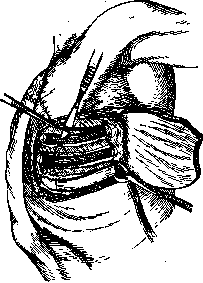
If the general condition of the patient allows, one should not rush to remove the posterior leaf of the periosteum as well, in order to definitely avoid regeneration of the removed ribs. Schmiden recommends removing the muscles of this area (m. transvers. thoracis, etc.). The skin flap is sutured back in place. As a result, a wide window is formed in the chest wall above the heart, closed by pliable tissues. Brauer's operation received quite wide distribution due to its simplicity and quite satisfactory clinical results. Guleke, in 60 cases collected by him, notes a fatal outcome in only 1 case and good results in 3U cases.
Related articles
Mentioned in
Cite this page
“Cardiolysis.” Soviet Medical Encyclopedia. English translation of Bolshaya Meditsinskaya Entsiklopediya, 1st ed. (Moscow, 1928–1936), ed. N. A. Semashko. https://sovietmedicalencyclopedia.pages.dev/article/cardiolysis/