Drum Cavity
Historical document, translated for reference. It reflects medical knowledge of the 1920s–30s and is not medical advice.
Summary
The article discusses the drum cavity (tympanic cavity) and drumstick fingers, a condition characterized by clubbed fingers with bulbous nail phalanges and convex nails resembling watch glasses. It describes the association of this condition with various diseases including lung diseases, heart defects, and others, along with theories about its origin.
Encyclopedia article (1928–1936)
DRUM CAVITY, see Middle Ear. DRUMSTICK FINGERS, fingers with bulbous nail phalanges and shortened, often lunula-less, sharply convex nails, thereby acquiring resemblance to watch glasses (see Figure 1). Who first gave this described change the name drumstick fingers is not established; the sometimes used name "Hippocratic fingers" for such fingers is incorrect, as Hippocrates described only changes in the nails. Drumstick fingers occur in pulmonary diseases leading to suppuration and tissue decay, predominantly in bronchiectasis (also in empyema, cavitary tuberculosis of the lungs, gangrene, malignant neoplasms of the lungs), in congenital heart defects, endocarditis, and less frequently in some other diseases (gastroectasia, cirrhosis of the liver, etc.). Changes in the terminal phalanges usually develop over months, sometimes over several weeks, and can sometimes undergo reverse development upon curing the underlying disease. Usually drumstick fingers are observed equally on both sides (weaker and less frequently on the feet than on the hands), sometimes unevenly; in individual cases, unilateral development of drumstick fingers has been described (aneurysm of a. subclavia dex. and others). As X-rays show, thickening of the fingertips occurs only due to soft tissues (see Fig. 2).
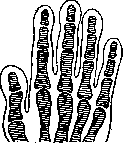
Figure 2.

The origin of drumstick fingers is explained either by the action of toxins absorbed from purulent and putrefactive foci, or by venous congestion. Other theories have also been proposed (trophoneurosis, endocrine lesion, etc.). The thickening of the soft parts of the terminal phalanges, in the opinion of most authors, is the initial stage of ossifying periostitis of the tubular bones ("osteoarthropathie hypertrophiante pneumique" P. Marie).
Related articles
Cite this page
“Drum Cavity.” Soviet Medical Encyclopedia. English translation of Bolshaya Meditsinskaya Entsiklopediya, 1st ed. (Moscow, 1928–1936), ed. N. A. Semashko. https://sovietmedicalencyclopedia.pages.dev/article/drum-cavity/